The most common cycling and weight loss mistakes are trusting your watch’s calorie estimate and eating it straight back, chasing the fat-burning zone, cutting too hard and losing muscle instead of fat, and abandoning the plan at the first plateau. Cycling raises how much energy you burn, but the burn is smaller than most riders assume and the hunger it creates is bigger, so nearly all the real work happens at the kitchen table.
The riders who get this right are rarely the ones eating the least. They are the ones who keep a modest deficit for months, fuel hard sessions properly, and measure progress on a trend line instead of a single morning number. That is what the twelve fixes below are for.
This guide is written for club and enthusiast road riders training 5 to 15 hours a week, mostly with a desk job and a long weekend ride in the mix. It is general information, not medical advice. If weight is affecting your health, talk to your doctor or a registered dietitian before changing how you eat.
Table of Contents
- Cycling and Weight Loss Mistakes at a Glance
- 1. Cycling and Weight Loss Mistake: Eating Back Every Burned Calorie
- 2. Cycling and Weight Loss Mistake: Cutting Too Many Calories
- 3. Cycling and Weight Loss Mistake: Following a Low-Carb Diet Year-Round
- 4. Cycling and Weight Loss Mistake: Skipping Meals Before Long Rides
- 5. Cycling and Weight Loss Mistake: Drinking Most Fluids Only After Riding
- 6. Cycling and Weight Loss Mistake: Adding Hours Without Adding Useful Work
- Why the fat-burning zone is a cycling and weight loss mistake
- 7. Cycling and Weight Loss Mistake: Overtraining and Under-Recovering
- 8. Cycling and Weight Loss Mistake: Using Exercise to Earn Unhealthy Food
- 9. Cycling and Weight Loss Mistake: Relying on BMI Alone
- 10. Cycling and Weight Loss Mistake: Chasing a Race-Light Weight
- 11. Cycling and Weight Loss Mistake: Ignoring Strength and Daily Activity
- 12. Cycling and Weight Loss Mistake: Looking for a Quick Fix
- Frequently Asked Questions
- How much weight should I lose while cycling?
- How many calories does cycling burn, and should I eat them back?
- Should I eat before a long cycling ride?
- Can cycling cause weight loss if I do not change my diet?
- Are weight-loss supplements or protein shakes necessary for cyclists?
- What signs mean cycling weight loss is going too far?
- What to Do First
Cycling and Weight Loss Mistakes at a Glance
| Mistake | Why it undermines weight management | The correction |
|---|---|---|
| Eating back every burned calorie | Watch and heart rate estimates overstate ride expenditure by roughly 20 to 50 percent, so you finish the day even | Fuel the ride you actually did, then judge the day on a weekly average |
| Cutting too many calories | A large deficit drains glycogen, drops power output and burns muscle | Run a smaller deficit and keep protein high |
| Low-carb year-round | Carbohydrate needs scale with ride length and intensity | Match carbs to the session, not to a diet label |
| Skipping meals before long rides | Empty-tank riding ends in bonks and a crash dinner | Eat a small carb-rich meal two to three hours out |
| Drinking most fluids after riding | Late hydration leaves you lightheaded and hungry on the bike | Drink to your own sweat rate, starting early |
| Adding hours without adding useful work | Unstructured volume adds fatigue more than it adds burn | Build slowly with recovery days between |
| Overtraining and under-recovering | Fatigue, poor sleep and missed meals push intake back up | Add rest before you add deficit |
| Earning unhealthy food with exercise | Post-ride compensation is untracked and usually larger than the ride | Plan the recovery meal before the ride |
| Relying on BMI alone | The scale cannot tell muscle from fat | Track a weight trend, waist and fitness together |
| Chasing a race-light weight | Fast weight cutting costs power, bone and recovery | Set a pace you can hold for months |
| Ignoring strength and daily movement | Sedentary hours can cancel the deficit you earn on the bike | Add two strength sessions and more daily steps |
| Looking for a quick fix | Aggressive plans fail in weeks and drive rebound eating | Review energy, performance and trend weight every two weeks |
1. Cycling and Weight Loss Mistake: Eating Back Every Burned Calorie
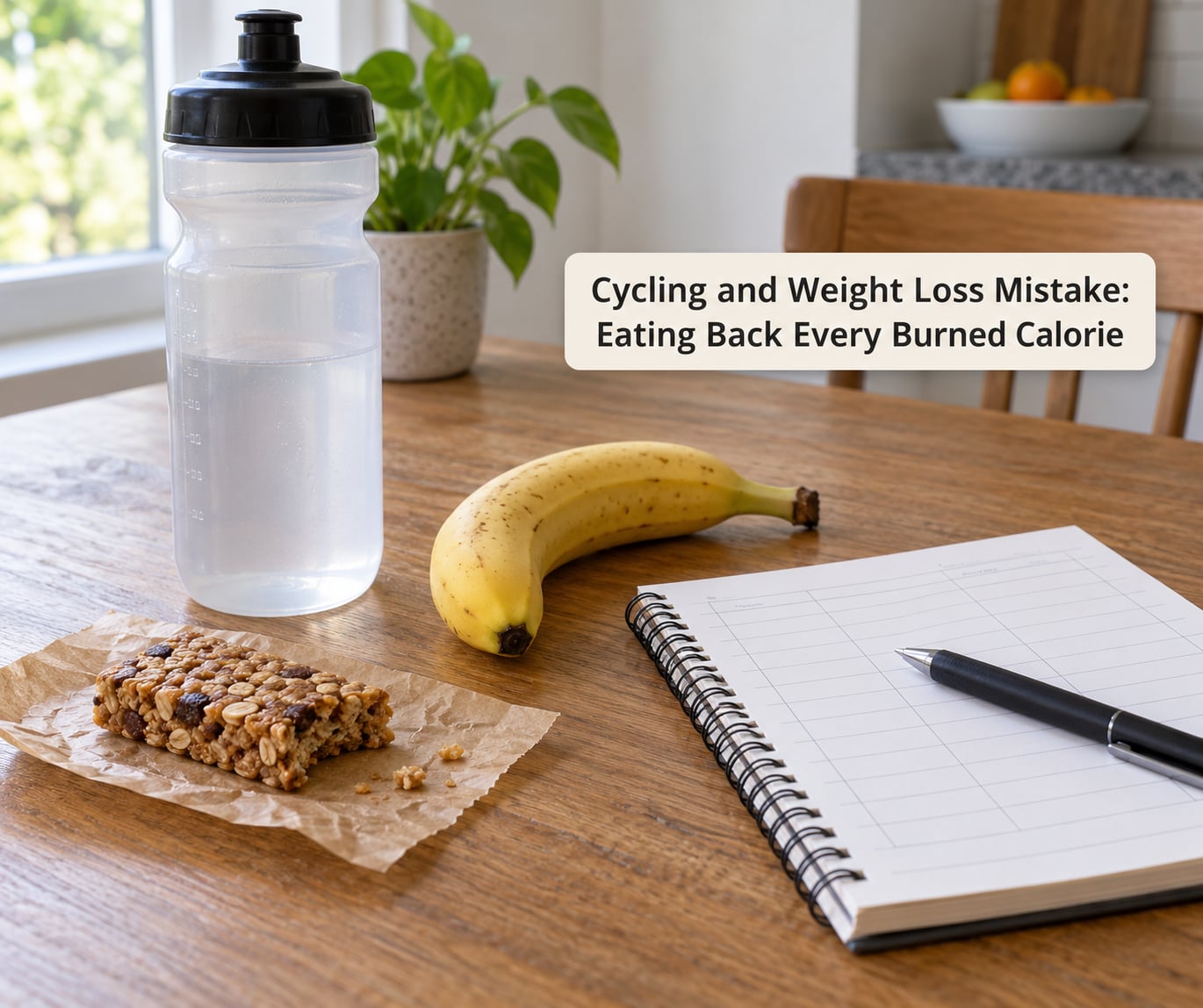
Eating back every number your watch logged is the single most expensive mistake in this list, because it makes the deficit disappear without you noticing.
Consumer devices estimate ride expenditure from heart rate, power and your weight, and research on those estimates consistently shows they run high. The error is usually in the range of 20 to 50 percent, which means a watch claiming 1,500 calories probably cost you somewhere nearer 1,000 to 1,200. That gap is not a rounding error. Eaten back faithfully every ride, it quietly turns a 300-calorie daily deficit into a maintenance day.
There is a version of this on r/cycling worth reading: a rider logged 4,000 calories burned on a 60-mile climbing ride, then had a bagel sandwich, a big lunch and sushi, and found the scale heavier for several days afterward. Nothing about that rider was cheating. The device and the appetite were both doing what they do.
Use watch numbers for one job only: comparing this ride to last week’s similar ride. Fuel the ride you actually did, based on duration and intensity, and stop there. If you want a real figure, weigh yourself before and after a steady one-hour ride in similar conditions, then subtract nothing. That single number is worth more than a season of watch data.
2. Cycling and Weight Loss Mistake: Cutting Too Many Calories
Cutting too hard is how riders lose the weight and lose their fitness at the same time.
When intake stays well below expenditure, recovery suffers before the scale does. Power drops on the third interval of a session that used to be fine, sleep gets worse, and the first sign people usually notice is that they are ravenous on the bike.
The threshold people quote is energy availability, measured in calories per kilogram of lean body mass per day. Sports dietitians commonly use roughly 45 kcal/kg for women and roughly 20 kcal/kg for men as the floor where health effects start to show, in the range reported by Cycling Weekly’s expert review. Staying under that line for long stretches is associated with relative energy deficit in sport, which shows up as low energy availability, disrupted hormones, falling bone density and a higher injury risk.
The TrainerRoad forum consensus is blunt about this: the biggest mistake riders make is eating too little, which crashes training quality and creates a rebound. A deficit you cannot hold through a century and a weekend is not a deficit, it is a diet phase.
A moderate deficit works better. Aim for something you could keep for a quarter, keep protein steady across the day, and if you are cutting hard for more than six to eight weeks, take a couple of weeks at maintenance. Riders who want help with a specific deficit number, or who have symptoms that worry them, should get that from a registered dietitian rather than from an app.
3. Cycling and Weight Loss Mistake: Following a Low-Carb Diet Year-Round
Carbohydrate needs change with the ride, so a single carb level cannot be right for every week of the year.
Carbohydrate is the fuel high-intensity work runs on. A zone 2 spin can be done on very little of it, but a three-hour ride with two climbs needs plenty, and hard intervals in the middle of a deficit are where low-carb riders first notice the ceiling drop. British Cycling’s training guidance is blunt that severe carbohydrate restriction has real costs for hard efforts.
There is a second, dumber effect people get caught by. Each gram of glycogen stored in muscle holds roughly 2 to 3 grams of water with it, so dropping carbs can move the scale up by several pounds before any fat is lost. Riders cut their carbs, watch the number rise, and conclude the plan failed when the plan was simply showing a water swing.
Carb cycling, which alternates higher and lower carb days around training, gets asked about constantly. It is not pointless and it is not magic either. It is a scheduling tool, useful when you want more fuel on hard days and less on rest days. British Cycling explains the fat-burning and carb-fuelling side in terms that are worth reading before you commit to a plan.
4. Cycling and Weight Loss Mistake: Skipping Meals Before Long Rides
Riding long or fast on an empty stomach is a mistake that feels disciplined and usually backfires within an hour.
With no fuel in the tank, a long ride drops in intensity, gets miserable, and ends with the rider ravenous. That hunger then drives the takeout order that arrives before the garage door is open, which does more damage than the skipped breakfast ever would have.
The practical fix is boring and reliable: a small carb-rich meal two to three hours before rolling, mostly carbohydrate and easy to digest, plus a top-up drink on top of your normal water for rides over about 90 minutes. Ordinary weekend endurance riding and a race where you are riding at your limit are different events. The second one needs deliberate fuelling and possibly a doctor or sports dietitian involved, because getting it wrong on race day is not a small mistake.
Skipping food to fit a calorie budget on the morning of a long ride is one of the clearest examples of saving a small number and paying a large one later.
5. Cycling and Weight Loss Mistake: Drinking Most Fluids Only After Riding
Drinking only when you get home leaves you under-hydrated during the part of the day that matters most.
Riders often fix thirst after a ride because thirst after a ride is loud. On the bike, a 2 to 3 percent body-weight fluid deficit shows up as elevated heart rate at the same power, worse perceived effort and a weaker appetite, which then gets misread as the ride having burned more than it did.
The only reliable number is your own sweat rate. Weigh yourself before a steady one-hour ride, note what you drink, weigh yourself again and subtract. That figure, adjusted for weather and duration, is your drinking target for the week. Sodium matters too in hot conditions, since it is what lets you retain what you drink.
Drinking large amounts only with meals also quietly reduces how much food you want, which some riders like and some riders interpret as a plan. It works until the day after a long hot ride when it catches up with you.
6. Cycling and Weight Loss Mistake: Adding Hours Without Adding Useful Work
Why the fat-burning zone is a cycling and weight loss mistake
The fat-burning zone is real as a proportion and misleading as a target, which is why it causes so much frustration.
At a low intensity your body draws a higher percentage of energy from fat. It also burns far fewer calories in total. British Cycling makes this exact point: the proportion of fat rises as intensity falls, while actual calories burned in a typical session stay relatively small. A two-hour steady ride at the fat end of your range can leave a bigger deficit than a short, hard one, but it also takes two hours of your life and leaves you hungry for the rest of the evening.
Long easy riding is still the backbone of weight management. What it is not is a shortcut where duration replaces structure. Unstructured volume piles up fatigue faster than it piles up burn, and fatigue raises appetite the following day.
The distinction that matters: adding hours helps when you are still recovering well, eating enough and sleeping properly. It stops helping the moment those three slip. Build in steps, keep easy days genuinely easy, and if power is dropping across a whole week while your resting heart rate is up, the extra hours are the problem rather than the solution.
7. Cycling and Weight Loss Mistake: Overtraining and Under-Recovering
Persistent fatigue, a falling ceiling on hard efforts and getting sick more often all point at recovery, not at a missing dietary trick.
When a rider is under-recovered, several things happen at once. Performance drops, so hard sessions feel bad. Sleep gets shallower. Stress hormones run higher, which shows up as hunger that arrives earlier and lasts longer, and riders respond to that hunger by eating more without deciding to.
The weight goal should never override this. If resting heart rate is elevated for several days, if you feel heavy-legged a week into a normal week, if you are ill more than a couple of times a season, or if the last ride made you feel worse for longer than a day, the fix is rest and more food, not a bigger deficit.
Persistent fatigue, dizziness, feeling cold all the time or a heart that races at low effort are medical territory. Stop training and see a doctor. Those are not things to coach around.
8. Cycling and Weight Loss Mistake: Using Exercise to Earn Unhealthy Food
Treating a ride as a calorie cheque turns the ride into a reason to eat, and the compensation is nearly always bigger than the expenditure.
Think about what happens after a hard century. You are tired, hungry and mentally cooked, so food becomes the reward rather than fuel. The takeaway is ordered before you get home. Nobody logs it. The next morning the scale is up two pounds, and the plan starts to look broken.
Here is the part almost nobody explains: the rebound is temporary and mostly water. A big ride means depleted glycogen, and refuelling replaces that glycogen along with the 2 to 3 grams of water per gram it carries, which explains a 2 to 4 pound rise that lasts 24 to 72 hours and then goes away on its own. A Facebook cycling group thread titled “Overeating off the bike making you gain weight” captures how common this loop is.
Deciding the recovery meal before you leave home fixes most of it. A normal combination is a protein source with carbohydrate, eaten without guilt and at a table. The meal is not a reward and it is not a calculation. It is the thing that lets you ride tomorrow.
9. Cycling and Weight Loss Mistake: Relying on BMI Alone
BMI cannot tell muscle from fat, so it is a weak instrument for a cyclist whose whole reason for training is to change body composition.
Weight training adds lean mass, which pushes BMI up while the thing you actually wanted, less fat, is happening. Some riders who are visibly leaner and faster get told their BMI is unhealthy. Others, who have not changed their muscle-to-fat ratio at all, get reassured by a number that never moved.
Three measures are more useful together. A weekly average of your weight, taken the same way each morning, smooths out water swings and shows the real direction over two or three months. Waist circumference at the navel catches the changes a scale misses. Your own performance data, functional threshold power or a steady time trial, tells you whether the plan is working or wrecking your riding.
None of these are medical measurements. If you are weighing whether a change in body composition is healthy for you, that is a question for a clinician, not a calculator.
10. Cycling and Weight Loss Mistake: Chasing a Race-Light Weight
Racing weight and general fitness are different goals, and cutting weight fast for a race can cost more than the race is worth.
A race weight usually means losing a few percent of body mass in a few weeks. Rapid weight loss takes glycogen, water and lean mass with it, so power-to-weight improves slightly while absolute power falls, and you arrive less able to hold your position on the climbs that decide most races.
Riders racing in a weight category need individual, professional guidance. Cutting several kilos in a short window is a medical and nutritional decision with a coach and a dietitian, not a solo experiment with online calculators.
For everyone else, a steady approach serves the ordinary goal, which is being fitter and lighter in a body that trains well for decades. That target has no deadline, which is the whole point of it.
11. Cycling and Weight Loss Mistake: Ignoring Strength and Daily Activity

Two sessions of strength work and a more active desk day do more for body composition than the fifth hour on the bike.
Weight training is what lets you cut while keeping muscle. Heavy work, roughly 8 to 10 reps per set, twice a week is what British Cycling points to for riders, not the high-rep endurance sets that get confused with cycling training.
Protein matters more while you are in a deficit than at any other time, spread across the day rather than loaded into one dinner. Daily movement outside the bike matters too. A 90-minute ride burns a meaningful chunk of energy, and eight desk hours can quietly undo the rest.
Mobility work and sleep complete it. Most riders lose weight while sleeping badly, then read the bad week as a metabolism problem. Seven to nine hours is not a nice-to-have for a rider in a deficit.
12. Cycling and Weight Loss Mistake: Looking for a Quick Fix
Most of the cycling and weight loss mistakes above share one root: wanting the result faster than body change actually happens.
Losing roughly 0.5 to 1 percent of body weight per week is a range that holds up over months and keeps your riding intact. Faster than that and you are mostly losing water, glycogen and muscle. Slower and the scale barely moves week to week, which is where most people quit.
A two-week review loop works better than daily weighing. Look at your average weight trend, your average ride power or pace, how you felt, and how much you were actually eating. If the trend is down and the riding is fine, change nothing. If the trend is flat for three review periods, adjust one variable at a time, and make it a smaller adjustment than the one that was failing.
Anyone with a medical condition, a history of disordered eating, or a weight target set by a coach or race category should be talking to a doctor or registered dietitian rather than a template.
Frequently Asked Questions
How much weight should I lose while cycling?
Most riders do best losing roughly 0.5 to 1 percent of body weight per week, which keeps power, recovery and training quality intact. That pace holds up for months and rarely triggers rebound eating. Faster losses usually come from glycogen, water and lean mass rather than fat, and they flatten your power-to-weight ratio. Judge progress on a several-week weight trend, not on a single morning reading, because water swings after long rides can move the scale several pounds in either direction.
How many calories does cycling burn, and should I eat them back?
A steady road ride burns roughly 400 to 600 calories an hour for most people, and watch estimates typically run 20 to 50 percent high because they infer expenditure from heart rate and power. So eat to fuel the ride you actually did, not the number on the screen. Refuel with carbohydrate and protein after hard sessions, and let your weekly average intake carry the deficit. Eating back every estimate is one of the most common cycling and weight loss mistakes riders make.
Should I eat before a long cycling ride?
Yes, for anything over about 90 minutes. A small carb-rich meal two to three hours before rolling, low in fibre and fat and easy to digest, gives you glycogen to work from and reduces the bonk that ends the ride early. That bonk usually leads to a ravenous ride and a large takeaway order afterwards, which costs more than the meal would have. Ride fast without eating and the same logic applies even harder.
Can cycling cause weight loss if I do not change my diet?
Sometimes, but rarely on its own. Cycling raises daily energy expenditure and can quietly take a few kilos off without deliberate dieting, especially for someone starting from a sedentary baseline. Beyond that first phase the effect shrinks, because the hunger a big ride creates usually offsets it. Forum consensus tends toward weight change being roughly 80 percent diet and 20 percent movement. Riding more helps a deficit work rather than replacing it.
Are weight-loss supplements or protein shakes necessary for cyclists?
No, and they are usually the least important thing on the list. Whole food that you can eat consistently beats any shake. Protein powder is convenient when you struggle to hit your protein target for muscle retention, but it is a convenience rather than a requirement. Most fat-loss supplements on the market have weak evidence, and a doctor or registered dietitian can tell you whether anything you are considering is worth your money.
What signs mean cycling weight loss is going too far?
Persistent fatigue, power that keeps dropping across a normal week, feeling cold all the time, dizziness, a racing heart at easy effort, frequent illness and constant hunger are all signs the deficit has gone too far. Reduced bone density and disrupted hormones are the longer-term concerns, and the thresholds people quote for low energy availability sit around 45 kcal per kg of lean mass per day for women and 20 for men. Stop cutting and see a doctor or registered dietitian.
What to Do First
Start with the pattern, not the number. Pick one small deficit you can hold for a quarter, and keep protein high so you lose fat rather than muscle.
Fuel the ride properly, meaning a pre-ride meal for anything long, carbohydrate and fluid during it, and a real meal after. Stop eating back watch estimates, because those numbers are too high and they quietly end your deficit.
Track a weekly average weight alongside waist and your own power data, and give any change four to six weeks before you touch it. Progress at 0.5 to 1 percent of body weight per week looks slow on the scale and adds up to more than anything faster.
Add two strength sessions, protect sleep, and let recovery days be recovery days. Then if the scale refuses to move for six weeks or you start feeling worse on the bike, talk to a doctor or registered dietitian rather than cutting harder.