You train for a high altitude ride the same way you train for any long day out: build a real aerobic base over several weeks, rehearse climbing and fueling until they feel automatic, and show up fresh rather than trying to manufacture fitness on the day. The thin air changes your numbers, not the method.
Most riders get this wrong in one of two directions. They either show up with no preparation at all, then blow up on the second of three long climbs, or they cram ten hard hill sessions into the final fortnight and arrive with tired legs and a cold.
Below is the plan we work to, split into five steps. It fits a recreational rider who also has a job, and it scales up for club riders chasing a gran fondo or a big mountain century. Expect four to eight weeks for a sea-level rider, two to four if you can get to the hills. Altitude itself is optional, which surprises people. What is not optional is the climbing, the pacing and the eating.
Table of Contents
- What You Need
- Route and elevation data
- An honest timeline
- Health and blood markers
- A bike set up for the climbing
- Nutrition you have already tested
- Step-by-Step: Build Your High Altitude Ride Plan
- Step 1: Set a realistic timeline and identify the climb demands Start by dividing the ride into its parts. Read the elevation profile and find the longest climb, then the steepest sustained grade on it, then the total vertical for the day. Those three numbers tell you what your training actually needs to contain. Thresholds help. Below about 500 m of climbing, altitude is largely irrelevant. Between 500 m and 2,000 m, most recreational riders will hold roughly 90 to 95 percent of their sea level power on the same effort. Between 2,000 m and 3,000 m, expect to lose closer to 5 to 7 percent of threshold power for every 1,000 m of elevation, and to reach roughly 80 to 90 percent of sea level output. Above 3,000 m the gap keeps opening up, and at the top of a 3,400 m pass you may be working near 75 percent of the watts that felt comfortable at the coast. Then match the block to the rider, not the other way around. Beginner or returning rider with a big-mountain ride 8 to 10 weeks out: spend the first four to six weeks building steady endurance before adding any climbing-specific work at all. Experienced club rider with 5 to 6 weeks: one long ride, one quality climbing session and one moderate tempo effort per week is plenty. Extreme elevation, meaning a start above 3,000 m such as a Colorado peak-stage event or a 100-miler with a mountain start: add a second aerobic day and a real taper, and plan the first two days at the venue as easy spin days rather than training. Remember the start elevation, not just the summit. If your target is a hundred-miler or a well-known mountain climb, the first forty minutes are usually the worst part of the day, and they happen at the altitude that hits an unacclimatized rider hardest. Step 2: Build an aerobic base without adding unnecessary volume Keep the easy riding easy. Around 80 percent of your weekly time should sit at a conversational effort where you can still speak in short sentences, because that is the pace that builds the engine you will rely on in hour four. A workable week for a rider with five or six sessions available looks like this: Monday rest, or 30 to 45 minutes of very easy spinning if you are the type who needs something on the day off Tuesday 60 to 90 minutes of steady endurance, flat or rolling Wednesday your quality session, either the climbing work from Step 3 or a 20 to 30 minute tempo effort, depending on the week Thursday rest or an easy 45-minute recovery spin Friday 60 to 90 minutes of endurance, ideally with some rolling terrain and a few short efforts at the end Saturday the long ride, 2 to 4 hours depending on where you are in the block Sunday rest Progress by adding time, not by making the easy days harder. Extending the Saturday ride by 5 to 10 minutes a week, or adding one interval block to the long ride, is plenty. Most riders who break in an altitude block did it in the four weeks before arriving, and they broke it with fatigue rather than with fitness. Add a little strength work twice a week if you can. Squats, lunges, single-leg work and a solid core routine do more for your climbing than another hour of steady spinning, because a long climb is a repeated effort under low oxygen and tired legs fail on the sixth hour. Step 3: Practice sustained climbing and pacing Climbing fitness is a specific kind of fitness. It is a repeatable effort at moderate intensity, held for a long time, where sprinting has no value at all. Train it the same way every week so you can judge your own pacing on the day. A good hill session is three to five repetitions of 8 to 12 minutes at a steady effort you would describe as hard but sustainable, with 8 to 10 minutes of easy spinning between each. Ride it at a power target if you have a reliable meter, or at a perceived effort of about 6 or 7 out of 10 if you do not. Resist the urge to go harder than that on the first repetition, because the whole point is arriving at the last one at the same heart rate and the same cadence as the first. Two details that matter more than riders expect: Cadence. Aim for roughly 80 to 100 rpm on the steep stuff. A lower gear lets you hold that cadence and keeps your legs turning smoothly, which burns less fuel and delays the moment everything turns to paste. Out of the saddle. Practise it, briefly, on the steep pitches. It gives the legs a change of position and can clear a build-up of pressure, but it also costs a lot of energy, so use it for 30 to 60 seconds at a time on the hardest ramps rather than swaying up the whole mountain. For the long, slow climbs, pace by feel instead of chasing sea-level power. Settle into an effort you could hold for four hours, check your breathing, and let the watts be whatever they are. Riders who arrive at the base of a mountain with a number in their heads tend to go out far too hard and spend the second half of the climb walking beside the bike mentally. Riders on the TrainerRoad forum make the same point in a different way: if your base is weak, altitude adds very little, and the best use of your time is raising your functional threshold with the structured training you are already doing. That is not a consolation prize. For most sea-level riders it is the larger share of the performance gain. Step 4: Train fueling, hydration, and heat management
- Step 5: Simulate the event and plan recovery Use the last two long rides to rehearse. Pick one with a long sustained climb and do the whole thing at your planned fueling rhythm and your planned effort, not your usual hard chatting pace. That single session exposes more problems than any amount of planning, and you still have time to fix them. On arrival, the acclimatization decision depends on what you are doing there. For a one-day mountain ride, most riders land best two to three days before the event, riding gently on the first two days to absorb the initial drop in performance. A camp-and-climb block works well if you can ride hard, because you sleep high and spin low each morning. Riders who descend into a valley for their quality sessions and come back up to sleep are following the classic climb-high, sleep-low pattern, and riders in the Alps describe it as the only way to keep any intensity at all while living high. Forum advice genuinely conflicts on arrival timing, and the reason is that the two camps are answering different questions. Riders heading home to race at sea level want to descend about a week out so the blood adaptation is still there but the flat days have passed. Riders racing at the altitude itself want to arrive early enough to feel human by the start. If the forum version of this advice left you confused, that is the whole explanation. Then taper properly. In the final week, cut your volume by roughly a third to a half while keeping one short hard effort so your legs stay sharp. Keep your normal riding rhythm, because arriving and then sitting on the couch for five days leaves you feeling oddly loose. Load carbohydrates in the day and evening before, eat a normal breakfast with 2 to 3 hours to digest it, and do not experiment with anything new. Have a weather plan. If the day turns cold, wet or windy, the honest response is usually to shorten the route, start earlier or lower the power target, not to push harder to compensate. And if you are unwell in the days before the ride, the right call is almost always to rest. A cold that turns into bronchitis at 3,000 m is a bad trade for any gran fondo. Two safety notes that are specific to riding in the mountains. If you develop a headache, nausea, dizziness or unusual fatigue during the ride, do not push on. Above roughly 2,500 m, descending is the treatment, and a road descent while symptomatic is exactly when people make poor decisions, so turn around early rather than late. If symptoms worsen at rest, or you develop confusion, breathlessness at rest or a walking gait, that is an emergency and you need to get down and get help, not finish the route. Common Mistakes Almost every wasted altitude block comes down to one of these. The fix is usually smaller than riders expect. Training too hard in the first few days at altitude
- Riding every workout hard
- Adding elevation too quickly
- Starting the ride too fast
- Forgetting to eat
- Ignoring wind, temperature and clothing
- Trying to create fitness on the ride itself
- Leaving it too late, or leaving it too early
- Frequently Asked Questions
- How many weeks do I need to train for a high altitude ride?
- Do I need to live at altitude to train for it?
- How do I handle thin air on long climbs?
- What should I eat before and during a high altitude ride?
- When should I drop to a lower gear at altitude?
- How do I adjust training for an exceptionally steep route?
- Conclusion
What You Need
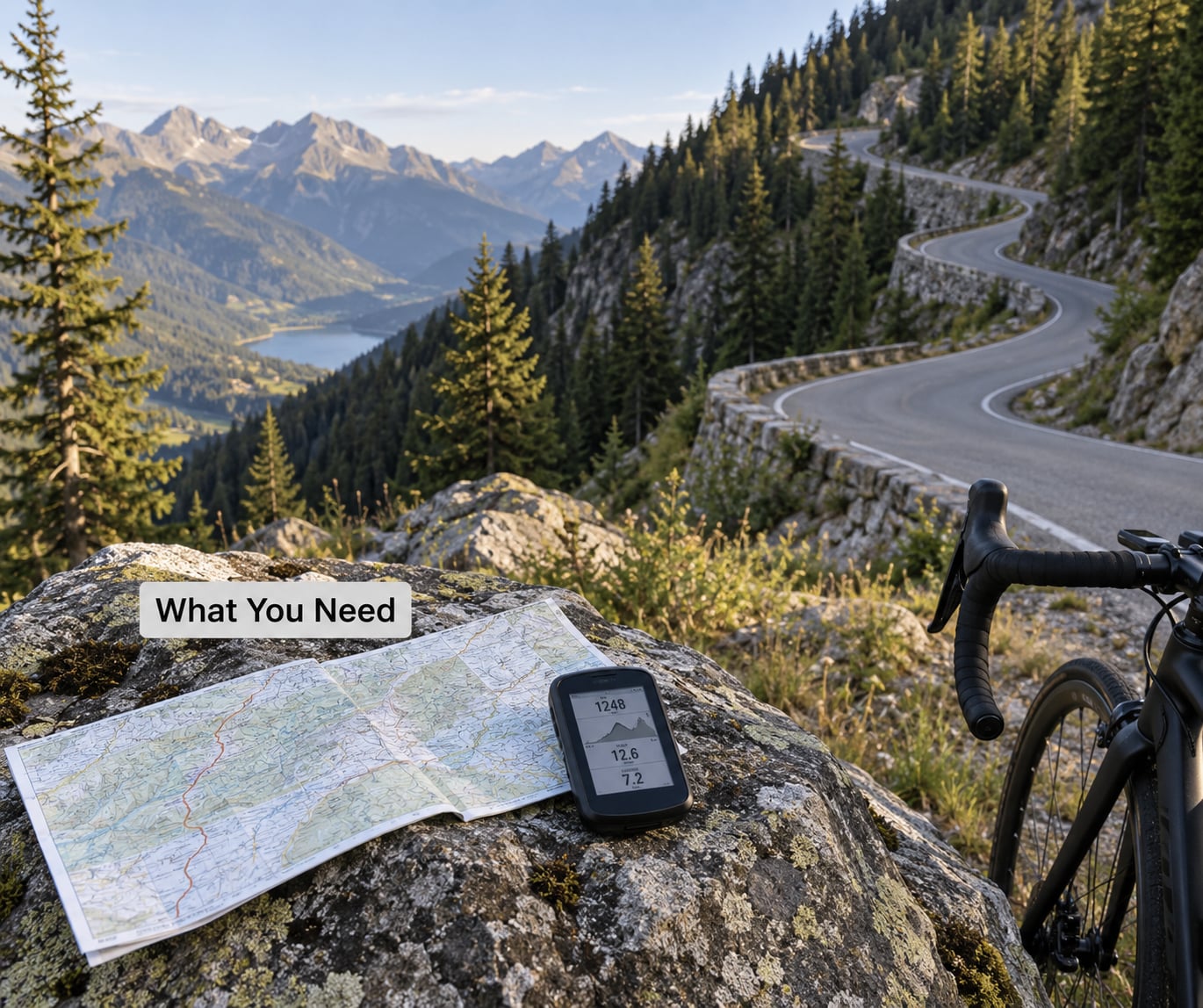
You need the route, an honest count of the weeks you have left, and a body that is functioning normally. Everything else is detail. Get these three right first and the rest is a matter of filling in sessions.
Route and elevation data
- Total elevation gain for the whole ride, and for each individual climb
- The longest sustained climb, its average grade, and the steepest pitches on it
- Surface: smooth tarmac, chip seal, or gravel that costs you 10 to 15 percent more effort
- Expected riding time, which is usually longer than your flat-distance estimate
- Water, food and resupply points, because mountain stages do not have a corner shop every 20 km
- Exposed sections with no shade and no shelter
A ride at 2,000 m with one 12 km climb is a different animal from a ride at 3,000 m with three 25 km climbs. The first is an endurance day, the second is a pacing test, and the plan should not look the same for both.
An honest timeline
Count backward from the ride date and write the number of weeks in pen. Then subtract one week for a taper and one week for life getting in the way. Whatever is left is what you actually have, and a six-week block built around that number beats a twelve-week plan you abandon in week three.
Health and blood markers
Altitude training works through red blood cells, and red blood cells are built out of iron. Booking a ferritin and vitamin D test 8 to 10 weeks out is the single most useful preparation step most riders skip, because low iron quietly means the whole block produces nothing. Talk to a doctor or registered dietitian about whether your levels are adequate and whether any supplement makes sense for you. Do not self-prescribe iron.
If you have a heart condition, anaemia, a history of disordered eating, or you get breathless at sea level on easy rides, speak with a healthcare professional before planning a big mountain day. That conversation is free and it changes the plan.
A bike set up for the climbing
Climbing outdoors punishes a sloppy chainline and an over-geared bike far more than a trainer does. Have the chain clean and oiled, the bottom bracket and cables checked, and the tyres pressed for what is actually under you. On loose climbs a lower gear ratio is kinder to your legs and your balance than grinding.
Nutrition you have already tested
Buy your gels, drink mix, bars and salt tablets before the week of the ride, and eat every one of them at least once in training. Gut training is a real adaptation. The worst possible moment to discover a new energy bar is at 2,400 m with 40 km still to go.
Step-by-Step: Build Your High Altitude Ride Plan
Preparation should develop five things in order: aerobic endurance, climbing-specific strength, steady pacing, fueling efficiency and recovery. It takes weeks because each one depends on the last. A single hard hill workout cannot do it, and that is exactly the trap most self-coached riders fall into when they read about altitude training and imagine one big weekend in the mountains fixes everything.
Step 1: Set a realistic timeline and identify the climb demands
Start by dividing the ride into its parts. Read the elevation profile and find the longest climb, then the steepest sustained grade on it, then the total vertical for the day. Those three numbers tell you what your training actually needs to contain.
Thresholds help. Below about 500 m of climbing, altitude is largely irrelevant. Between 500 m and 2,000 m, most recreational riders will hold roughly 90 to 95 percent of their sea level power on the same effort. Between 2,000 m and 3,000 m, expect to lose closer to 5 to 7 percent of threshold power for every 1,000 m of elevation, and to reach roughly 80 to 90 percent of sea level output. Above 3,000 m the gap keeps opening up, and at the top of a 3,400 m pass you may be working near 75 percent of the watts that felt comfortable at the coast.
Then match the block to the rider, not the other way around.
- Beginner or returning rider with a big-mountain ride 8 to 10 weeks out: spend the first four to six weeks building steady endurance before adding any climbing-specific work at all.
- Experienced club rider with 5 to 6 weeks: one long ride, one quality climbing session and one moderate tempo effort per week is plenty.
- Extreme elevation, meaning a start above 3,000 m such as a Colorado peak-stage event or a 100-miler with a mountain start: add a second aerobic day and a real taper, and plan the first two days at the venue as easy spin days rather than training.
Remember the start elevation, not just the summit. If your target is a hundred-miler or a well-known mountain climb, the first forty minutes are usually the worst part of the day, and they happen at the altitude that hits an unacclimatized rider hardest.
Step 2: Build an aerobic base without adding unnecessary volume
Keep the easy riding easy. Around 80 percent of your weekly time should sit at a conversational effort where you can still speak in short sentences, because that is the pace that builds the engine you will rely on in hour four.
A workable week for a rider with five or six sessions available looks like this:
- Monday rest, or 30 to 45 minutes of very easy spinning if you are the type who needs something on the day off
- Tuesday 60 to 90 minutes of steady endurance, flat or rolling
- Wednesday your quality session, either the climbing work from Step 3 or a 20 to 30 minute tempo effort, depending on the week
- Thursday rest or an easy 45-minute recovery spin
- Friday 60 to 90 minutes of endurance, ideally with some rolling terrain and a few short efforts at the end
- Saturday the long ride, 2 to 4 hours depending on where you are in the block
- Sunday rest
Progress by adding time, not by making the easy days harder. Extending the Saturday ride by 5 to 10 minutes a week, or adding one interval block to the long ride, is plenty. Most riders who break in an altitude block did it in the four weeks before arriving, and they broke it with fatigue rather than with fitness.
Add a little strength work twice a week if you can. Squats, lunges, single-leg work and a solid core routine do more for your climbing than another hour of steady spinning, because a long climb is a repeated effort under low oxygen and tired legs fail on the sixth hour.
Step 3: Practice sustained climbing and pacing
Climbing fitness is a specific kind of fitness. It is a repeatable effort at moderate intensity, held for a long time, where sprinting has no value at all. Train it the same way every week so you can judge your own pacing on the day.
A good hill session is three to five repetitions of 8 to 12 minutes at a steady effort you would describe as hard but sustainable, with 8 to 10 minutes of easy spinning between each. Ride it at a power target if you have a reliable meter, or at a perceived effort of about 6 or 7 out of 10 if you do not. Resist the urge to go harder than that on the first repetition, because the whole point is arriving at the last one at the same heart rate and the same cadence as the first.
Two details that matter more than riders expect:
- Cadence. Aim for roughly 80 to 100 rpm on the steep stuff. A lower gear lets you hold that cadence and keeps your legs turning smoothly, which burns less fuel and delays the moment everything turns to paste.
- Out of the saddle. Practise it, briefly, on the steep pitches. It gives the legs a change of position and can clear a build-up of pressure, but it also costs a lot of energy, so use it for 30 to 60 seconds at a time on the hardest ramps rather than swaying up the whole mountain.
For the long, slow climbs, pace by feel instead of chasing sea-level power. Settle into an effort you could hold for four hours, check your breathing, and let the watts be whatever they are. Riders who arrive at the base of a mountain with a number in their heads tend to go out far too hard and spend the second half of the climb walking beside the bike mentally.
Riders on the TrainerRoad forum make the same point in a different way: if your base is weak, altitude adds very little, and the best use of your time is raising your functional threshold with the structured training you are already doing. That is not a consolation prize. For most sea-level riders it is the larger share of the performance gain.
Step 4: Train fueling, hydration, and heat management
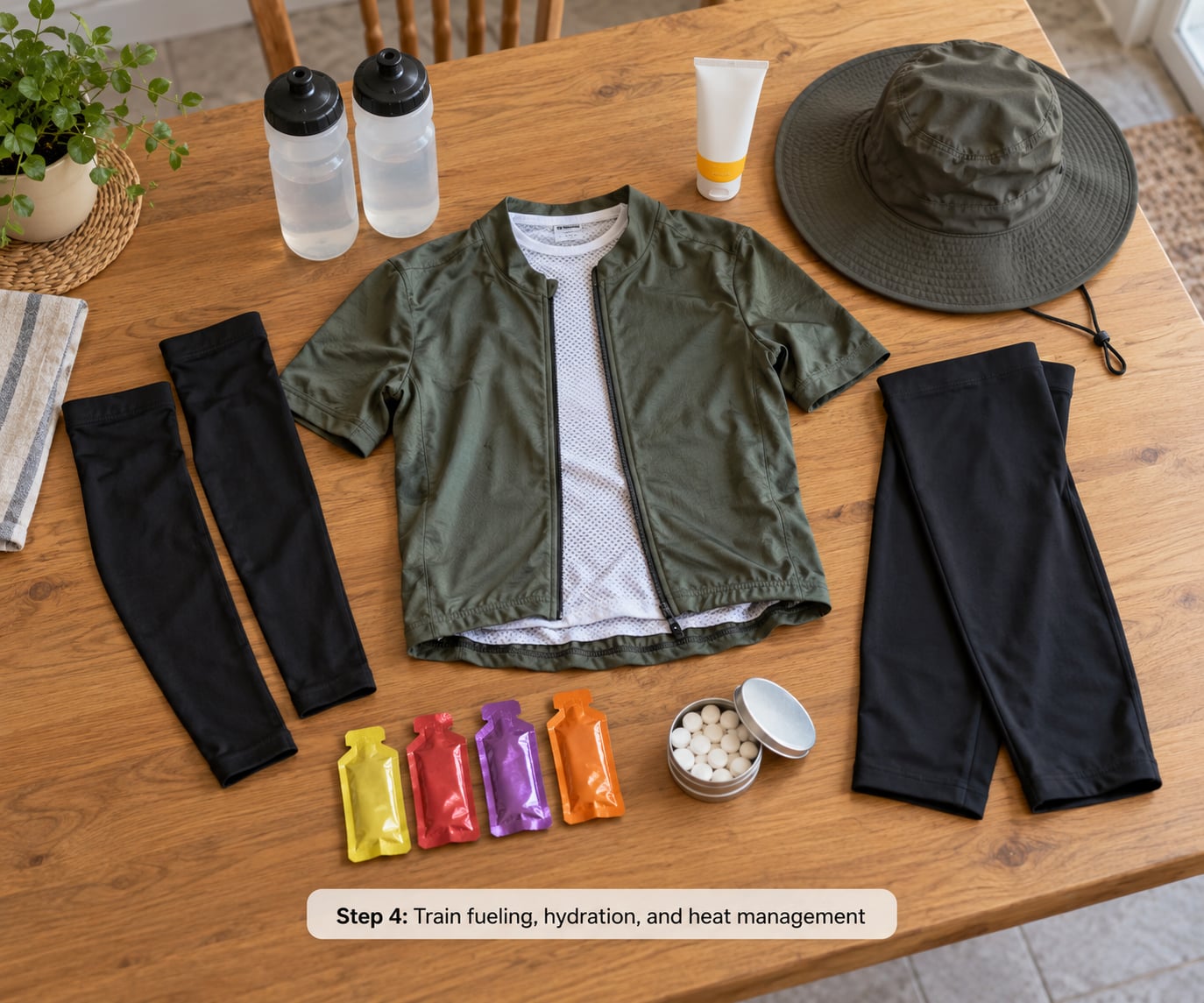
Eat and drink on every long ride, even the ones where you feel fine, because the ride where you forget to eat is always the long one. The practical targets most coaches land on are 60 to 90 g of carbohydrate per hour on a long mountain day, at least 500 to 700 mg of sodium per hour, and roughly 700 to 800 ml of fluid per hour.
Drink to a plan rather than to thirst alone, especially in heat. Small and frequent beats a large volume every half hour, because your body absorbs fluid better that way, and a reasonable rhythm is 180 to 210 ml every 15 minutes. Adjust for conditions rather than for habit: a cold, overcast climb needs less, a hot exposed descent needs considerably more, and wind on an open mountainside dries you out faster than the temperature suggests.
Two things catch riders out at altitude. Appetite genuinely drops, so you have to eat on schedule rather than when you feel like it, and the gut gets slower, so liquid carbohydrate is often easier to manage on the steepest sections. Many riders keep a bottle of drink mix with a higher carbohydrate concentration for exactly that reason.
Test the exact products on training rides. A long Saturday ride is the perfect laboratory: work out that a gel every 25 minutes plus a bottle per hour keeps you steady, then repeat that on the day. Salt tablets belong in the mix if you are a salty sweater, and you can taste it in your jersey the following day, which is a decent bioassay.
Thin air also changes effort perception. The same gradient that felt fine at the coast will feel like a wall, and the mental frustration of that is a real factor in how riders pace. It is easier to handle once you have felt it in training at a lower intensity and learned that slowing down by ten watts is not a failure.
Step 5: Simulate the event and plan recovery
Use the last two long rides to rehearse. Pick one with a long sustained climb and do the whole thing at your planned fueling rhythm and your planned effort, not your usual hard chatting pace. That single session exposes more problems than any amount of planning, and you still have time to fix them.
On arrival, the acclimatization decision depends on what you are doing there. For a one-day mountain ride, most riders land best two to three days before the event, riding gently on the first two days to absorb the initial drop in performance. A camp-and-climb block works well if you can ride hard, because you sleep high and spin low each morning. Riders who descend into a valley for their quality sessions and come back up to sleep are following the classic climb-high, sleep-low pattern, and riders in the Alps describe it as the only way to keep any intensity at all while living high.
Forum advice genuinely conflicts on arrival timing, and the reason is that the two camps are answering different questions. Riders heading home to race at sea level want to descend about a week out so the blood adaptation is still there but the flat days have passed. Riders racing at the altitude itself want to arrive early enough to feel human by the start. If the forum version of this advice left you confused, that is the whole explanation.
Then taper properly. In the final week, cut your volume by roughly a third to a half while keeping one short hard effort so your legs stay sharp. Keep your normal riding rhythm, because arriving and then sitting on the couch for five days leaves you feeling oddly loose. Load carbohydrates in the day and evening before, eat a normal breakfast with 2 to 3 hours to digest it, and do not experiment with anything new.
Have a weather plan. If the day turns cold, wet or windy, the honest response is usually to shorten the route, start earlier or lower the power target, not to push harder to compensate. And if you are unwell in the days before the ride, the right call is almost always to rest. A cold that turns into bronchitis at 3,000 m is a bad trade for any gran fondo.
Two safety notes that are specific to riding in the mountains. If you develop a headache, nausea, dizziness or unusual fatigue during the ride, do not push on. Above roughly 2,500 m, descending is the treatment, and a road descent while symptomatic is exactly when people make poor decisions, so turn around early rather than late. If symptoms worsen at rest, or you develop confusion, breathlessness at rest or a walking gait, that is an emergency and you need to get down and get help, not finish the route.
Common Mistakes
Almost every wasted altitude block comes down to one of these. The fix is usually smaller than riders expect.
Training too hard in the first few days at altitude
The first 48 hours at elevation is when you are least able to absorb training quality and most likely to accumulate fatigue you never recover from. Ride easy, spin long, keep the effort genuinely conversational. Riders who blow their first two days then spend the rest of the trip managing tired legs.
Riding every workout hard
Easy days are not wasted days, they are where the aerobic work happens. A rider doing every session at threshold arrives with a good fitness story and poor legs. Keep easy riding genuinely easy, and put your one hard session where it belongs.
Adding elevation too quickly
Total vertical is a stress, like any other. Adding a large chunk of climbing to a week that already went well is how a build turns into a three-week dip. Build the climbing load in stages and only once your base is holding steady.
Starting the ride too fast
Adrenaline and fresh legs will happily push you 20 watts above what the climb can hold. On a long gradient that error is paid back with interest at kilometer 20. Start at an effort that feels slightly too easy, and let the effort come to you.
Forgetting to eat
Suppressed appetite plus a big effort equals an empty tank, and the crash comes on a climb where you cannot fix it. Set a timer or count gels by the kilometer so eating happens whether or not you want it.
Ignoring wind, temperature and clothing
Downhill descents at altitude chill you to the bone in minutes, and a cold rider stops eating and starts losing power. Carry a windproof layer that fits under your jersey, arm and leg warmers for the cold climbs, and enough sunscreen that reapplication is automatic.
Trying to create fitness on the ride itself
A hard hill session two weeks before an event costs you more than it gives. Coaches and forum riders are blunt about this: a solid aerobic base with disciplined long-term structure produces more than a badly organised trip to the mountains. Altitude is the garnish, not the meal.
Leaving it too late, or leaving it too early
Arrive the night before for a big mountain day and you will spend the morning climbing out of your own head. Descend the day after a high-altitude block and race immediately and you will race on legs that are not there yet. Both mistakes come from treating arrival as a detail rather than a training session.
Four things worth doing that cost you nothing:
- Check the elevation profile of your last three long rides against the profile of your target ride.
- Practise eating and drinking on every ride longer than two hours until it needs no thought.
- Know your gear ratio for the steepest pitch and make sure you can hold a comfortable cadence in it.
- Write a one-line go or no-go rule for the morning of the ride, while you are calm.
Frequently Asked Questions
How many weeks do I need to train for a high altitude ride?
Allow four to eight weeks for most recreational riders, and three to four if you already ride regularly and the plan is mostly climbing practice and fueling rehearsal rather than building an aerobic base from scratch. Reserve the final seven days for a taper where you cut volume but keep one short sharp effort. If you have less than three weeks, prioritise long steady rides, repeatable hill sessions and eating on every long outing.
Do I need to live at altitude to train for it?
No. A live-in altitude block produces a real hematological adaptation, but the gains are modest for amateurs, some riders do not respond at all, and training quality often drops while you are up there. For a single day at elevation, arrive two to three days early and ride easy. Forum consensus is consistent: if your sea-level training is unstructured, fix that first, because a strong base buys far more than three weeks in the mountains.
How do I handle thin air on long climbs?
Expect roughly 5 to 7 percent less threshold power for every 1,000 m of elevation, so your usual power numbers no longer mean the same thing. Set targets by perceived effort instead, settle into an effort you could hold for hours, and let the watts be whatever they are. Expect heart rate to drift up for a given power in the first days, breathe more deeply and deliberately, and keep climbing cadence around 80 to 100 rpm.
What should I eat before and during a high altitude ride?
On the day before, eat normally and prioritise carbohydrate foods you already tolerate. On ride day, have a familiar breakfast with two to three hours to digest, then take in 60 to 90 g of carbohydrate per hour on long mountain stages, with at least 500 to 700 mg of sodium and roughly 700 to 800 ml of fluid per hour. Appetite drops at altitude, so eat on a schedule and use liquid carbohydrate when solid food stops appealing.
When should I drop to a lower gear at altitude?
Drop a gear the moment your cadence falls below about 80 rpm, your breathing becomes ragged, or you find yourself pushing hard in a seated position to hold speed. Holding a smooth 80 to 100 rpm saves fuel, reduces the strain on your knees and delays the point where your legs stop working smoothly. Shifting early feels like giving up for the first kilometre and then feels obvious for the next twenty.
How do I adjust training for an exceptionally steep route?
Steep routes shift the demand from aerobic volume to sustained climbing strength and pacing discipline. Add one repeatable hill session a week, three to five efforts of 8 to 12 minutes at a hard but steady effort, and make your long ride include one long climb ridden at a controlled pace. Practise out-of-the-saddle briefly on the ramps, confirm a low enough gear ratio for the steepest pitch, and consider arriving two to three days early so you are not climbing out of your own head on race morning.
Conclusion
Start by pulling up the elevation profile and writing down three numbers: the total climb, the longest sustained climb and the elevation at the start. Those three figures decide whether this is an endurance day or a pacing test, and they set the shape of the block.
From there, build gradually over four to eight weeks. Keep the easy riding easy, add one repeatable climbing session a week, rehearse eating and drinking until it is automatic, and taper instead of cramming. If you want to train for a high altitude ride properly, arrive early enough to be useful, ride the first days quietly, and turn around the moment symptoms say stop. Fitness built over months is what carries you up the mountain; fitness you hope to find on the road is not there.