Sweet spot training for cyclists means riding structured intervals at roughly 88-94% of your Functional Threshold Power, a band that sits between hard tempo and your genuine threshold. It builds aerobic fitness faster than slow endurance riding on its own, which is why it suits anyone with a full workweek. The hard part is not understanding the idea. It is dosing it so you get faster instead of tired.
What follows is written for road riders who want a working plan they can execute on their own: how to find an honest FTP, what each zone should feel like, how long the intervals should be, and how that fits into a normal week. Updated for 2026.
Table of Contents
- What Is Sweet Spot Training for Cyclists?
- How Do Sweet Spot Zones Work for Cycling?
- What Is the Best Sweet Spot Duration for a Road Ride?
- How Do You Find Your Own Sweet Spot?
- How Do You Structure Sweet Spot Training Sessions?
- Three sessions worth stealing
- Can You Do Sweet Spot Training Without a Power Meter?
- What Mistakes Make Sweet Spot Training Less Effective?
- How Should Sweet Spot Training Fit Into a Weekly Plan?
- How Do You Know When to Recover or Stop?
- Frequently Asked Questions
- Is sweet spot training the same as threshold training?
- How hard should a sweet spot cycling interval feel?
- How often should I do sweet spot training each week?
- How long should I stay in the sweet spot zone?
- Does sweet spot training work for long-distance road cyclists?
- What should I do if I feel exhausted during a sweet spot session?
- Conclusion
What Is Sweet Spot Training for Cyclists?
Sweet spot training is structured cycling work performed at about 84% to 97% of Functional Threshold Power (FTP), with most current coaching frameworks settling on 88-94% as the working band. That band sits right between upper Zone 3 (tempo) and lower Zone 4 (threshold), and it should feel like hard but controlled effort around 7 out of 10.
The 84-97% figure is the wide definition, and it is not wrong, just loose. A long, steady effort at 85% and a sharp 10-minute effort at 96% produce different things even though both sit inside the wide band, which is why some coaches narrow the target once a rider has enough data. If you are starting out, use 88-94%.
Here is how it differs from the other work you do.
Easy endurance (Zone 2) is conversational and builds durability. It rarely raises FTP on its own, and no amount of it substitutes for real intensity. Sweet spot is the middle: hard enough to force adaptation, not so hard that you need a day off to recover.
Threshold work sits above the band, roughly 95-105% of FTP or higher. It is valuable, but it costs a great deal per minute and takes days to come back from. VO2 max work is above that again and belongs in short doses.
Coach Frank Overton is generally credited with developing the method around 2004, on the simple idea that you can build most of the aerobic gains of a traditional high-volume base without paying for all those hours.
How Do Sweet Spot Zones Work for Cycling?
FTP is the yardstick, and the percentage is what actually matters. A rider who cannot hold 300 watts still trains at 88-94% of their own number, exactly as a stronger rider does at a different absolute figure. Frame it that way and the training stops feeling like a numbers game.
| Zone | Percent of FTP | Approx. percent of max HR | RPE (1-10) | How it feels | Main adaptation |
|---|---|---|---|---|---|
| Zone 2 endurance | 56-75% | 65-75% | 3-4 | Steady, full sentences | Durability, fat oxidation |
| Zone 3 tempo | 76-90% | 75-82% | 5-6 | Comfortably hard | Aerobic volume, endurance |
| Sweet spot | 88-94% | 75-85% | 7 | Hard, breathing in rhythm | FTP, capillarisation, fatigue resistance |
| Zone 4 threshold | 91-105% | 85-92% | 8-9 | Comfortably at the edge | Lactate clearance, climbing |
| Zone 5 and above | 106%+ | 90%+ | 9-10 | Suffering, short recoveries | VO2 max, anaerobic |
Watch the overlaps. Sweet spot straddles the top of Zone 3 and the bottom of Zone 4, which is exactly why the same session can be called tempo by one rider and threshold by the next. Your power file, not the label, decides.
Two practical cues matter more than the number. First, cadence: if it collapses for the last third of an interval, you have drifted past the band. Second, power drift: if interval three of four runs more than a few percent above interval one, the first effort was not really an effort.
What Is the Best Sweet Spot Duration for a Road Ride?
Duration changes what the session does, so pick it based on the adaptation you want rather than the number that looks impressive.
| Format | Typical timing | What it targets | Who it suits |
|---|---|---|---|
| Short efforts with surges | 4-8 min efforts, 3-5 sets | Muscle tension, cadence under fatigue, finishing ability | Everyone; a good first introduction |
| Classic 20-minute work | 2-3 sets of 20 min, 5-10 min easy | FTP, the highest bang for the time | Racers and riders with a decent aerobic base |
| Long sustained efforts | 30-60 min at 85-90%, one or two sets | Endurance at intensity, pacing discipline | Century riders, gran fondos, ultras |
| Long ride with embedded segments | 2-4 x 20-30 min inside a 3-5 hour ride | Realistic pacing, fuelling under load | Gravel and ultra riders, late-season prep |
Two hard boundaries are worth keeping. Most coaches treat 15 minutes as the practical floor for a session to count as sweet spot work, and roughly three hours as an absolute ceiling for a single day. That ceiling comes from one extreme racing effort, not from normal training, and most riders need nothing close to it.
For road riding, the most useful format is the 2 x 20 or 3 x 15 session. It is repeatable, measurable and fits inside an hour and a half.
How Do You Find Your Own Sweet Spot?
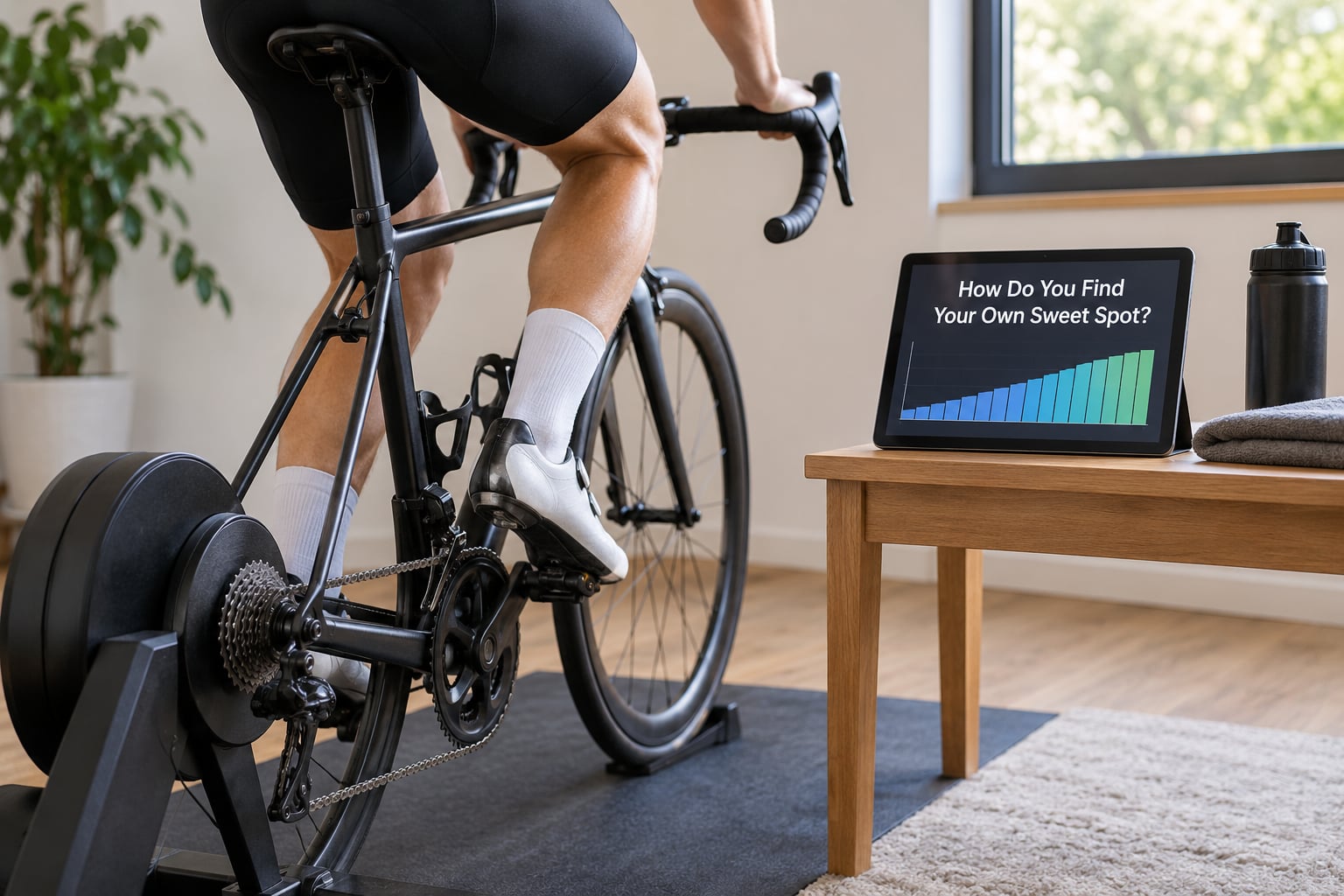
You cannot find a sweet spot without knowing your FTP, and the number matters more than the method you used to get it. An honest baseline beats a precise one you guessed at.
The 20-minute maximal field test is the best trade-off most riders will ever make. Ride a hard, steady effort for 20 minutes after a thorough warm-up, then multiply your average power by 1.05. Do it on a repeatable route, with no chasing cars and no sprinting the last minute.
The ramp test is easier to pace correctly. Increase power in small steps until you fail, and the last full minute you held is roughly your threshold value. It suits riders who cannot hold a steady effort outdoors.
Indoor auto-detect tests are the most convenient and usually the most generous to the rider, so treat the result as a starting point. Most power meters and smart trainers now run a detection routine during a hard spin; save the number, then re-test in a few months.
Then check the number against reality. Ride 2 x 10 minutes at your computed sweet spot, five minutes easy between, and watch three things: whether the second effort holds within a few watts of the first, whether your effort rate sits near 7, and whether you can still speak in short sentences. If you are at a 9 and fading, your FTP is set too high.
That is the most common self-diagnosis on cycling forums, and it is usually right. Set zones from a slightly conservative number and the intensity will correct itself within a couple of weeks. If you are managing a medical condition, a recent injury or a return from a long layoff, get a qualified coach or a clinician’s view before running any test at all.
How Do You Structure Sweet Spot Training Sessions?
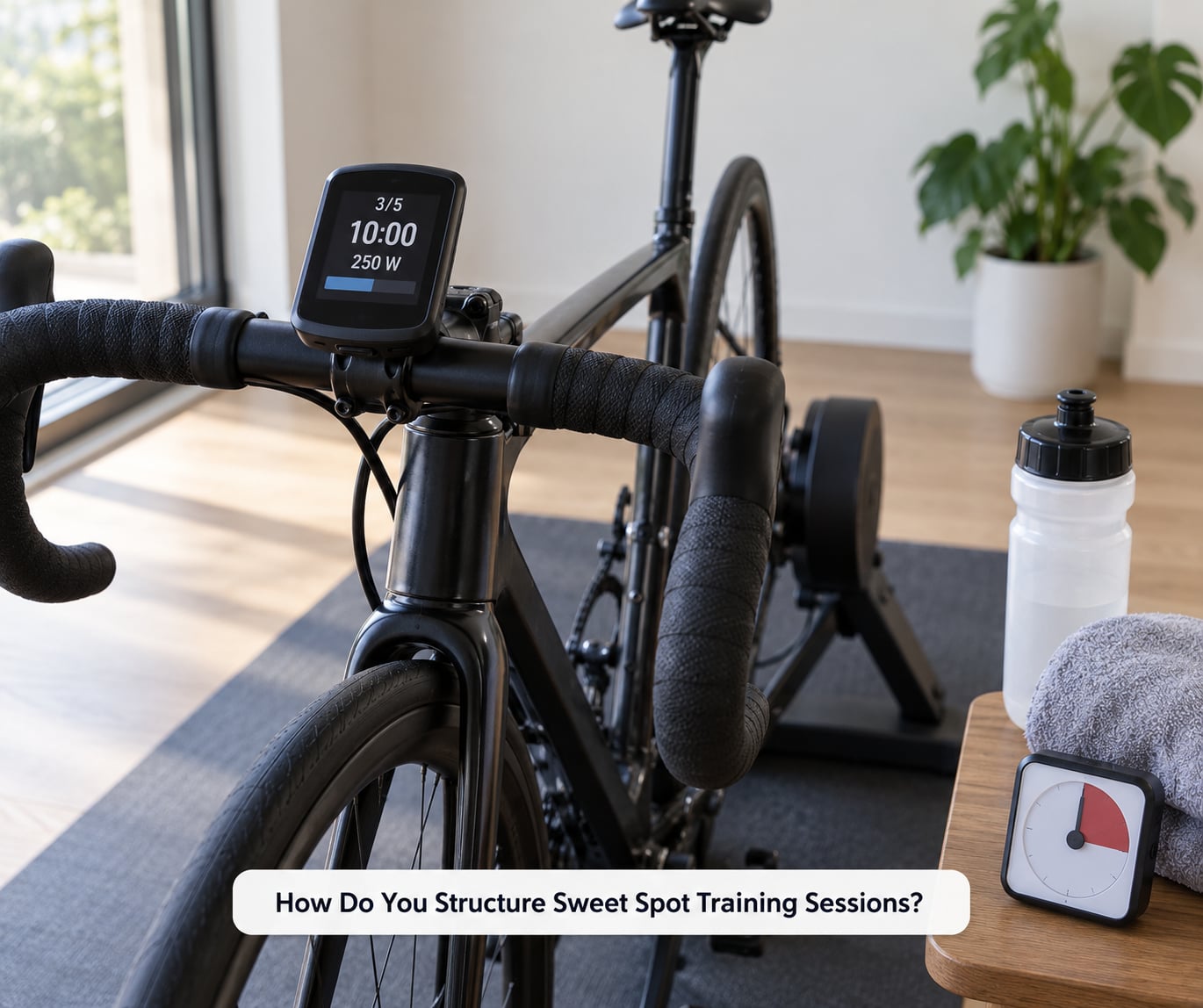
Every session has the same five parts, whether it lasts 40 minutes or two hours: warm-up, work intervals, recovery, cool-down and fuel. Keep the structure identical and only the numbers change as you get fitter.
Warm-up. Spin 15 easy minutes, then add a few short 15-second surges at high intensity. You are raising the signal to the legs and warming the muscles that matter, not burning your glycogen before the work starts.
Intervals. Follow the duration table above. Whatever you pick, write the target on your head unit before you start. Riders who ride intervals freestyle tend to creep upward as the set goes on.
Recovery. Five to ten minutes at Zone 1-2, pedalling easy. This is the part riders cut, and it is the part that lets you do the next interval properly.
Cool-down. Ten to fifteen minutes easy at the end. It costs little and it makes tomorrow’s ride better.
Fuel. An hour of sweet spot work is a fast hour. Take carbohydrate before you ride and water with electrolytes during it, especially indoors where heat builds fast. A cooling fan makes a real difference to how the final set feels.
Three sessions worth stealing
Beginner, 2 x 12 minutes at 88% of FTP with 8 minutes easy between and 15 minutes of warm-up and cool-down. Add a set every few weeks until three sets feel routine, then move to longer efforts rather than harder ones.
Intermediate, 3 x 15 minutes at 90% of FTP with 5 minutes easy between. This is the workhorse session, and it is where most of the FTP gains come from over a winter block.
Century preparation, 4 x 8 minutes at 92% of FTP with 3 minutes easy between, started with 3 x 15-second surges at the top of each rep. Shorter efforts with surges leave you fresher for a long event than a single grinding hour would.
Scale by one variable at a time. Add a set, or lengthen the efforts, or nudge the power up by one to two percent, then leave it alone for two or three weeks. A recovery week where everything drops back to easy riding is part of the plan, not a missed week.
Can You Do Sweet Spot Training Without a Power Meter?
Yes, and for a lot of riders it is the only realistic way to do structured work at all. Four cues replace the wattage, and none of them is as precise, but together they get you into the right neighbourhood.
Rate of perceived exertion. Aim for 7 out of 10. You can talk in short phrases, not sentences, and you would finish a short climb on the bike.
The talk test. Full sentences marks Zone 2. Short phrases marks the sweet spot. One or two words between breaths marks threshold, and that is the ceiling.
Cadence and feel. Pick a comfortable seated cadence, usually 85-95 rpm on the flat, and hold it. If the legs feel heavy and the cadence sags, you have gone too far.
Terrain and heart rate. A long, shallow rise is close to a controlled interval. A steeper ramp is closer to threshold work, so use gentler gradients.
Heart rate is a useful guardrail at roughly 75-85% of your maximum, but it should never define the session on its own. It lags behind power, drifts upward in heat and dehydration, and climbs with fatigue, so the same heart rate can mean three different intensities.
Buying a meter is worthwhile when you can, but plenty of riders hold their fitness for years using effort alone.
What Mistakes Make Sweet Spot Training Less Effective?
These five show up repeatedly in rider forums and in coaching reviews, and each one has a simple fix.
Chasing an FTP you never earned. Someone sets a number on a good day, then trains above what they can actually hold. The fix is the reality check in the FTP section above: if interval two cannot hold, the number is fiction.
Making every interval as hard as possible. Sweet spot is not a suffering contest. If your effort rate climbs past 8 by the second rep, you have turned the session into threshold work and the recovery bill lands two days later.
Stacking hard days with no easy ride between. Most riders with a job and a family cannot absorb more than one or two quality sessions a week. The fix is a hard day followed by genuinely easy riding, and a full recovery week every fourth week.
Increasing duration too fast. Going from 30 to 90 minutes of sweet spot in a week is a classic overreach. Add roughly ten percent to total time in the zone at a time and let fitness, not ambition, set the pace.
Reading discomfort as progress. The last five minutes of a set should feel uncomfortable and stay manageable. If you are counting down the minutes and hoping it ends, the set was too long, too hard, or both.
None of these show up in a power graph. They show up three weeks later as a flat fitness chart and a rider who quietly stops training.
How Should Sweet Spot Training Fit Into a Weekly Plan?
Sweet spot is one ingredient in a week, never the whole week. The rest of your riding is what lets you absorb it.
| Rider level | Weekly hours | Sweet spot per week | Sessions |
|---|---|---|---|
| Recreational / returning | 4-6 hours | 20-45 minutes | 1 session, 2 x 12 min |
| Enthusiast club rider | 7-10 hours | 45-90 minutes | 2 sessions, 3 x 15 min |
| Racer | 10-14 hours | 90-180 minutes | 2-3 sessions, some threshold |
| Elite / heavy racing load | 15+ hours | 180+ minutes | 3 sessions plus race-specific work |
A common build pattern is three weeks of work to one week of recovery. In the recovery week, every ride is easy, or you ride at all if life allows it.
For a rider with six hours a week, a realistic week looks like this: an easy 90-minute ride on Tuesday, a sweet spot session on Thursday, a two-hour easy weekend ride with some faster riding in the middle if you feel good, and one short recovery spin.
For a club rider with ten hours, there is more room but not much more sweet spot. Two long endurance rides, one sweet spot indoor session, one longer outdoor session with embedded intervals, and a second quality day on a weekend when the weather and family calendar allow it.
Put the hard sessions on days you know you can protect, and keep at least one day completely off the bike.
How Do You Know When to Recover or Stop?
Signals that the dose is too high show up before the power chart does. Persistent soreness that does not settle overnight, poorer sleep, a flat mood and dropping performance across every session are the classic cluster, and riding through them is how riders end up injured rather than just tired.
Some specific rules help. If your resting heart rate is several beats above your normal over several mornings, take the easy week you were avoiding. If a session feels heavy from the first interval, shorten it rather than forcing the numbers. If motivation is gone for two or three sessions in a row, the plan is too demanding for the life you are actually living.
Stop the session immediately if you feel chest pain, unusual breathlessness, dizziness, palpitations or sharp pain anywhere. Those are medical matters, not training data, and you should get them checked by a doctor rather than analysed on a bike computer.
Fatigue is normal. Feeling worse for a week after a hard block is a signal, not a failure.
Frequently Asked Questions
Is sweet spot training the same as threshold training?
No, though the two zones touch. Sweet spot sits at roughly 88-94% of FTP, where you can hold a controlled effort and still talk in short phrases. Threshold work starts around 95-105% of FTP, feels noticeably harder, and can only be held for shorter periods. Many riders do both, with sweet spot taking the larger share because it builds fitness with less cost per minute.
How hard should a sweet spot cycling interval feel?
About 7 out of 10 on the perceived exertion scale. Breathing is fast and rhythmic, you can manage short phrases but not full sentences, and your cadence holds steady without sagging. If you are counting down the minutes and hoping the set ends, it was harder than sweet spot and should be logged as threshold work.
How often should I do sweet spot training each week?
Most riders do well with one or two sessions a week, and that is true regardless of total hours. Recreational riders on four to six hours a week should aim for 20-45 minutes in the zone total. Club riders on seven to ten hours can handle 45-90 minutes. Keep at least one genuinely easy day between quality sessions and plan a full recovery week every fourth week.
How long should I stay in the sweet spot zone?
Individual efforts usually run from 4 minutes to 30 minutes, and the 2 x 20 or 3 x 15 minute session at 88-94% of FTP is the classic workhorse: repeatable, measurable and easy to progress. Longer efforts of 30-60 minutes work well for century and gravel preparation when they are held at the lower end of the band.
Does sweet spot training work for long-distance road cyclists?
Yes, and it is the most useful single session type for long events. It raises the power you can hold for extended periods, improves your tolerance of hard efforts late in a long ride, and builds race pace without the fatigue of threshold work. Most riders get more from two sweet spot sessions a week plus long easy endurance miles than from hard racing efforts every weekend.
What should I do if I feel exhausted during a sweet spot session?
Shorten the set rather than pushing to the end, and ride the remaining intervals at the lower end of the band. If the exhaustion feels sudden, or comes with chest pain, dizziness, unusual breathlessness or palpitations, stop the ride and seek medical advice. Ordinary accumulated fatigue is a sign to cut back for the week, not a reason to push through.
Conclusion
The safest first step is unglamorous: find out what you can actually hold right now, be honest if the number is lower than you hoped, and ride one manageable session such as 2 x 12 minutes at 88% of FTP. Then do it again next week, and only add volume once two sessions in a row feel controlled.
Sweet spot training rewards consistency rather than heroics. Riders who build one solid session a week and protect their easy days usually overtake the ones chasing new personal records every Sunday, and they still have legs left in August.