
Periodization for cyclists is the habit of dividing a training season into planned phases instead of riding whatever feels good on any given day. In practice it means four things: a base block that builds aerobic fitness, a build block that adds harder work, a peak block that sharpens you for a target event, and recovery weeks that let the adaptation land. The point is not paperwork. The point is arriving at your century, your fondo, or your race day in 2026 with the fitness you trained for and enough left in the tank to use it.
Most riders already do a rough version of this without naming it. The trouble starts when the rough version is accidental: hard every weekend, easy in between, no recovery, and a big event six weeks after the hardest block. That shape produces a rider who gets tired instead of fast.
What follows is the practical version, built for road cyclists training around a job and family rather than full-time athletes. Numbers come with ranges because the right number for you depends on your hours, your history, and how much of your life is currently under stress.
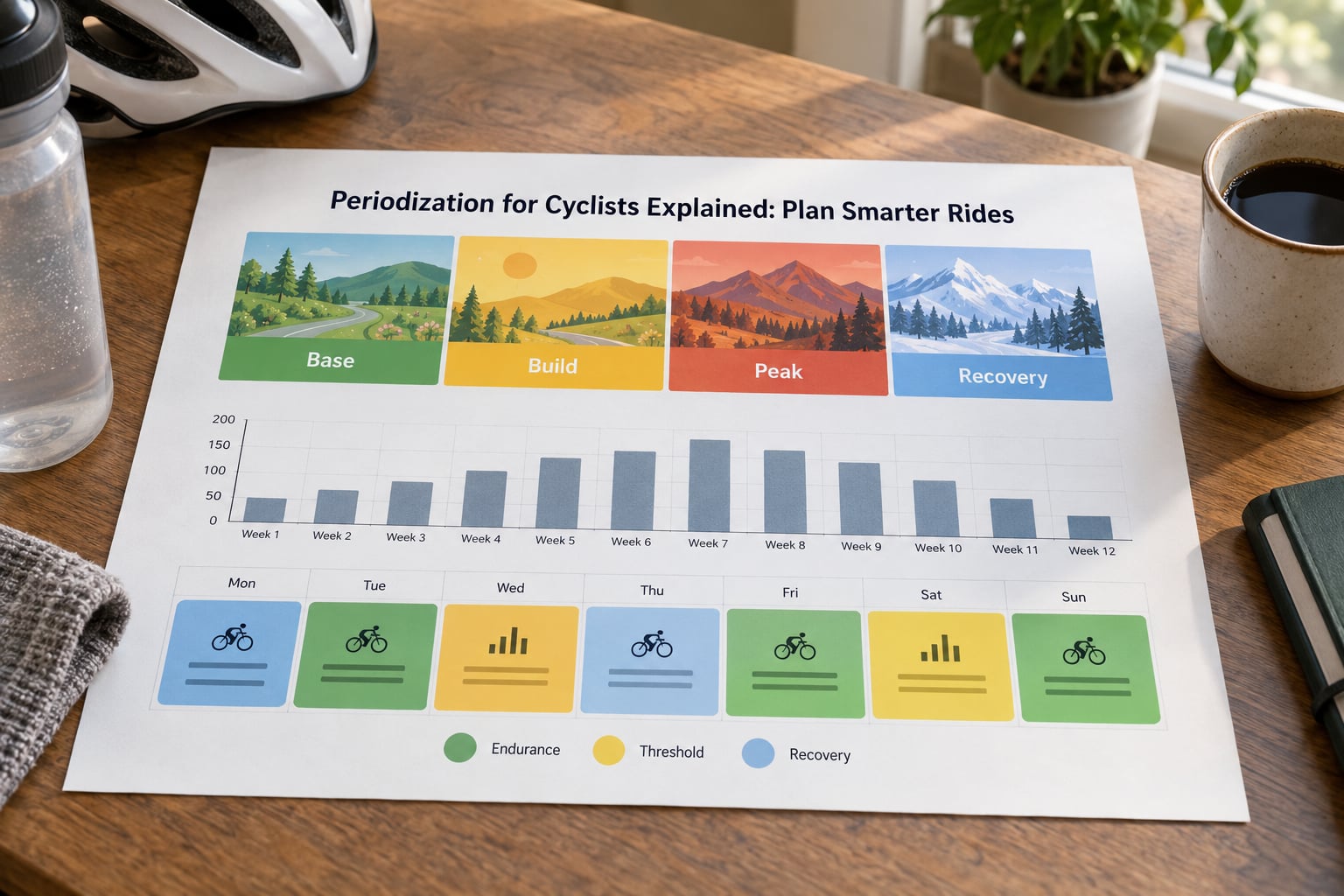
Table of Contents
- What Periodization for Cyclists Explained Really Means
- Why periodization for cyclists beats random hard-and-easy riding
- Which Training Phases Should a Cyclist Use?
- How Do Annual, Meso-, and Microcycles Fit Together?
- How Much Volume and Intensity Should Each Week Contain?
- How Do You Build Endurance Without Boring Yourself?
- When Should You Add Intensity and Race-Specific Work?
- How Do Recovery Weeks and Down Weeks Work?
- How Can You Adjust a Plan for Work, Weather, Illness, and Life?
- How Do You Build Your First Periodized Cycling Plan?
- Frequently Asked Questions
- How long should a cycling training periodization last?
- Can beginners use a four-week repeat every month?
- Should a cyclist increase mileage or intensity first?
- How many hard sessions should be in a week?
- What should I do if I miss several training rides?
- Do I need a power meter to use periodization?
- Conclusion: Start With One Event and Three Simple Phases
What Periodization for Cyclists Explained Really Means
Periodization for cyclists is the structured division of a season into phases, each with a different mix of volume, intensity, and specificity. The phases progress from base to build to peak to recovery, and the changes are planned in advance rather than decided on the day. It works because fitness adapts to load, and load only produces useful adaptation if you allow recovery and then increase the stress again.
That last clause is where most self-coached plans fall apart. Riders add load, get a small improvement, add more load, feel tired, drop to easy riding for a fortnight, then restart from roughly the same place. The cycle repeats all season and fitness stalls around week nine.
Why periodization for cyclists beats random hard-and-easy riding
Hard-and-easy riding is not the same as periodized training. One is a distribution of effort you happen to ride. The other is a sequence with an order and an end date, where each phase sets up the next.
Four differences show up in practice:
- Progression is planned. Volume or intensity rises on a schedule you decided in advance, not on how a Saturday feels.
- Recovery is scheduled. Easy weeks are entries in the plan rather than evidence that you failed a hard one.
- Specificity is timed. Race-shaped work arrives close enough to the event to be useful, and early enough to be absorbed.
- There is a target date. The season ends at something, which makes trade-offs decidable.
Riders on cycling forums describe the same stall in different words. One describes hitting mileage targets for months without getting faster, another describes arriving at a June event flat after peaking in February. Both are periodization failures rather than fitness ceiling problems.
Which Training Phases Should a Cyclist Use?
Use four phases, and expect to spend most of your hours in the first two. The peak block is short by design, and recovery is what makes the other three worth doing.
1. Base. Duration rides at conversational pace, long enough to build the engine underneath you. The work is volume and consistency, not speed. Most self-coached plans run four to eight weeks here, starting after a transition or off-season block. Set an honest baseline first: your current weekly hours, your longest comfortable ride, and your resting heart rate on a normal morning.
2. Build. The same aerobic base plus a small, deliberate slice of harder work. Threshold intervals are the usual entry point, in the range where you can hold a hard effort for a sustained stretch. Volume often stays similar or dips slightly while intensity rises, so the block is not simply “more of everything”.
3. Peak. Race-specific work, a reduced volume taper, and the last meaningful fitness gains. Most riders do well with two to four weeks of this before the event. Keep some intensity so the legs stay sharp, but cut the long hours that create fatigue.
4. Recovery. Either a deload inside a block or a longer transition after a big event. Same phase name, very different length. A deload is three to seven days of noticeably easier riding inside a training week. A transition is a stretch of weeks after a season’s main event, where the goal is rest, cross-training, and coming back without losing the engine entirely.
What each phase looks like in practice:
| Phase | Primary focus | Weekly volume | Intensity mix | Typical hard days | Usual length |
|---|---|---|---|---|---|
| Base | Aerobic durability, consistency, tendon and muscle tolerance | Highest of the season, built gradually | 80-90% easy, rest conversational or steady | 0-1 | 4-8 weeks |
| Build | Raise sustainable power, then add higher intensity | Similar or slightly lower than base | 75-85% easy, 1-2 threshold or VO2max sessions | 1-2 | 4-6 weeks |
| Peak | Race specificity, sharpening, taper | 20-40% below pre-taper weeks | Fewer but more race-shaped efforts | 1-2, shorter | 2-4 weeks before the event |
| Recovery | Absorb adaptation, restore freshness | 60-80% of surrounding weeks | Almost all easy, no intervals | 0 | 3-7 days, or a multi-week transition |
These are ranges, not rules, and the ratios matter more than the totals. A rider with eight hours a week can run the same phases with a smaller stage.
How Do Annual, Meso-, and Microcycles Fit Together?
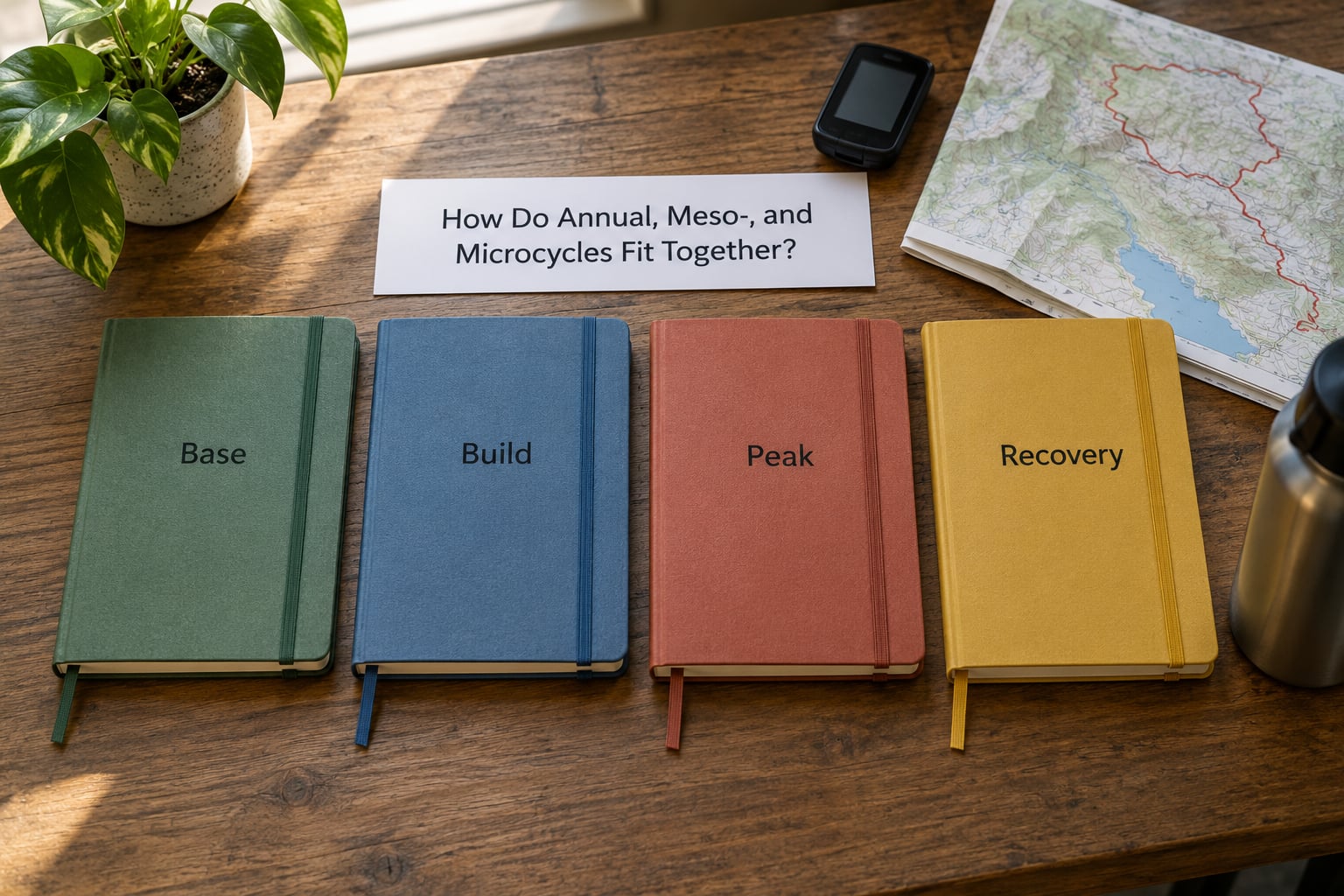
Periodization happens at three nested scales, and mixing them up is a common source of confusion. The macrocycle is the season. The mesocycle is a block of three to six weeks with one job. The microcycle is the individual week, usually Monday to Sunday, where you arrange hard days and easy days sensibly.
| Level | Time horizon | Typical example | What it decides | Question it answers |
|---|---|---|---|---|
| Macrocycle | Several months to a year | A full season from off-season to a July century, or a road race calendar | Which phases run when, and where the A-race sits | What am I working toward, and when? |
| Mesocycle | 3-6 weeks, sometimes up to 8 | A four-week aerobic base block, or a three-week threshold and climbing block | The dominant adaptation for that stretch | What is this block for? |
| Microcycle | One week | Two hard sessions, one long ride, the rest easy | Session order, spacing, and rest days | When exactly do I go hard? |
Here is a concrete 24-week version for a rider with a gravel century in late 2026, assuming roughly eight to ten hours a week and a full winter indoors.
Macrocycle: the century is the target, so the last four weeks taper into it and the twenty weeks before that build toward it. Mesocycles: four-week blocks, each with a single job. Microcycles: within each block, one threshold session, one long ride, one short easy or tempo effort, and the rest easy.
- Weeks 1-4, base. Long ride grows from 2.5 to 3.5 hours. One short steady effort if you want one. Volume up, nothing fast.
- Weeks 5-8, base 2. Long ride to four hours. Cadence work and one tempo block introduced. First deload in week 8 at about 70% of the week before.
- Weeks 9-12, build 1. Two threshold sessions, one of them on the turbo for consistency. Long ride stays near four hours.
- Weeks 13-14, build 2 (shortened). Climbing repetitions and race-pace work. Deload in week 14.
- Weeks 15-18, build 3. Long ride toward five hours, one threshold session, one short VO2max set, and your longest steady effort of the season.
- Weeks 19-20, peak. Volume drops 20-30%, intensity stays, with one race-simulation ride that mimics the century profile.
- Weeks 21-24, taper and event. Easy spinning, short openers, long rest between efforts, and the ride itself.
Notice what the plan does not do: it never adds volume and intensity in the same week after week 12. That restraint is most of the method.
How Much Volume and Intensity Should Each Week Contain?
Organize a week around duration, one or two genuinely hard sessions, and easy riding between them. That is the whole skeleton. The numbers below are starting ranges for a healthy adult rider with a few seasons of consistent training; scale them to your own baseline rather than borrowing someone else’s.
| Building block | Starting range | Notes |
|---|---|---|
| Weekly duration | 6-10 hours for most amateurs; 5-8 is a workable minimum | Raise by no more than roughly 5-10% a week, and cut hard after a busy stretch |
| Long ride length | 3-5 hours on a weekend, building toward your event requirement | Length matters more than speed for most non-racers |
| Easy riding share | 75-85% of total hours | Easy means you could hold a conversation |
| Threshold work | One or two sessions of 2 x 20 minutes up to 3 x 10 minutes | The highest-value interval for a self-coached rider |
| VO2max work | One short session, roughly 3 x 5 minutes or 5 x 3 minutes | Do not run this and a long threshold session in the same week |
| Recovery week volume | 60-80% of the surrounding weeks | Intensity drops to near zero |
| Loading to recovery ratio | 3:1 for most riders; 2:1 for riders over 40 or under high life stress | Two hard weeks then a lighter one is a perfectly good pattern |
Three adjustment rules matter more than the table. If your available hours drop by a third, cut volume first and keep the sessions that build the specific thing you are training for. If work stress rises, move to the 2:1 ratio before you break. If a week felt unusually hard, repeat it instead of adding to it.
Riders ask about the two popular ratios constantly. The 80/20 idea says roughly 80% of your time should be easy, which lines up with the ranges above. The 75% rule refers to a harder variant used by some riders who can hold 75% of sessions easy and still fit real intensity in. Neither is a law; both are ways of saying that easy riding should be the default, not the exception.
For riders on a power meter, the same idea shows up as training stress. Weekly stress should rise gradually, and a recovery week drops it below the trend line. If you have no meter, ride time and perceived effort do the job well enough.
How Do You Build Endurance Without Boring Yourself?
Endurance comes from consistency, not from novelty, but consistency is much easier to keep when the week is not four identical hours in the saddle. Different formats train overlapping things and none of them has to be the same every week.
Long weekend rides build the part of fitness that only time delivers: capillary density, fuel handling, and the tolerance to sit in one position for hours. Riders heading for a century need at least one long ride each week, and most benefit from two in the final month.
Shorter endurance sessions of 60 to 90 minutes at steady pace keep the engine turning on busy weeks when three hours is not possible. They are less efficient per hour than a long ride, which is exactly why they are a good compromise rather than a replacement.
Group rides hold intensity steady for a long time with less mental effort, and the social pressure keeps you out. The trade-off is that pace often creeps up into a range you cannot sustain alone, so treat a group ride as a hard session when it turns chatty.
Cadence and pedalling mechanics work raises cadence to a comfortable high range on easy rides, which reduces the strain per stroke and lets riders spin at a lower gear. It is a useful tool in base blocks and almost useless if it turns every ride into a test.
Terrain substitutes for structure. A rolling route handles steady-state work without a designated interval session, and a hilly route gives climbing practice. Riders with no indoor option can periodize almost entirely on the road this way.
Here is a century build for someone currently riding five hours a week, shown as volume rather than speed, since that is the lever most riders can pull:
- Weeks 1-3. 5 hours, one long ride of 2.5-3 hours, everything else easy.
- Week 4. Recovery week at 4 hours, no hard session.
- Weeks 5-8. 6-6.5 hours, long ride to 3.5 hours, one steady effort of 45-60 minutes.
- Week 9. Recovery week at 5 hours.
- Weeks 10-13. 7 hours, long ride to four hours, one threshold session of 2 x 20 minutes.
- Weeks 14-16. 7.5-8 hours, long ride to 4.5 hours, one threshold session and one short climbing-focused effort.
- Week 17. Recovery week at 6 hours.
- Weeks 18-20. 8-9 hours with a five-hour long ride, then cut volume by about a quarter for the final two weeks.
No universal load sits inside that outline. Someone who already rides ten hours a week would hold the long rides and add a second hard session; someone with a demanding job would run the same shape at two-thirds the hours and lose nothing structural.
When Should You Add Intensity and Race-Specific Work?
Add intensity when your base block is done and the next one has a clear purpose, not on a calendar date. A few signs that you are ready: your long rides feel controlled rather than draining, you can ride the weekend route without being cooked by Sunday afternoon, and you have completed at least two or three consistent weeks without unusual fatigue.
Start at threshold, not above it. Two 20-minute efforts at a sustainable hard pace build more usable fitness than six sprints, and they cost far less in recovery. From there, work outward by purpose:
- Threshold for riders who need a higher sustainable speed: a hill, a long climb, or a fast century. Sets run from 2 x 30 minutes down to 4 x 8 minutes as fitness improves.
- VO2max intervals for the short, sharp end: 3 x 5 minutes or 5 x 3 minutes, with long recoveries. One per week, maximum, and not in the same week as heavy threshold volume.
- Sprints and neuromuscular work for criteriums, bunch riding, and hills out of the saddle. Tiny time cost, real benefit for specific events.
- Climbing repeats to practice the pacing, position, and nutrition of a summit finish rather than to build raw power.
- Race simulation in the final three weeks: one long ride that mimics the event profile, including the same pacing plan and a practice of the food and drink you will use on the day.
Intensity must not replace endurance. Riders who skip the base and jump to intervals usually gain a hard engine and a weak one, then wonder why they can hold 20 minutes but not four hours. The order matters: volume builds the platform, intensity sharpens it, and specificity points it at the goal.
It is also fine to add intensity, then pull it back. A congested month at work, a sick child, or a two-week holiday is a reason to run a shorter or fully easy week rather than to cram the missed sessions into the next one. Riders who miss a week usually lose very little fitness; riders who panic and add volume lose the season.
How Do Recovery Weeks and Down Weeks Work?
A recovery week is planned in advance, sits inside a training block, and cuts both volume and intensity. The common prescription is roughly 60-80% of the surrounding volume with no hard efforts at all. Riders often describe it as the week that makes the previous three count, which is exactly right physiologically: adaptation is consolidated during the easier days, not the hard ones.
Recovery weeks are not the same as rest. On a recovery week you still ride, you just ride easily and you may ride more often for less time each time. Complete days off are for illness, injury, or a genuine need for mental distance, and they belong to the transition phase rather than the middle of a block.
Signs you need a reduction that was not on the calendar:
- Resting heart rate sitting noticeably above your normal for several mornings.
- Riding well below your usual power on a familiar route without a reason.
- Low energy after long rides that used to finish fine.
- Sleep, mood, or motivation dropping off across more than a few days.
Persistent fatigue, a raised resting heart rate that does not settle with a few easy days, mood changes, or feeling unwell during ordinary rides are reasons to see a doctor rather than a coach. Overtraining syndrome and illness share symptoms, and only a clinician can sort that out. Until you know which you are dealing with, cut the training back and treat rest as the training.
Where the rider falls in life decides the ratio. Riders over 40, and riders carrying a demanding job or young children, tend to do better on two hard weeks then an easy one than on three then one. Their recovery capacity is not lower in any meaningful way; it is already partly spent on everything that is not cycling.
How Can You Adjust a Plan for Work, Weather, Illness, and Life?
Every plan eventually meets a week that does not look like the plan. The useful question is not whether you missed the session but what the week now looks like. Work through these in order: protect the priority session, keep the habit alive, and let the plan expand to absorb the gap.
One missed ride. Move it rather than add it. If the missed session was the long ride, swap it for the next free weekend morning. If it was threshold work, drop it that week entirely if the rest of the week is already busy.
Bad weather for a stretch. Short indoor sessions cover intensity well because the work is the same, only the setting changes. Endurance is the harder thing to replace, so keep a long steady ride on a trainer if the forecast is grim for more than a few days, and accept that a missed long ride is a small loss.
Travel and work blocks. Reduce the plan to a maintenance version: two easy rides, one moderate session, one longish steady effort. Two or three weeks at a lower load costs far less than it feels like it will, and it keeps the habit intact.
Illness. Stop hard training, especially with a fever, and get medical advice if symptoms persist. Return gradually: easy riding first, no intervals until you are through it, and rebuild volume over a week or two rather than jumping back to where you left off. Riders who restart at full load often get a second illness, which costs three weeks instead of one.
Aged forty-plus or a high-stress month. Shift to the 2:1 ratio, keep one quality session a week, and let the rest be easy. Consistency over a long season beats heroics in any three-week window.
The forum consensus is consistent on this point: plans that flex survive, rigid plans get abandoned in March. Keep the shape of the plan even when the contents change. A rider who trains four hours instead of eight in a hard month still completed the block.
How Do You Build Your First Periodized Cycling Plan?
Building a plan takes about an hour the first time and twenty minutes to adjust afterwards. The process below is deliberately simple, because a plan you will actually follow beats a sophisticated one you abandon.
Step one: choose one objective. A single A-event, a target FTP, or a goal century. Riders with several races either pick one A-race and treat the rest as B-races, or run a two-peak season with two shorter build phases and a transition in between.
Step two: establish your baseline honestly. Write down your current weekly hours, your longest recent ride, and how many hard sessions you have completed in the last month. Do not plan from your best week of the past two years.
Step three: work backwards from the event date. Count the weeks available and reserve two to four for peak and taper. Subtract three recovery weeks for every twelve weeks, or one for every four if you are over 40 or stressed.
Step four: fill the remainder with blocks. Give each three to six week block one job: build the aerobic base, raise threshold, work on climbing, or sharpen race-specific. Resist adding a second job halfway through.
Step five: write the microcycles. For every week, pick the hard days first, then place the long ride where it does not follow a hard day, then fill the rest with easy time.
Step six: set the review point. At the end of each block, check your hours completed, your hardest sessions, and how you felt. If you missed more than a third of the block, shrink the next block rather than chasing it.
The checklist to keep beside the calendar:
| Step | What you do | Decision it produces |
|---|---|---|
| Objective | One A-event, one performance target, one long goal ride | A date the plan works backwards from |
| Baseline | Average weekly hours, longest recent ride, recent hard sessions | The number you actually start from |
| Timeline | Count back 2-4 weeks for peak and taper | When to start reducing |
| Recovery | One light week per three loading weeks, or per two if older or stressed | Where the easy weeks sit |
| Blocks | One job per 3-6 week mesocycle | What each block is for |
| Hard days | Pick sessions first, then long ride, then easy time | The weekly microcycle |
| Review | Compare planned versus completed hours at each block end | Adjust the next block’s size |
You do not need a power meter, a coach, or a paid plan to run this. A power meter makes load easier to judge and is genuinely useful from the first season onward. A calendar, a notebook, and honest hour counts are enough to begin.
Frequently Asked Questions
How long should a cycling training periodization last?
A full macrocycle usually runs from the end of your main event in one year to the same point the next, so roughly nine to twelve months. Riders who target a single spring race often start a four to six week base in late autumn. Individual mesocycles run three to six weeks, and each microcycle is one week. The length that matters most is the base phase, which needs six to eight weeks to build a real aerobic floor before harder work stacks on top.
Can beginners use a four-week repeat every month?
Yes, and for your first season it is probably the best plan available. Ride easy most days, add one long weekend ride, and include one steady or threshold effort a week. At the end of every fourth week, drop your hours by a quarter and ride with no effort above conversational. Repeat that cycle for two or three months and you will build more fitness than most riders who start chasing power numbers in week two.
Should a cyclist increase mileage or intensity first?
Increase volume first. The aerobic base is the platform everything else sits on, and it responds to time in the saddle rather than to hard efforts. Riders who add intensity before the base is solid often build a strong engine and a weak one, then struggle to hold four hours. Intensity becomes the priority once long rides feel controlled and you have completed several consistent weeks without unusual fatigue.
How many hard sessions should be in a week?
One or two, for almost everyone outside a race week. One threshold session covers most of the benefit for a self-coached rider, and a second can be a short VO2max set or climbing work on a different day. Putting three hard days into a week usually costs more in recovery than it returns in fitness. During base, drop to one or none, and keep hard days at least 48 hours apart.
What should I do if I miss several training rides?
Do not try to make up the hours, and do not stop. Resume with the plan as written, dropping the sessions you genuinely cannot fit and keeping the long ride and one quality session if both are possible. Riders lose very little fitness over a one to two week gap, and much of that returns with a week of normal riding. If the missed stretch was longer than a month, rebuild volume gradually and add intensity only once easy riding feels normal again.
Do I need a power meter to use periodization?
No. Ride time, perceived effort, and a written record of your weekly hours are enough to run a periodized plan well, and many riders do it that way for seasons. A meter makes the load numbers more precise and speeds up threshold work, which becomes useful in your second or third season. Whichever you use, the same rules apply: increase gradually, plan a lighter week regularly, and cut back when fatigue lingers.
Conclusion: Start With One Event and Three Simple Phases
Pick one objective, count back from the date, and split what remains into a foundation block, a development block, and the final event or performance weeks. Put a lighter week in every third or fourth week and call it planned rather than earned. That is a complete first periodized plan, and it will do more for you than a complicated one you abandon in March.
Treat the plan as a flexible guide rather than a contract with yourself. Adjust the volume when your week changes, drop a session rather than doubling another, and ride the goal event as a reward for months of unglamorous work. If fatigue lingers or symptoms persist, take that to a doctor rather than a training plan, and ask a qualified coach or registered dietitian about individual questions on fuel, recovery, or load.