Most riders are back to baseline cycling fitness in six to eight weeks of easy, consistent riding, and need four to six months before they are genuinely race ready. Knowing how to get back in cycling shape after injury is mostly about resisting one temptation: riding like you did before, the first time the saddle feels normal again.
Here is the honest version of what happens. Fitness leaves in a predictable order. Top-end speed and VO2max fade fastest, often measurably within two to three weeks of no riding. Aerobic endurance goes next, over the following month or two. What sticks around far longer is neuromuscular pattern — balance, pedal stroke, the small stabiliser muscles that keep you seated. That is why the bike feels normal in week one and your engine does not.
The gap between those two things is the muscle-memory trap, and it is where most comebacks fall apart. Riders feel good, chase old power numbers, blow up inside 30 minutes, and spend three days recovering from a session that should have been a walk. Building the return around a staged, pain-aware progression takes longer on paper and much less time in reality.
One note before anything else: this is general information, not a diagnosis or a rehab protocol. If you are recovering from surgery, a fracture, a head injury, or any pain that is sharp, worsening or unexplained, a physiotherapist or sports medicine doctor should set your timeline. Treat their clearance as law — riders in cycling forums say plainly that following the physiotherapist’s six weeks exactly would have saved them months of guesswork.
Table of Contents
- What You Need
- Step-by-Step: How to Get Back in Cycling Shape After Injury Safely
- Step 1: Get Medical Clearance and Set a Baseline
- Step 2: Restore Comfortable Movement Before Adding Ride Time
- Step 3: Return to Short, Easy Rides
- Step 4: Build Duration Before Intensity
- Step 5: Rebuild Higher-Intensity Fitness and Group Readiness
- Common Mistakes
- Frequently Asked Questions
- How long does it take to get back in cycling shape after an injury?
- How long does it take to recover from iliotibial band friction syndrome?
- Is cycling bad for IT band syndrome?
- Should I ride with pain after an injury?
- Do I need a physio before returning to cycling?
- How soon after a crash can I ride again?
- Start This Week, Not Next Season
What You Need
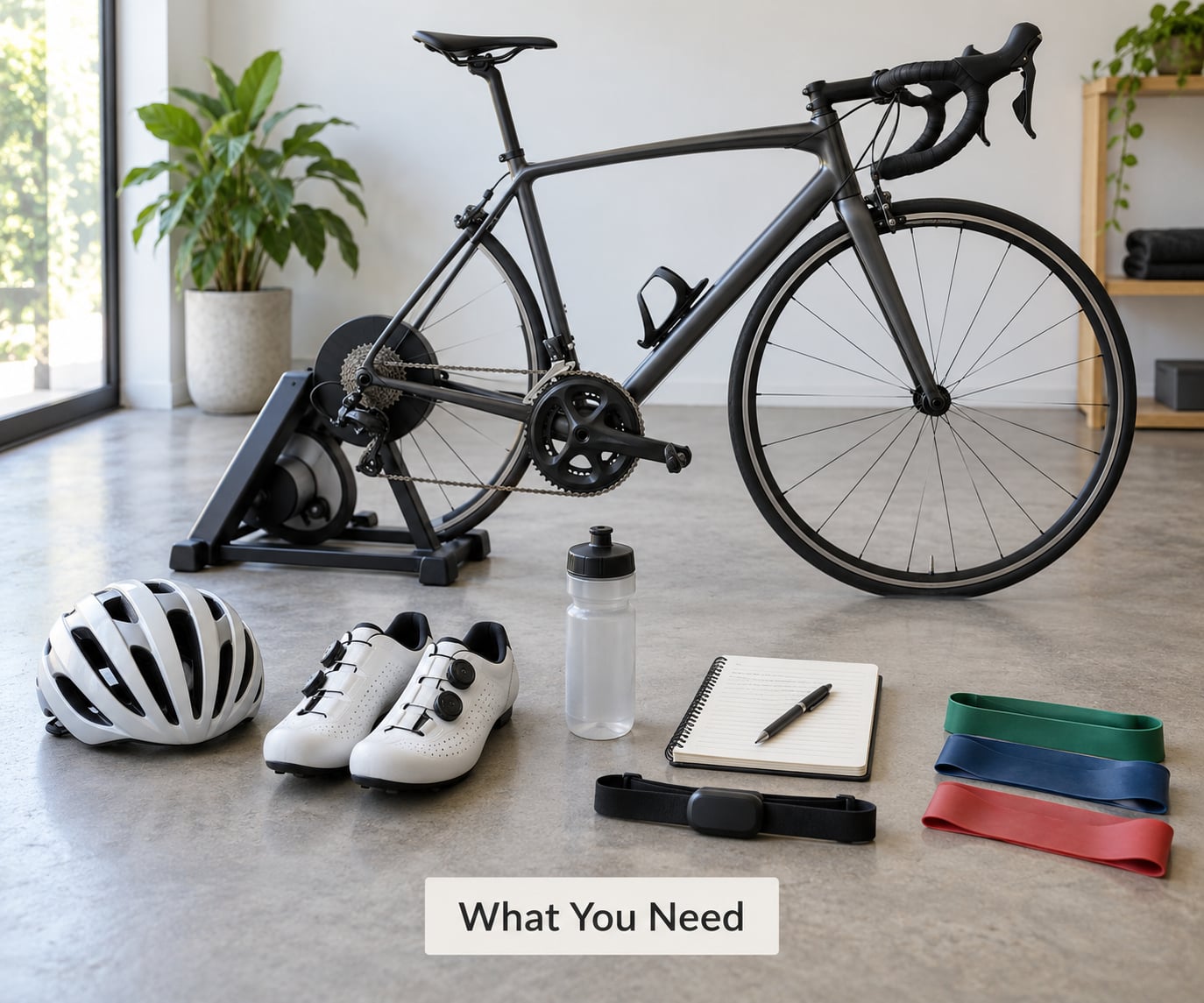
Before you touch the bike again, gather a few things. None of them are expensive. All of them make the return safer.
- Medical guidance. A physiotherapist or sports medicine doctor, and a plan from them in writing — cleared to ride, cleared to ride how long, cleared to add what.
- Your own baseline record. What did you ride before? Weekly hours, longest ride, typical FTP, resting heart rate. Write it down now, because in six weeks you will not remember and comparison is the fastest way to talk yourself into a mistake.
- A heart rate monitor you trust. Perceived effort alone is unreliable when you are fatigued, which is exactly when it matters. Heart rate gives you an objective ceiling for an objective rebuild.
- Your old bike, checked over. Brakes, cables, chain, tyre pressure, cleats. Post-crash bikes often need more than people expect.
- A flat, predictable route. A loop with no traffic, some shade, and a couple of places you can stop if something feels wrong.
- Cross-training options. Resistance bands, a pool, or a gym. Best of all is a stationary bike or turbo trainer, because it lets you ride without balance, braking or road risk.
Writing the baseline down matters more than it sounds. Forum riders returning after three to six months describe the same moment: the first ride feels great, and then they cannot understand why 30 minutes used to be nothing. Notes beat memory.
Step-by-Step: How to Get Back in Cycling Shape After Injury Safely
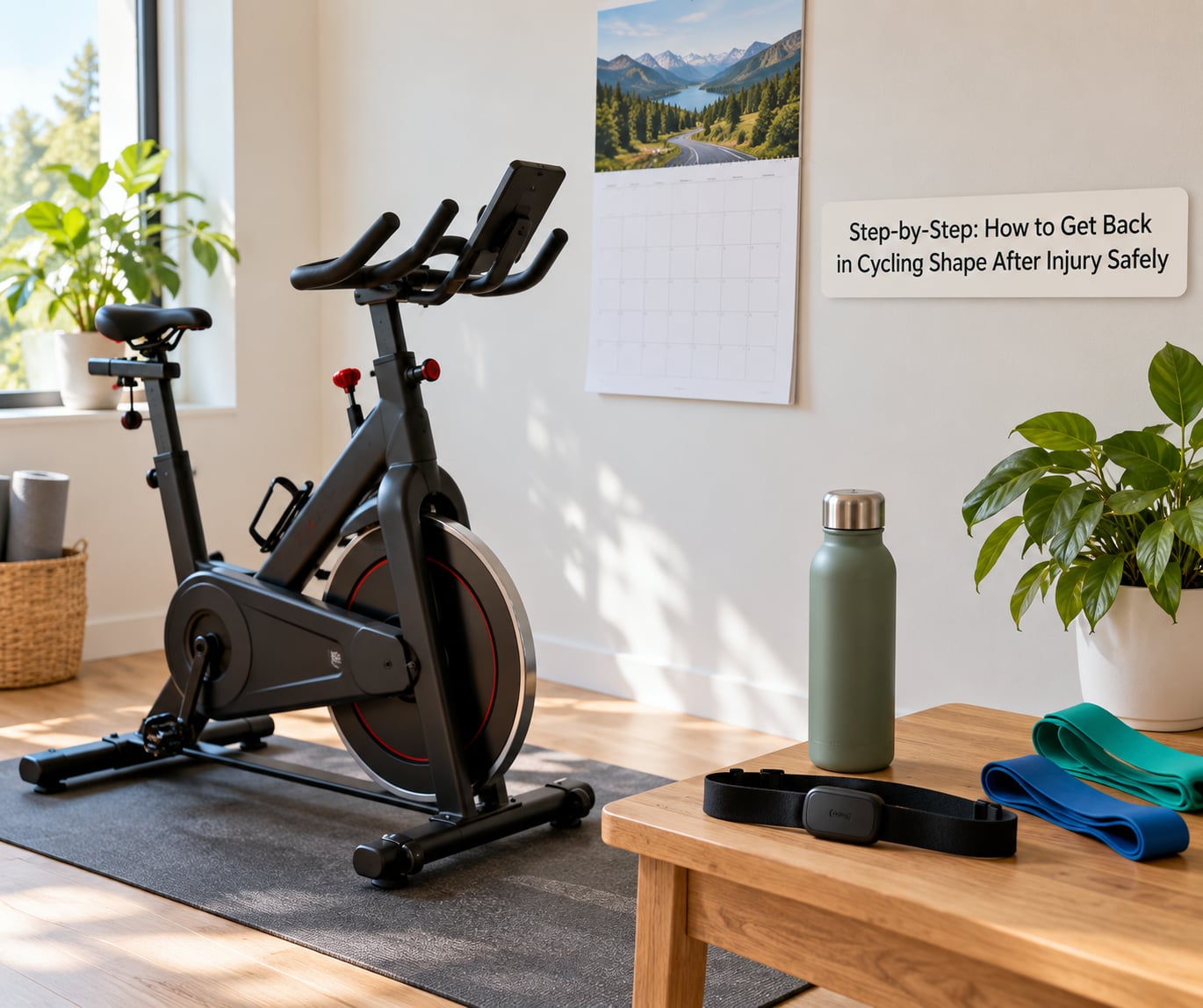
Here is the plan as four phases across roughly eight weeks. The progression rule underneath all of it is simple: add no more than about 10% to your weekly riding volume, and only add intensity once three or four weeks of steady riding have gone without a symptom flare-up.
| Phase | Weeks | Rides per week | Duration | Intensity ceiling | Cross-training |
|---|---|---|---|---|---|
| Phase 1 — Symptom-free movement | 0–2 | 0 rides on the road | 15–20 min stationary only | Easy spin, low resistance, full recovery | 2–3 strength sessions plus daily mobility |
| Phase 2 — Short easy returns | 3–4 | 3 | 20–30 min | Conversational pace, flat loops only | 2 strength sessions |
| Phase 3 — Build the base | 5–6 | 4 | 40–60 min | Zone 1–2 with one short tempo block | 1–2 strength sessions |
| Phase 4 — Add intensity and group riding | 7–8+ | 4–5 | 60–90 min | One hard session per week, easy days easy | 1 strength session, mobility as needed |
Step 1: Get Medical Clearance and Set a Baseline
Clearance first, riding second. For a crash, surgery, a fracture or any head injury, that means a clinician, not a forum thread. For a low back twinge or a knee that has ached for months, it can be as simple as asking a physiotherapist to watch you squat, hop on one leg and climb a flight of stairs.
Useful questions to ask: what movements should I be avoiding, what symptoms mean I have gone too far, and what would make you change your advice. Write the answers down.
Then run a simple screen on yourself, and be honest. Can you walk normally for 20 minutes? Can you squat to the depth you need to get on and off the saddle? Can you stand on one leg for 30 seconds without wobbling or pain? Can you climb stairs without a hand on the rail? Is there no pain, stiffness or asymmetry that is worse than a dull ache you have had for weeks?
Any no answer means you are not ready to ride yet, and that is information rather than failure. Riders returning from a serious back injury have described the same lesson: walking came back first, months before the bike did.
Step 2: Restore Comfortable Movement Before Adding Ride Time
Before ride time goes up, movement quality has to go up. Most returning riders’ first problem is not the injured site — it is glute weakness, poor core stability and stiff hips, which is why a lot of lower back pain on the return was never really a back injury at all.
A short, practical set to run two or three times a week:
- Glute bridges — 3 sets of 12, lying on your back, driving through the heels. Trains the glute that keeps your pelvis steady when you pedal.
- Clamshells — 3 sets of 15 each side, banded or not. Side-lying, knees bent, opening the top knee. Targets gluteus medius, the muscle that controls hip position in the saddle.
- Single-leg balance — 3 holds of 30–45 seconds each side. Balance degrades fast when you stop riding and it is exactly what cornering asks of you.
- Core anti-rotation — 3 sets of 8 side each way from a half-kneel. A cyclist’s core resists twisting, it does not crunch.
- Thoracic and hip mobility — 5 minutes daily. Rotation and hip range of motion are what a long, hunched position takes away first.
Ten to fifteen minutes of this, most days, beats an hour of stretching you do once a week. Progress from bodyweight to bands to light weights, and stop each set while you can still hold the position cleanly.
Step 3: Return to Short, Easy Rides
The first rides back are deliberately boring. Twenty to thirty minutes, flat, conversational — the pace where you could hold a full sentence without gasping. That effort level is roughly zone 1 to zone 2, and staying there is not a lack of ambition, it is the whole point of the phase.
Use the turbo trainer for some of these. It removes the two things that scare returning riders most, balance and traffic, and it makes short sessions easy to fit into a week that has other things going on. Riders who cannot face the road yet consistently find indoor minutes keep the comeback on track until the road stops feeling hostile.
Your check afterwards matters more than the numbers on the ride. How did you feel an hour later? The next morning? Was there any symptom that came back, changed or lingered? If a session produces a two-day response, it was too long, too hard, or too soon, and you repeat the phase rather than pushing through it.
Step 4: Build Duration Before Intensity
This is where most riders get the order wrong. Volume first, intensity later, always. Ride 40 minutes, then 50, then 60, adding about 10% a week, and keep the effort honest.
Watch three things: how the ride felt, how you slept, and whether any symptom from the injury reappeared. If it did, step back a phase. There is no prize for finishing a calendar.
Riders coming back after three to six months report something specific and worth knowing: easy spinning feels completely normal, then the moment intensity creeps in they empty out fast. That is the aerobic base being thinner than the bike suggests, and it is why Phase 3 allows one short tempo block rather than a full interval session.
Do not retest FTP yet. An eight-week-old test tells you almost nothing useful, and a bad number early in a rebuild is mostly a mood event. Wait until you have six to eight consistent weeks behind you.
Step 5: Rebuild Higher-Intensity Fitness and Group Readiness
Only after three or four steady weeks without a flare-up do you add real intensity. One hard session a week is plenty at first, and hard means genuinely hard rather than moderately hard every ride. Easy days stay easy — that is the part returning riders resist most.
Group rides come last, and they are a specific risk. A club ride sets a pace you did not choose, on terrain you did not pick, for longer than you planned. Ride your own group or a beginner club ride, sit near the front so you are not chasing drops you cannot cover, and agree in advance to peel off early. Riders who joined a fast group in week one tend to be the ones who end up back in the physio’s waiting room.
Descent confidence comes back on a ladder too: flat loops first, then gentle rollers, then one familiar descent at a controlled speed, then corners at speed. The final rung is the exact corner or stretch where you crashed, and riders who have deliberately ridden it again, slowly, on a calm day report it doing more for their head than any amount of encouragement from friends. Avoidance tends to feed anxiety rather than fade it.
A few injury-specific notes worth knowing before you wonder whether you are progressing normally:
- Knee pain and IT band syndrome. Pain on the outside of the knee that flares every time volume jumps usually points at position, not fitness. Saddle height, cleat position and crank length all change knee loading, and a short period of raising the saddle, daily foam rolling and longer calf and hip stretches can help. Riders on cycling forums who stopped chasing it with stretching alone and got a proper assessment saw it settle.
- Lower back pain. Frequently glutes and core rather than the spine. Weak glutes plus a long, static, flexed position is the classic setup, which is why the anti-rotation and bridge work above tends to matter more than any amount of extra kilometres.
- Shoulder and collarbone. Once cleared, rebuild pushing and steering load separately. Light pressure, high cadence, low resistance, and expect a few weeks of arm weakness that has nothing to do with your legs.
- Head injury or concussion. Nothing on the bike until a clinician says so, and no heroics. Balance and confidence after a head injury need their own assessment, not a fitness test.
- Saddle sores. If pressure damage has not fully healed, riding will reopen it. This is a case for changing something — saddle width or shape, position, or a bike that fits you better — before riding again rather than tolerating it.
Riders over 40 should expect a slower ramp than the numbers suggest. Tendons stiffen, bone density and connective tissue adapt more slowly, and recovery from a hard session can take longer than the session itself. Same plan, more patience, and fewer surprises.
One more thing that quietly derails rebuilds: eating too little. You are adding work to a body that came out of the rebuild under-fuelled, and low energy availability during a ramp is a real risk to recovery. Eat enough to cover the work, and if you manage diabetes or blood sugar, expect to adjust your carb timing around longer sessions and check with your clinician about your own plan.
Common Mistakes
1. Riding your old intensity as soon as it feels fine. Comfortable on the bike is not the same as fit, and neuromuscular patterns outlive cardiovascular fitness by months. The correction: judge your return by the recovery response over the next 24 to 48 hours, not by how the ride felt.
2. Adding volume and intensity in the same week. Two new stressors at once is the classic way to end up back at the clinic. The correction: volume first for three or four weeks, one hard session per week after that, and no more than about 10% growth weekly.
3. Treating pain as something to push through. Some soreness is expected. Sharp pain, pain that changes your gait or pedalling, pain that arrives during the ride, or pain that is worse for 48 hours afterwards are stop signals. The correction: drop back a phase, and get the injury assessed rather than negotiating with it.
4. Comparing yourself to riders who never stopped. Your old self is a memory, not a benchmark, and the comparison is the most reliable way to lose motivation in month two. The correction: write your baseline numbers down before you return, then compare to those instead of to the club group ride.
5. Joining a fast group ride too early. Group pace is a decision made by the group, and it will outrun you. The correction: first group rides at your own pace, near the front, with a plan to peel off early.
6. Stopping all exercise because the bike is off the table. A total break means starting from less than you had to. The correction: stationary cycling, walking, swimming, and two strength sessions a week from week one — enough to hold your engine while the injury settles.
Frequently Asked Questions
How long does it take to get back in cycling shape after an injury?
Most riders regain baseline fitness in six to eight weeks of consistent, easy-to-moderate riding, and need four to six months before racing again. Top-end speed and VO2max go first, often within two to three weeks of not riding, while endurance follows over the next month or two. The timeline depends on how long you were off, how serious the injury was, and your age.
How long does it take to recover from iliotibial band friction syndrome?
It varies with severity and how long it went untreated, and only a clinician can tell you where you are in that. Signs it is settling: the pain stops appearing during easy riding and stops returning the morning after. Many riders also need saddle height, cleat position or crank changes, plus daily foam rolling and hip and calf work, because position often drives the flare. Get it assessed before adding volume.
Is cycling bad for IT band syndrome?
Not automatically. Plenty of riders keep cycling with modified position, lower volume and strength work through the phase. What tends to cause a setback is riding through escalating pain or increasing volume while the band is still irritated. A rough guide: mild ache that settles with easy riding and is no worse the next morning is usually manageable, sharp pain, limp or night pain is not. Have it assessed either way.
Should I ride with pain after an injury?
General soreness that clears within a few hours and is no worse the next day is usually fine. Sharp pain, pain that changes how you pedal or walk, pain that arrives during the ride, or symptoms that are worse 48 hours later mean stop, drop back a phase, and get it looked at. Do not use pain tolerance as your progression criteria. Your physiotherapist can give you a clearer rule for your specific injury than any general guide.
Do I need a physio before returning to cycling?
For a crash, surgery, fracture or head injury, yes, and medical clearance comes first. For a persistent knee, back or shoulder problem, a physiotherapist is usually worth it, because they can tell you which movements are safe and which will set you back. Riders who guessed at their own timeline often lost months. If cost is the issue, ask for a short block of sessions focused on assessment and a return plan.
How soon after a crash can I ride again?
For minor soft-tissue knocks without head involvement, many riders return within days to a week, but only once moving is pain-free and there is no tenderness over a collarbone, ribs or joints. Any head impact, or significant pain on movement, means no riding until a clinician clears you. The physical timeline is usually the easy part; the confidence on corners and descents is what takes longer, and that is better handled on a ladder than by waiting.
Start This Week, Not Next Season
Do one thing this week: book the assessment, or if you are already cleared, run the readiness screen and write down your pre-injury numbers. Then set a calendar reminder for eight weeks and treat it as the plan, not a wish.
Six to eight weeks of easy, boring, consistent riding will hand you back more fitness than a month of trying to be your old self. The riders who get there fastest are the ones who accept that the first six weeks are not about speed at all.