If you want to know how to taper before a big ride, cut your riding volume by roughly 40-60% over 8-14 days, keep a few short hard efforts in the mix, and let the long hours disappear. Most riders need 45 to 60 minutes to plan it, and an honest look at the last three weeks of training.
Here is the part almost everyone gets wrong: they treat the taper as time off. Sitting on the couch for six days does not make you fresher, it makes you flat and a bit fidgety. A taper is a controlled reduction in load, not a break from the bike. You keep the rhythm of riding, you shrink the sessions, and you protect sleep and food.
Below is the approach I keep coming back to for centuries, double-centuries and fondos: set the date, work backward fourteen days, cut duration rather than intensity, and spend the last two days on logistics instead of kilometres.
Table of Contents
- What You Need
- The event details, written down
- Your last three weeks of training
- A recovery routine you already use
- A fueling plan that has been tested
- A way to track how you feel
- Step-by-Step: How to Taper Before a Big Ride
- Step 1: Set the Race-Day Target and Work Backward
- Step 2: Reduce Volume, Keep Some Intensity
- Step 3: Keep the Final Week Genuinely Easy
- Step 4: Protect Sleep and Recovery
- Step 5: Practice Fueling Without Overeating
- Step 6: Prepare the Bike and Logistics
- Step 7: Race Day and the First Week After
- Common Mistakes That Ruin the Week
- Frequently Asked Questions
- How many days before a big ride should I start tapering?
- Should I keep training hard during the taper?
- What if I feel sore during the final week before a big ride?
- Should I cut carbohydrates during taper week?
- How much should I ride in the last three days before an event?
- When should I return to normal training after a long ride?
- Conclusion
What You Need
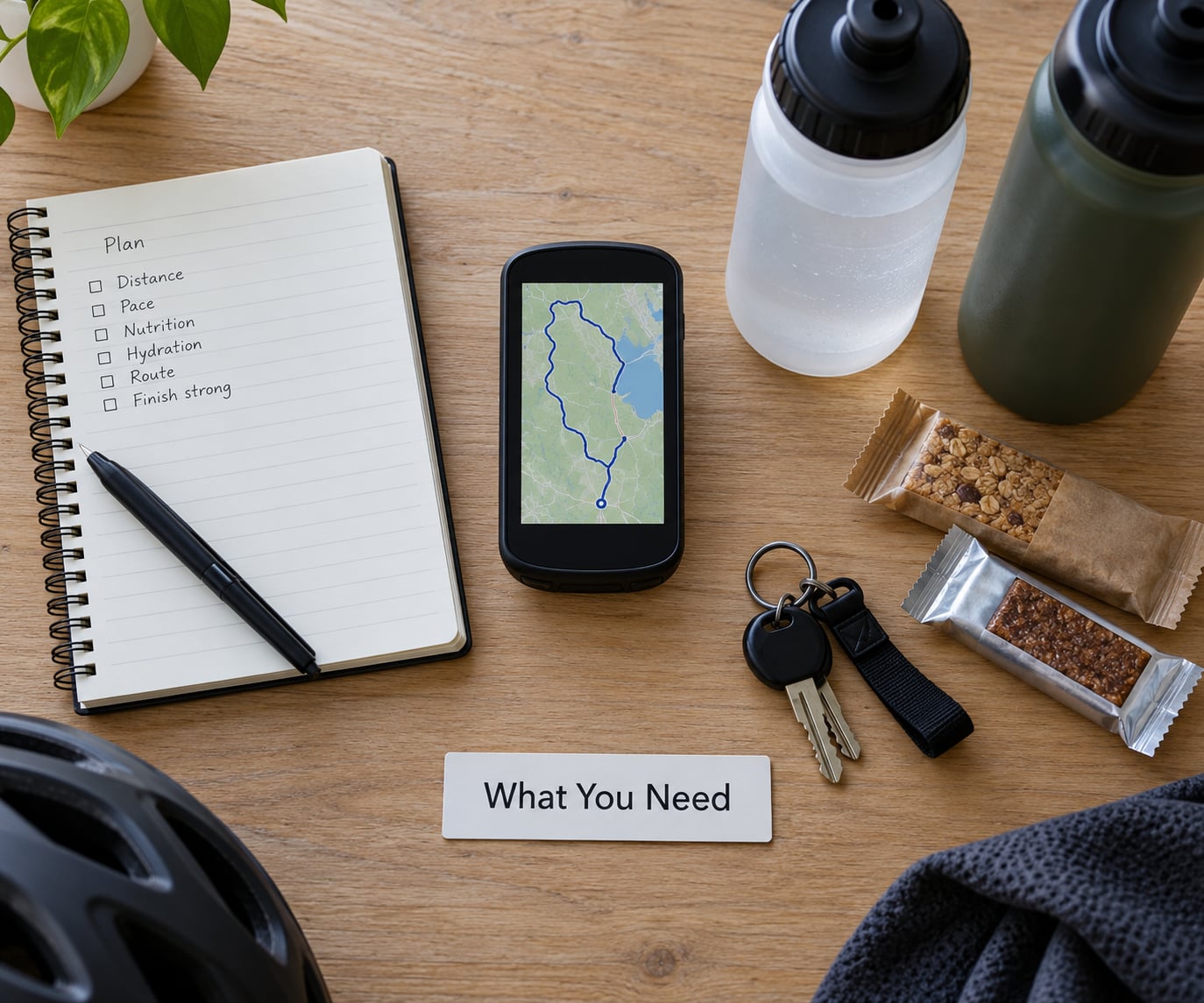
Before you cut a single mile, gather four things. Without them the taper turns into a guessing game, and guessing games in October are how riders show up flat.
The event details, written down
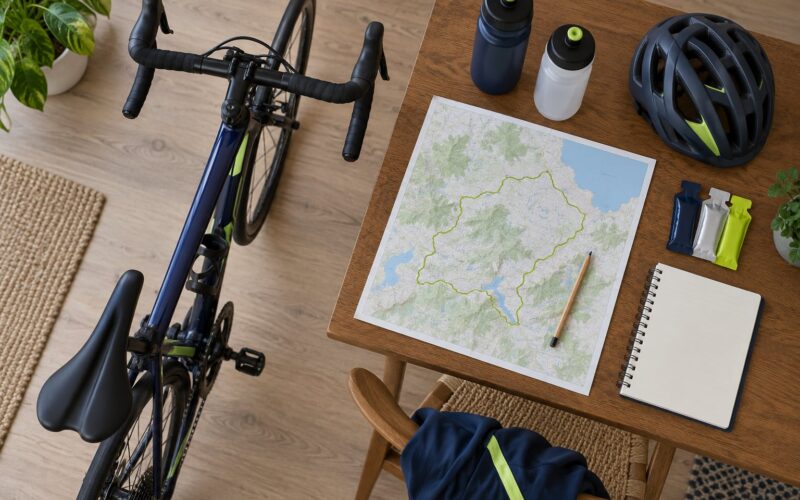
Start time, distance, elevation profile, cut-off time, the size of the field, and the forecast. A 100 km fondo with 1500 m of climbing asks something different of your legs than a flat 100 km charity ride with a food stop every 25 km, even though the mileage is identical. A two-hour start time is a completely different physiological problem from a seven in the morning roll-out.
Your last three weeks of training
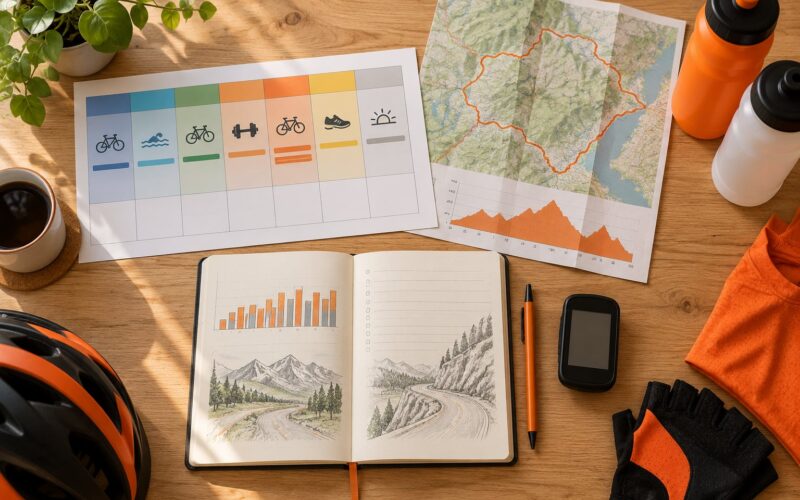
Write down what you actually did, not what your training plan said you should have done. Average weekly hours, your longest recent ride, and how many of those hours were genuinely hard. This is the baseline you cut from. A rider coming off 15 hours a week needs a deeper cut than someone who normally does 8.
A recovery routine you already use
Foam roller, a stretch routine you like, ten minutes of easy walking, a cold shower if that is your thing. Nothing new during the taper. Introducing a recovery tool in race week is how you end up with a sore back on Saturday.
A fueling plan that has been tested
Number of carbs per hour, what you drink, what is in your bottle cages, and a backup. Buy the products two or three days out and ride with them once. A brand new gel on a climb at kilometre 90 is an experiment, not a plan.
A way to track how you feel
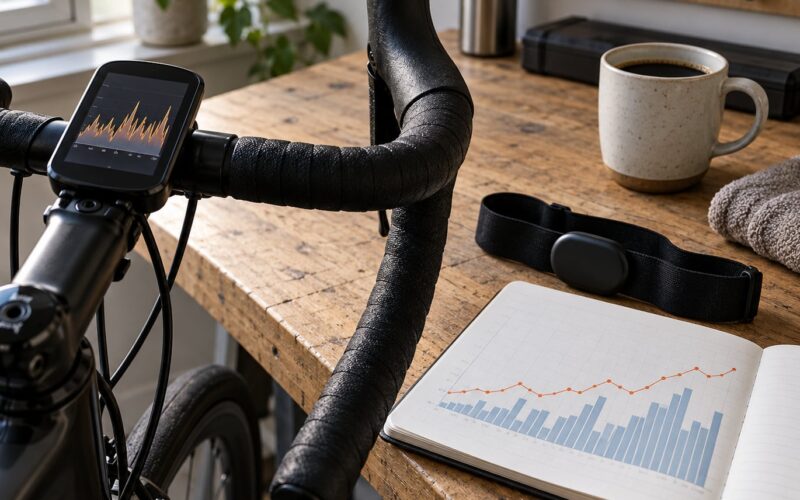
Whatever you use, it just has to be simple enough to keep doing when you are tired. Morning resting heart rate, a daily rating of leg feel out of ten, hours of sleep, and a note on mood. Four numbers, once a day, takes under a minute. That single minute is what lets you catch an over-taper two days out instead of on the start line.
Step-by-Step: How to Taper Before a Big Ride
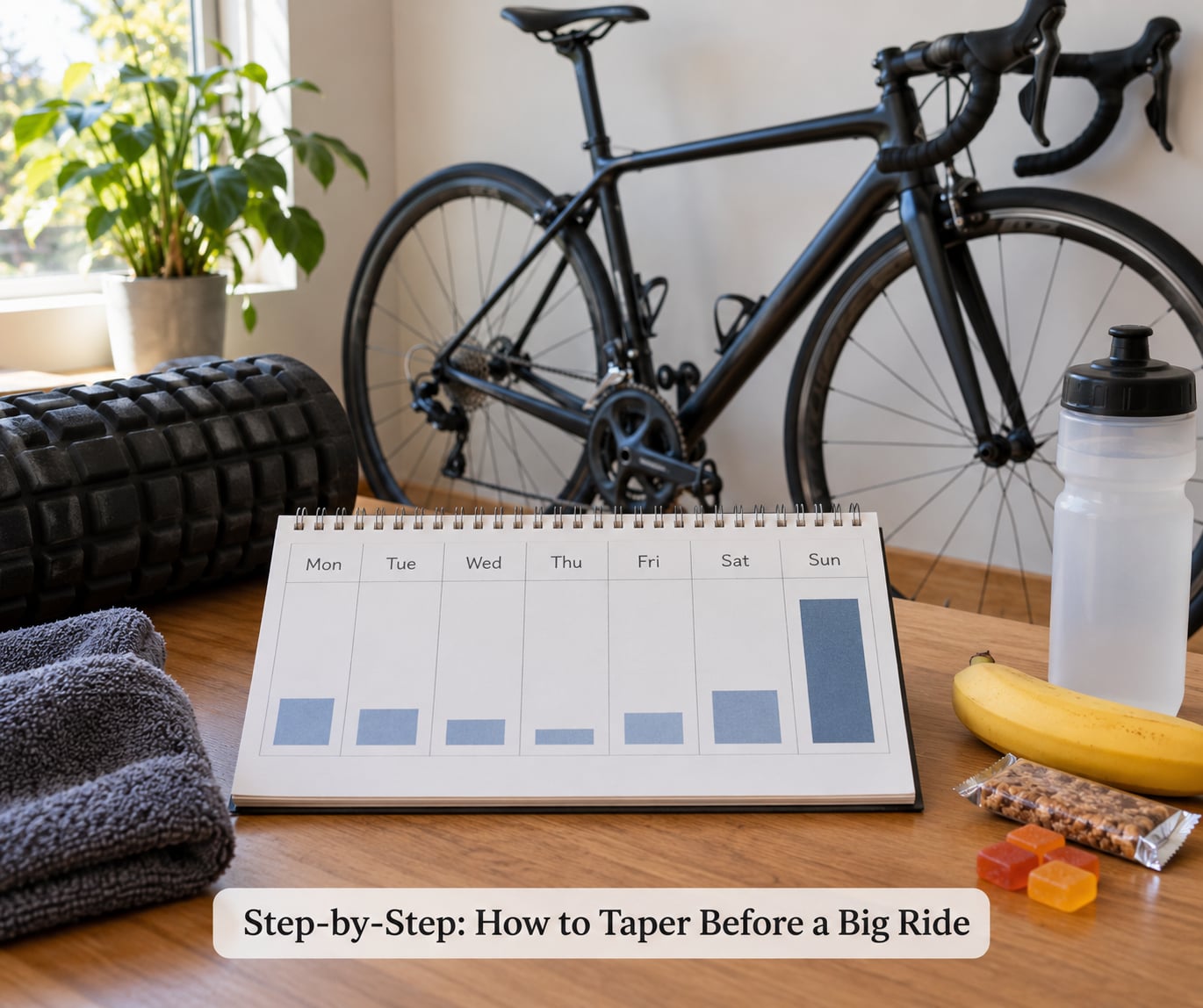
Step 1: Set the Race-Day Target and Work Backward
Count backward on the calendar. Most recreational riders land on a 10 to 14 day taper, and the research on endurance events broadly points at 8 to 14 days as the useful window. Shorter than 8 days and you are often still carrying fatigue. Longer than about three weeks and you start giving back real fitness, which is the fear that drives a lot of bad taper decisions.
Adjust the length with three inputs. Distance pushes it longer: a double-century deserves the full fortnight, a 60 km club ride does not need one. Your normal weekly volume pushes it deeper: the more you ride, the more fatigue you have to flush. How long it has been since your last long ride pushes it the other way, because you need enough short sharpening sessions to feel rhythmic again.
A useful rule for club riders: if your longest ride in the past six weeks was four hours, aim to still ride 75-90 minutes within five days of the event. If it was eight hours, 45-60 minutes is plenty. You are looking for the feel of a bike, not the load of a training block.
Step 2: Reduce Volume, Keep Some Intensity
Volume means the total time you spend on the bike. That is the dial to turn, and the research is unusually consistent here: reducing training load by 40-60% produces the biggest performance return, and a nonlinear reduction, where the cut deepens as the event approaches, tends to beat a flat cut.
Intensity is the dial to hold. A short openers session, 3-5 minutes at race effort, keeps your neuromuscular system sharp and reminds your legs what fast feels like. Many riders report that a primer the evening before does more for their confidence than a whole week of easy spinning, because the legs have been quiet for too long and the first half hour on the road feels strangely uncoordinated until it doesn’t.
Frequency can mostly stay the same. If you ride five days a week, ride five days a week, just shorter. Riders who keep their usual ride days and simply trim the duration tend to report far less anxiety than riders who suddenly have free weekends. The habit matters more than the hours at this stage.
A fourteen-day version, based on a rider who normally does 10 to 12 hours a week:
| Days Out | Ride Type | Duration | Key Point |
|---|---|---|---|
| 14 to 12 | Steady endurance | 90 to 120 min | Start the volume cut here, about 30% down |
| 11 to 9 | Endurance plus a touch of intensity | 75 to 90 min | Include one 3-5 min effort at race effort |
| 8 to 7 | Easy spin with 4-6 short accelerations | 60 min | Last real workout with meaningful load |
| 6 to 4 | Easy endurance | 45 to 60 min | Conversational pace the whole way |
| 3 | Primers | 30 to 40 min | 4-5 x 30 sec at race effort, full recovery |
| 2 | Very easy spin or nothing | 20 to 30 min | Prep the bike, lay out kit, eat well |
| 1 | Rest or gentle shakeout | 0 to 20 min | Sleep, hydrate, stay off the pedals |
Two patterns show up when people describe their tapers. A step taper drops straight to the final-week load and stays there, which suits riders who get anxious about doing too little. An exponential taper cuts a modest amount at first, then sharply in the last week, which is the pattern most of the published work supports. Whichever you pick, the deep cut belongs in the final seven days, not the first.
Step 3: Keep the Final Week Genuinely Easy
The last week is where riders sabotage themselves. Legs feel heavy and odd, often around days three to five, and the instinct is to go ride hard to make them feel normal. That is the wrong read. Heavy legs mid-taper are a normal sign that fatigue is clearing, and pushing through them re-loads the system you just emptied.
Keep everything conversational. You should be able to speak in short sentences at the top of the ride, and the whole session should finish feeling like you did too little rather than too much. If your power file shows threshold-level numbers on a taper-week ride, something went off plan.
Rest days are fine in the final three days, but total immobility for a full week leaves many riders describing their legs as dead on the start line. If you feel better moving, do 20 easy minutes. The goal is loose legs, not a fitness test.
Step 4: Protect Sleep and Recovery
Fatigue is not only muscular. Poor sleep, travel stress and work pressure all count as load, and during a taper those sources often get bigger because the training stress suddenly drops and your nervous system notices the space. This is the window where the classic taper tantrum shows up: restless, slightly irritable, convinced you are losing fitness.
Keep your normal sleep and wake times, even on a shifted race schedule. Aim earlier if you can, and treat pre-event nights as the priority sleep of the week. Skip the hard strength session, skip anything that leaves you sore. Mobility work and walking are fine and cheap.
Use your four tracking numbers to make a call rather than guessing. Rising resting heart rate of five or more beats over several days, sleep quality down, and legs that feel worse rather than better are signs you cut too much. The fix is almost always one short ride with a few accelerations, not more rest. If those markers look fine but you feel sluggish, that is a different story, and a short primer usually settles it.
Step 5: Practice Fueling Without Overeating
Do not cut carbohydrates during the taper. If anything, your intake per hour of eating goes up slightly in the last three days while total calories come down, because you are riding less. The research on glycogen supercompensation for longer endurance efforts is well established enough that going low-carb in the final week is a strange thing to choose.
A gallon of water weight in the days after you stop training is normal for most riders. It is stored carbohydrate and the water that travels with it, and it comes off on its own during race week. Weighing yourself daily and panicking about a kilo or two is the fastest route to an under-fuelled start.
Practice your race breakfast two or three mornings out. Same food, same timing, same amount of fluid. Then rehearse the on-bike plan at a shorter distance: 60 to 90 minutes, the exact products, the exact number of calories per hour. Find out now whether the thing you have been carrying all summer actually sits well, not at 140 km in the heat with a clock running.
On a 100 km ride, most riders land somewhere around 60-90 g of carbohydrate per hour, higher in cool conditions and lower when the heat is bad, and a beginner should start at the lower end. Whatever your number, test it first.
Step 6: Prepare the Bike and Logistics
The final two days are for admin, and admin is what people leave to the morning of the event. A bike service, tyre and brake check, chain wear check, and a full cassette and brake pad inspection if you have not done one recently. Then ride the bike, on the course if you can, and listen for anything new: a creak, a rub, a noisy freehub.
Pack the day before and lay it out. Base layers, bib and jersey, socks, gilet, gloves, a spare pair, lights if the start is dark, pump, tubes, tire levers, multitool, chain quick link, cash or a card for the aid station. Then the food: the number of gels or bars you plan to eat, plus extras, plus one thing you would actually enjoy that you do not normally train on.
Check the route details you might not remember. Where the aid stations are, whether the last one closes early, whether there is a bail-out option, and what the cutoff does to your plan. Work out the ride there, the parking, and the time you need to be at the start for a 7 a.m. roll-out. A tidy evening here is worth more than another 20 km.
Step 7: Race Day and the First Week After
On the morning, eat the breakfast you rehearsed and drink more than usual with the meal. Skip anything new, including that coffee shop idea you had at 5 a.m. Most riders settle into their first hour slower than they should because the start is crowded and the pace is chaotic. Sitting in the pack for the first 30 to 45 minutes costs almost nothing and saves a lot.
Hold your fueling rate from the first hour rather than waiting until you are empty. The riders who blow up in the last third are usually the ones who skipped early, felt fine, and then hit the wall at kilometre 110. Use the guide that says fresh riders finish strong.
Afterwards, do not decide anything dramatic. Eat properly, ride a short easy spin the next day if you feel like it, and expect the legs to be strange for two or three days. A long ride can take a week to fully absorb. Return to normal training gradually: about half your usual volume in week one, building from there. Going back to a hard week straight away is how a good ride turns into three weeks of feeling tired.
Common Mistakes That Ruin the Week
Treating the taper as a full break. Six or seven days off leaves riders stiff, flat and slightly panicky. Fix: ride five or six short sessions instead. Keep the habit, shrink the hours.
Adding a hard validation effort two or three days out. It feels reassuring and it reliably costs you more than it gives. A short opener wakes the legs up; a full threshold session loads them. Fix: 3-5 minutes at race effort, not 30.
Cutting intensity along with volume. Easy-only riding for two weeks leaves some riders without race rhythm. Fix: keep brief race-pace touches in days 12 through 7 out, then stop adding load and just keep them short.
Going low on carbs to feel lighter. You will start under-fuelled, and the weight you lost is mostly water you needed. Fix: keep carb intake per hour steady or slightly higher while total calories drop with your riding.
Chasing a training plan instead of your own data. A generic taper ignores your baseline. Fix: cut 40-60% from your own recent average, not from an ideal week you have never actually hit.
Panicking about detraining and adding mileage. A week or two off costs very little fitness. Fatigue costs a lot. Fix: trust the two-week window, and if your tracking numbers are flat and your legs feel springy, go ride.
Arriving at the start with logistics unsolved. A flat, a missing pump or a wrong start time wipes out weeks of good work. Fix: bike checked, kit packed, route reviewed, all of it done on day minus two.
Frequently Asked Questions
How many days before a big ride should I start tapering?
Most riders do best with 10 to 14 days, and the useful range in the research on endurance events runs from about 8 to 14 days. Longer distances, higher normal weekly volume and a gap since your last long ride all push you toward the longer end. A century or fondo justifies the full fortnight; a shorter club ride does not need one.
Should I keep training hard during the taper?
No, not hard in the usual sense. Cut duration hard, keep intensity in small doses. A few minutes at race effort every five to seven days keeps your legs sharp, and a short primer the day before helps, but a full threshold workout in the final week works against you. The goal is to shed fatigue while keeping the feel of going fast.
What if I feel sore during the final week before a big ride?
Some soreness and heavy legs in the middle of the taper are normal, often peaking around days three to five, and they usually clear. Gentle riding and mobility work will do more than another hard session. If soreness is sharp, localised or paired with a rising resting heart rate and poor sleep, that is different, so ease off and if it persists, have a clinician look at it.
Should I cut carbohydrates during taper week?
No. Keep your carbohydrate intake per hour steady or slightly higher in the final three days while your total calories drop along with your riding. Carbo loading for longer endurance efforts is well supported, and a small weight gain of one or two kilos is usually glycogen and water rather than fat. Starting a long ride under-fuelled costs far more than starting a kilo heavier.
How much should I ride in the last three days before an event?
Very little. Most plans put one short spin of 30 to 40 minutes three days out with a few accelerations, nothing or 20 easy minutes two days out, and rest on the day before. If your last long ride was four hours or more, staying in the 45 to 60 minute range through race week is plenty to keep your rhythm without adding fatigue.
When should I return to normal training after a long ride?
Give it a few days and go back gradually. Ride easy the day after if the legs feel reasonable, expect two or three days of strange legs, then return at roughly half your usual volume for the first week and build from there. Many riders feel good for a day and then hit a delayed fatigue wall, so a conservative first week saves the rest of the season.
Conclusion
Pick the event date, put it in your calendar, and count back fourteen days. Cut your riding time by 40-60% from your own recent average, keep a few short efforts at race pace, and leave the last three days almost empty. Then protect sleep, keep eating your carbs, test the food, check the bike and pack the bag.
That is the whole method. It works because fatigue fades faster than fitness, and the only job you have in the final fortnight is to let one go while holding on to the other.