Functional threshold power is the highest average power output, in watts, a cyclist can hold for roughly an hour without fatiguing. Nobody tests it by riding a steady hour, so in practice it gets estimated as 95% of your average power from a hard 20-minute effort, and that one number then sets every training zone you use for the rest of the season.
That is the whole definition. The rest of this page covers what the number actually measures in your body, how to test it without a laboratory, which test method fits your setup, and why the percentage zones that come with it don’t suit everybody equally.
Table of Contents
- What functional threshold power actually means
- How is functional threshold power different from maximum power?
- Is FTP a real physiological threshold?
- FTP compared with other cycling power metrics
- How Is Functional Threshold Power Measured?
- How is functional threshold power calculated? The 95% rule
- Which FTP Test Method Should You Use?
- What Do Your FTP Power Zones Mean?
- Why percentage zones can mislead riders with high heart rate at low watts
- How Do You Use FTP Without Overtraining?
- Why Does Functional Threshold Power Change?
- Frequently Asked Questions
- Is FTP the same thing as maximum power?
- How often should I retest my functional threshold power?
- Why is my FTP different between my indoor trainer and bike computer?
- Should I make every ride harder than my FTP?
- How much should FTP increase as a cyclist gets fitter?
- Can I calculate FTP from a 20-minute or 30-minute test?
- What to Do First
What functional threshold power actually means
In short: functional threshold power (FTP) is the highest average power output, in watts, that a rider can sustain for approximately one hour without the power dropping off. It is usually derived from a 20-minute all-out test and used as the multiplier for your six training zones.
The term itself started as a coaching convention rather than a laboratory measurement. Early coaches wanted a single repeatable number that could replace the fuzzy talk about “hard” and “comfortable” paces, so they anchored it to a one-hour effort and called it FTP. The one-hour window is a convention, and that matters when you read anyone claiming your FTP is a precise physiological boundary.
What FTP does capture well is repeatable effort. Ride below your FTP and the watts hold steady, cadence stays where you want it, and breathing stays under control for hours. Push a little above it and fatigue arrives quickly and quietly at first, then the power starts sliding within minutes. That behaviour, not an exact physiological line, is what makes the number useful.
How is functional threshold power different from maximum power?
Maximum power is what you can produce for a few seconds on a steep ramp or in a sprint. A fit rider might see three to five times their FTP for a handful of seconds, then need several minutes to recover. FTP and maximum power measure different systems, and a rider with a huge sprint and a modest FTP is a common and perfectly legitimate combination.
This is the same reason a fast sprinter can be a mediocre time trialist. If you train intervals above your FTP every time, you will sharpen your sprint and quietly erode your hour-long power, which is the number most road riders actually need for a long event or a hilly Sunday loop.
Is FTP a real physiological threshold?
Not exactly, and knowing that saves a lot of confusion. The closest laboratory concept is maximal lactate steady state, the point where lactate production and clearance balance and blood lactate can stay near a slightly elevated but stable level. FTP sits somewhere near that region for many riders, but the correlation is loose, and research comparing different ways of estimating 60-minute power has found that taking 90% of a 20-minute average can sometimes track 60-minute power better than the familiar 95% conversion.
Treat FTP as a very consistent yardstick that you compare against itself over time, not as a switch that flips inside your muscles. The number only needs to be repeatable to be useful, and the same protocol on the same equipment on a similar day is repeatable enough for almost every rider.
FTP compared with other cycling power metrics
| Metric | What it measures | Typical test | How to use it |
|---|---|---|---|
| Functional threshold power | Highest average power sustainable for about an hour | 20-minute all-out test, or a ramp test converted with a 0.75 factor | Sets your training zones and gives you a progress number |
| Maximal aerobic power | The top of your sustainable range, roughly three to eight minutes at very high effort | A 3-minute or 5-minute all-out effort | Guides VO2max-style interval sessions |
| Critical power | The highest power you can hold for a long but finite effort, typically above 20 minutes | Field testing or a power-duration model from several efforts | Separates short-term power from fatigue resistance; rides endurance events well |
| Watts per kilogram (W/kg) | Your FTP divided by your body weight in kilograms | No separate test, it is arithmetic on an FTP you already have | The fairest way to compare riders of different sizes, especially on climbs |
| Average power | Mean power across a whole ride, whatever its length | Nothing to test | Describes a completed session; says nothing about your ceiling |
Average power deserves a warning because it causes endless arguments. A three-hour ride at 180 watts and a one-hour ride at 180 watts produce the same number, and they place completely opposite demands on your body. FTP is useful precisely because it describes a known duration, so it maps onto repeatable efforts.
Most apps and head units now model a three-zone critical power curve instead of a single FTP number, and that model is more honest about the shape of your fitness than any one number can be. Nothing wrong with keeping FTP as your zone anchor, though, as long as you know what it is doing and what it is not.
How Is Functional Threshold Power Measured?
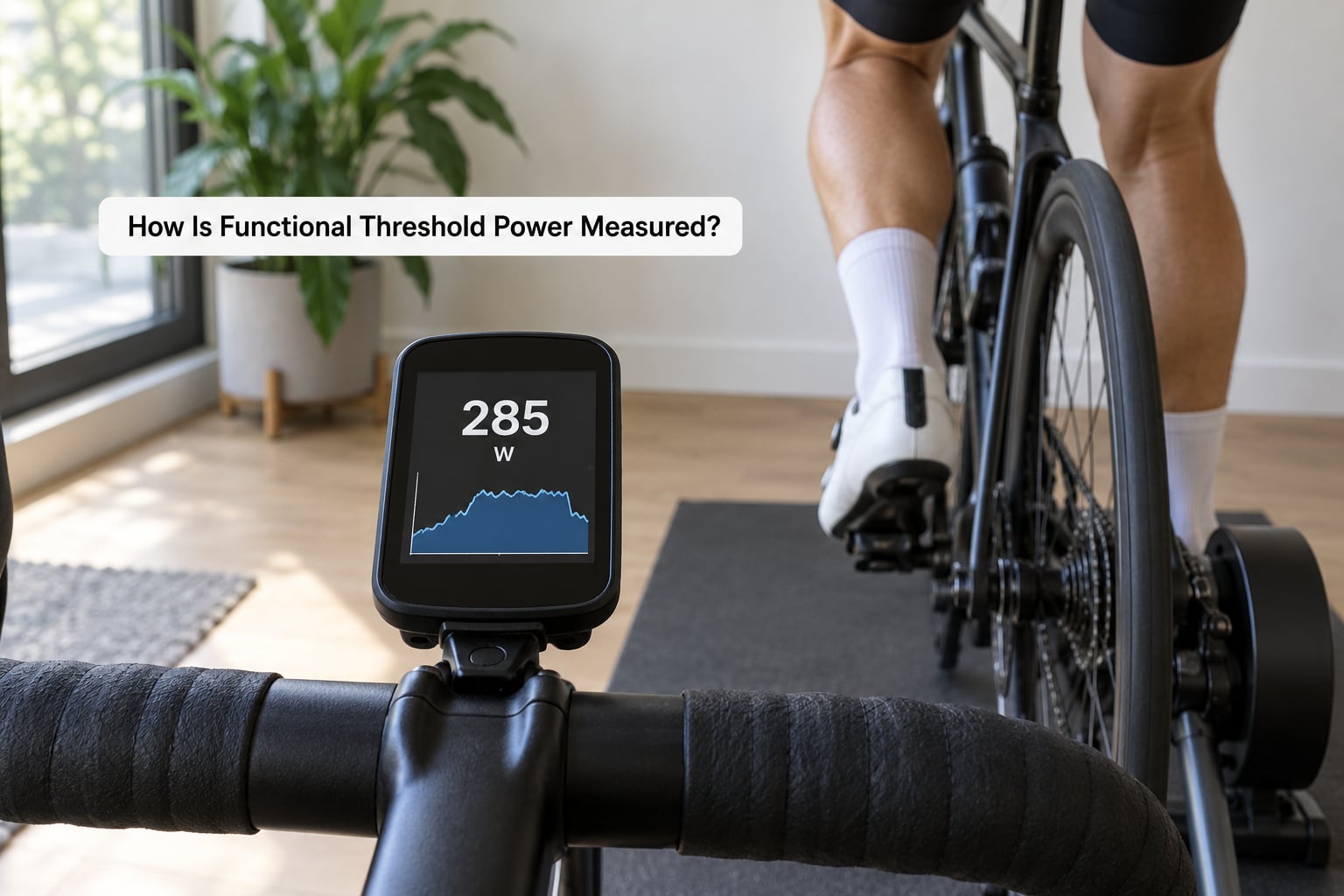
You need two things: a power meter or a smart trainer that reports watts, and a willingness to suffer for about half an hour. Most riders get a usable answer on the second attempt, and the data you need is simply the average power for one timed effort, recorded in watts.
Conditions matter more than people expect. The same rider can test 12 watts apart between a hot afternoon and a cool one, and a tired rider can test 20 watts low. A test taken after a rest day, on familiar equipment, with the same tyre pressure, stands a much better chance of matching the last one.
How is functional threshold power calculated? The 95% rule
The 20-minute all-out test is the protocol almost every platform uses by default, and the reason is practical. Twenty minutes is long enough to average out pacing mistakes and short enough that most riders can hold a genuinely hard effort for the whole thing, whereas an hour of all-out riding is miserable and hard to pace.
- Warm up for 20 to 30 minutes. Easy spinning, then a few short ramps to raise your temperature and get blood moving. A cold start produces a lower number than the same rider would produce warmed up.
- Settle for the first few minutes of the effort. The temptation is to sprint the opening minutes, and every rider who does it comes off the bike with a lower average. Aim to settle at a pace that still feels slightly too fast.
- Hold steady for the remaining minutes. Small, boring, consistent. If you are counting the seconds at minute eight, you went out too hard.
- Cool down for 10 to 15 minutes. Easy spinning until your breathing comes down. Skipping this leaves you cooked for the evening.
- Multiply the 20-minute average by 0.95. That gives your estimated FTP.
A worked example: if your 20-minute average power comes out at 275 watts, your estimated FTP is 275 times 0.95, which is 261 watts, so about 260. That 260-watt figure is what you enter into the app, and the zones fall out of it from there.
Most modern platforms will detect the effort and update your number automatically, and some will flag the result if it looks implausible. If you are in control of the test yourself, a 20-minute average that suddenly jumps 60 watts is usually a mis-timed interval, a power spike on a pedal stroke, or a genuinely different day, so check the ride file before you believe it.
Which FTP Test Method Should You Use?
| Method | Advantages | Limitations | Best for |
|---|---|---|---|
| 20-minute test on a trainer | Repeatable, weather-proof, pacing is stable because the terrain does not change | Hard to hold for 20 minutes, and some riders find the mental side worse indoors | Anyone with a smart trainer, especially in winter or in a hot climate |
| Ramp test | Short, exhausting, and gives a number even if you are not fresh | Convert the result with a 0.75 factor, which adds a layer of estimation on top of estimation | Riders without a power meter, or anyone who wants a rough number fast |
| Outdoor field test | Measures your power on the surface you actually ride, with real wind and real road | Wind, corners, traffic and heat all move the number around | Riders who train outdoors and want realism over precision |
| Calculator or platform estimate | Free, instant, and a useful placeholder for the first few weeks | Built on population averages, so error grows the further you sit from them | New riders deciding whether a power meter is worth buying |
A ramp test works by increasing resistance in fixed steps until you crack, then the software reads off the power you held in the final minute or two. Multiply that number by 0.75 to estimate FTP, so a 320-watt ramp result gives you roughly 240 watts of FTP. It is a rougher estimate than the 20-minute test, and plenty of riders manage a full 20 minutes but struggle to push a ramp to genuine failure, which is exactly what makes the shorter test popular in January.
If you ride outdoors, a common field protocol is to do the 20-minute effort twice on the same flat, straight stretch, a week or two apart, and take the better result. The second attempt benefits from knowing the first one, and the aim is not a laboratory measurement, it is a number you will still recognise in six months.
What Do Your FTP Power Zones Mean?
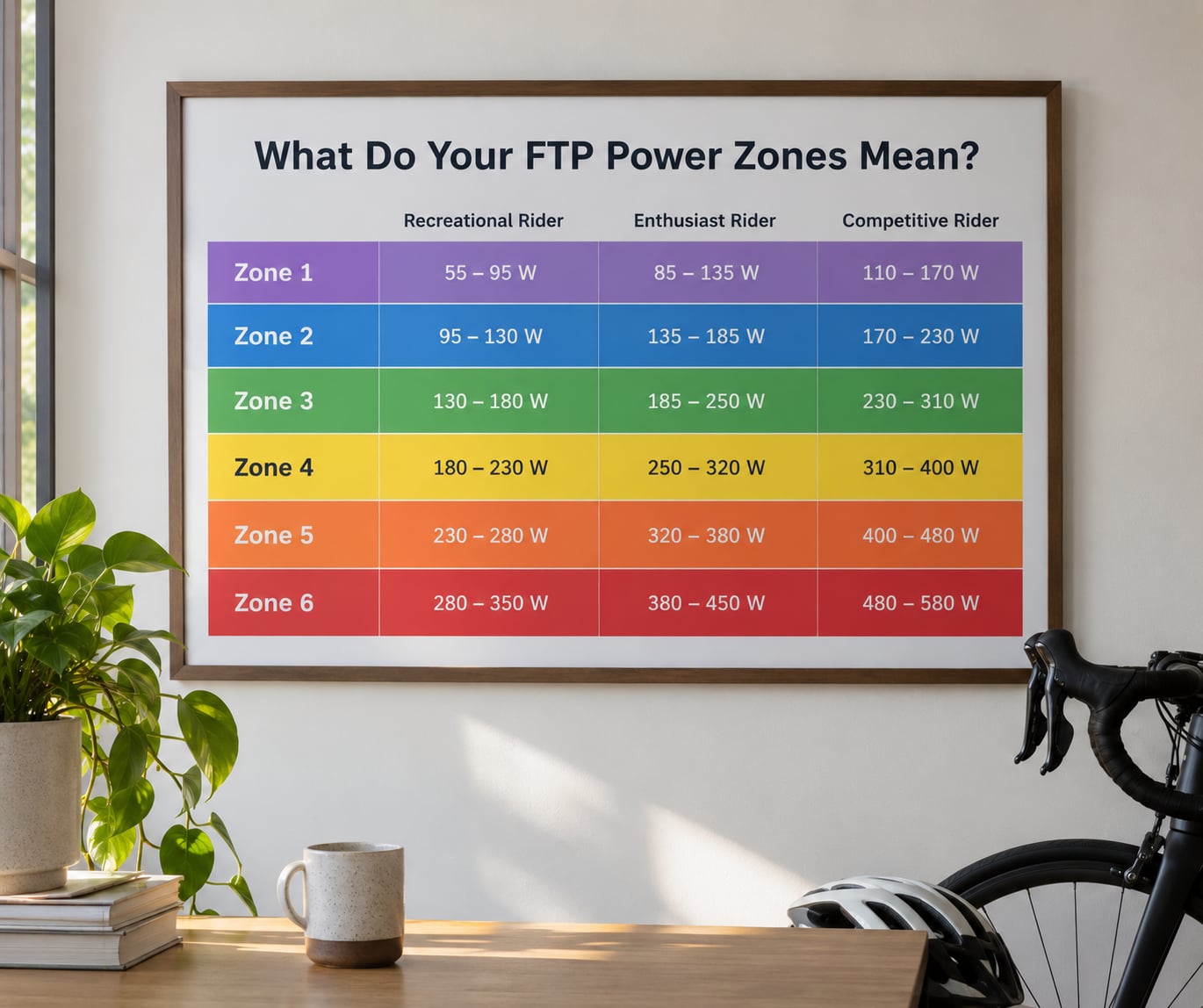
Your zones are simply percentages of FTP. The classic six-zone model splits the range from below your threshold to well above it, and every app on the market uses some version of it, though the exact boundaries differ a little between platforms and coaches. If your FTP is wrong, every zone derived from it is wrong in the same way, which is why riders with stale numbers end up training at intensities that do not match the workout they think they are doing.
| Zone | Percent of FTP | Watts at 260W FTP | What it is for |
|---|---|---|---|
| Zone 1, active recovery | 0 to 55% | 0 to 143W | Cooling down, spinning between hard efforts, days off the bike |
| Zone 2, endurance | 56 to 75% | 146 to 195W | Long steady rides, recovery rides, the bulk of your weekly hours |
| Zone 3, tempo | 76 to 90% | 198 to 234W | Sustained efforts, faster group rides, improving your ceiling for “comfortably hard” |
| Zone 4, threshold | 91 to 105% | 237 to 273W | Hard climbs, racing, riding with riders who go hard on Saturday |
| Zone 5, VO2 max | 106 to 120% | 276 to 312W | Short intervals of three to five minutes with real recovery between them |
| Zone 6, anaerobic | 121 to 150% | 315 to 390W | Very short sprints and neuromuscular work, a small slice of the week at most |
Change the percentages, not the structure, when your goal changes. Century and gran fondo riders benefit from spending more of the ride in Zone 2 and protecting that position late on, while a rider chasing a club race time can push Zone 3 up slightly for long efforts. For climbing, work in Zone 3 for a long ramp and Zone 4 for short pitches, because holding Zone 5 up a hill is a contest you will lose on most Sundays.
Why percentage zones can mislead riders with high heart rate at low watts
The most common complaint on the training forums runs like this: a rider sets Zone 2 at 60% of FTP, rides there, and still watches their heart rate climb out of range after fifteen minutes. It is one of the most repeated questions on cycling forums, and the honest answer is that the zone is probably fine and something else is driving the heart rate up.
Aerospace research on lactate steady state shows that the power-to-lactate relationship is not a single fixed line for everyone, and the point where lactate starts accumulating noticeably varies by several percent between riders at the same FTP. Heat, dehydration, low sleep, an illness you are pushing through, and simply having poor riding economy can all push heart rate up at an unchanged, perfectly appropriate power. The power is not wrong, and the zone model cannot fix a fitness or recovery problem.
What helps is a heart-rate-based intensity check alongside the watt target, plus a cheap test of endurance. Ride the same long route at the same power on two different days, early in the ride and again in the final hour, and compare. If your heart rate sits several beats higher in the second half on a cool morning with the same terrain, your durability is the limit, not your FTP.
How Do You Use FTP Without Overtraining?
FTP is most useful as a ruler for deciding how hard a session should be, not as a target to chase. The biggest mistake is trying to prove the number every week, which is a fast route to a plateau and a very tired cyclist.
Put the bulk of your riding in Zone 1 and Zone 2. For a weekend rider, that usually means most of the long ride spent near 65 to 75% of FTP with the pace steady enough to hold conversation in short sentences. Add one genuinely hard session a week, in Zone 4 or Zone 5, and keep the rest genuinely easy. Most riders who plateau are not short of intensity, they are short of easy volume.
For long events, aim to arrive in the final quarter with something left. A century ridden almost entirely in Zone 4 is a common and very expensive mistake, and riders who do it usually report the same thing afterwards: the numbers looked fine and the ride felt terrible. Aiming closer to 70 to 75% of FTP for most of a 100-mile ride leaves room for a strong finish, and for most recreational riders that is worth more than chasing a slightly faster average.
Ramp the load gradually. A single test, then a few weeks of steady endurance work with one hard session, then another test, is a cycle that works for years. Big jumps in volume or intensity in the same week as a test is the pattern that ends seasons early, and forum threads about stalled or dropped FTP usually have the same story underneath them, a hard block layered on top of a hard block.
Why Does Functional Threshold Power Change?
Your number moves, and most of the movement is not a change in fitness. Knowing which is which saves you from rewriting your zones every time a test feels strange.
- Fitness. The real gain, and the only one worth celebrating. It arrives over months of consistent riding, not weeks.
- Fatigue and form. Testing hard without recovering produces a low number that has nothing to do with your ceiling.
- Weight. A lighter rider shows a higher W/kg for the same absolute watts, so two tests at different body weights are not directly comparable.
- Altitude and weather. Air density drops with altitude, and heat and humidity raise heart rate at identical power. Both push the number down.
- Motivation and pacing. A rider who is flat outranks a rider who could go further, and the estimate carries that difference into your zones.
- Equipment and setup. Tyre pressure, a dry chain, a bent derailleur, cleats that have lost their release, or a saddle that has moved will all eat watts quietly.
- Test variability. Even done properly, repeated tests land within a few percent of each other. Treat differences smaller than that as noise.
Retest roughly every four to six weeks during a build phase, every eight to twelve weeks in a base phase, and always after a break of several weeks away from the bike. Riders often avoid retesting because they fear a worse number, then train on stale zones for months, which is a strange trade. If a result looks wildly wrong, repeat the test on comparable conditions before you change anything, because a bad day is far more common than a sudden 50-watt jump.
On improvement rates, forum threads are full of wildly different numbers, so take the soft version. A first year of steady structured riding commonly brings single-digit percentage gains, and after that a few percent per season is a reasonable expectation for most recreational riders. A first-season number in the low hundreds is normal and not a failure, and plenty of riders who test in the 140s this year are testing in the 180s two seasons later simply by riding more often.
Frequently Asked Questions
Is FTP the same thing as maximum power?
No. Maximum power is what you produce for a few seconds, typically three to five times your FTP on a steep ramp, and it trains sprint and anaerobic systems. FTP is the highest average power you can hold for about an hour. They train different things, and a rider can be strong at one and middling at the other without either number being wrong.
How often should I retest my functional threshold power?
Every four to six weeks during a build phase and every eight to twelve weeks in a base phase, plus once after any break longer than a few weeks. More often than that and you are mostly measuring noise, since day-to-day variation of a few percent is normal. Retest on similar equipment, in similar weather, and preferably on a fresh day.
Why is my FTP different between my indoor trainer and bike computer?
Usually it is not your fitness. Trainers hold resistance constant while the road changes gradient and wind, and fans, tyre pressure, drivetrain condition and sensor accuracy all shift the reading slightly. A mismatch of a few watts is normal. A gap of 20 watts or more usually means a different protocol, a different day, or a power calibration worth checking.
Should I make every ride harder than my FTP?
No, and this is the most common way riders wear themselves out. Most of your weekly time belongs in Zone 1 and Zone 2, with one hard session a week around Zone 4 or Zone 5. If every ride sits above your threshold you will get slower, not faster, and a long event ridden mostly above FTP usually ends with nothing left for the final hour.
How much should FTP increase as a cyclist gets fitter?
Expect single-digit percentage gains in a first year of consistent riding, and a few percent per season after that, provided the training is actually progressive. FTP can also fall for reasons that have nothing to do with fitness, including fatigue, weight change, heat, illness or worn equipment, so compare numbers over months rather than weeks.
Can I calculate FTP from a 20-minute or 30-minute test?
Yes. Take the average power for the test duration and multiply by 0.95 for a 20-minute effort, which is the most widely used conversion. From a 30-minute test the multiplier is usually around 0.90 to 0.93, and from a ramp test about 0.75. The 20-minute test is the most reliable of the three, so use it when you can.
What to Do First
What is functional threshold power matters less than having one honest number and using it sensibly. Do a 20-minute test on a trainer or a flat road after a couple of easy days, multiply the average by 0.95, and write the result down with the date next to it.
Then set your zones from that number, spend the first block of training genuinely easy, and add one hard session a week without increasing volume and intensity in the same week. Retest in six weeks under similar conditions. If the new number is higher, that is real progress; if it is nearly identical, your training needs volume or recovery rather than harder efforts, and no zone table will change that.