A double century is 200 miles in a single day, and for most riders the limiting factor is not fitness but time, pacing and fueling. To learn how to train for your first double century, you need roughly four to six months of progressive riding, one long ride a week that grows toward six to eight hours, deliberate practice eating 60 to 80 grams of carbohydrates an hour, and a two-week taper. You almost never need to ride 200 miles in training, and coaches across the major endurance forums are blunt about why.
The good news is that 200 miles does not require superhuman fitness. It requires you to arrive at mile 160 still able to make a decision. Here is the plan.
Table of Contents
- What You Need
- Step-by-Step
- How to train for your first double century from a realistic baseline
- Step 1: Build a sustainable aerobic base
- Step 2: Extend your longest ride
- Step 3: Practice riding after fatigue
- Step 4: Build pacing, positioning, and group-riding skills
- Step 5: Train your fueling and hydration routine
- Step 6: Complete a dress rehearsal ride
- Step 7: Taper without losing fitness
- Step 8: Execute the double century safely
- Common Mistakes
- Frequently Asked Questions
- How long does it take to train for a first double century?
- How many miles per week should I ride before a double century?
- Should I train on back-to-back days for a 200-mile ride?
- How fast should I ride during long training rides?
- What should I eat and drink during double-century training?
- Start Your First Double Century Training Plan
What You Need
Before the first long ride, four things have to be in place: a baseline you have honestly measured, a bicycle and kit you have tested, a fueling supply you have rehearsed, and a calendar that ends on a fixed event date. That sounds obvious, but most riders who sign up for a 200 without these end up dropping out somewhere past mile 150.
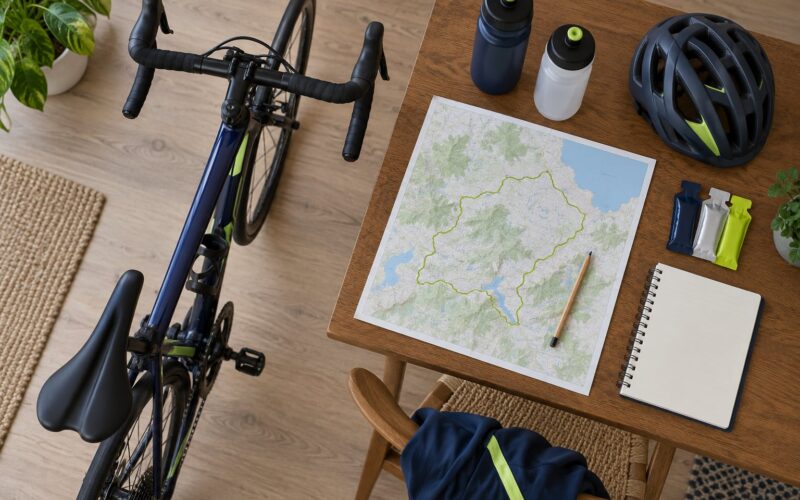
Check your baseline first. Write down your average weekly mileage for the last four weeks and the longest single ride you have done in the last 90 days. Both numbers matter, and the second one usually exposes more than riders want to admit.
Set a start date and an end date. Work backwards from the event. A 16-week plan needs about four months; a 12-week plan needs three and is only realistic if you already ride a century comfortably. Anything under 12 weeks is what forum riders call a “training block that ends with a bonk.”
Test the bicycle and the kit. Whatever saddle you plan to ride for 200 miles should already have at least 50 miles on it. A new saddle at mile 140 is how a good day turns into a day you remember badly.
Stock fuel supplies. Buy more than you think you need, because the boring part of eating every 30 minutes is doing it without thinking, and you do not want to think about it at mile 130. Budget enough for 10 to 12 hours of riding plus a spare hour of contingency.
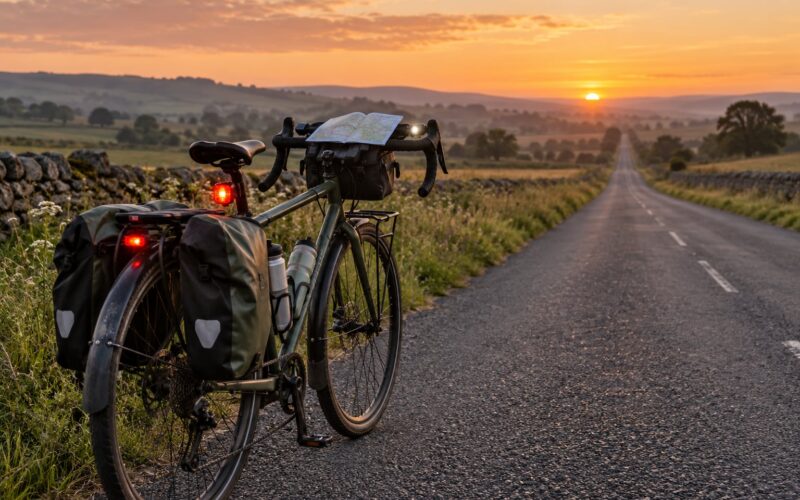
Set up backup lights and navigation. If your event finishes in daylight you can skip the second battery. If it finishes after dark, a rear light plus a backup light plus a paper route is not paranoia, it is planning.
One general note before any of this: cycling training is physical exertion. If you have a heart condition, a recent injury, unexplained symptoms, or any concern about your health, talk to a doctor or another qualified health professional before starting a program like this, and stop riding and seek medical attention if you feel unwell while training.
Step-by-Step
The plan runs in eight phases across four to six months. Each phase has a job, and doing them out of order is how riders end up tired in week 6 with an event in week 16.
How to train for your first double century from a realistic baseline
Your preparation window should be four to six months, adjusted to where you start. If your last 90 days include a 100-mile ride in about six or seven hours, 12 to 16 weeks is realistic. If your longest recent ride is 40 miles, plan 20 to 24 weeks instead of compressing the timeline.
Look at four things before you commit: weekly mileage, longest recent ride, comfort with climbing, and how quickly you recover. Weekly mileage tells you whether you can absorb volume. Longest recent ride tells you whether your body is used to hours in the saddle. Climbing comfort matters because a hilly course multiplies the cost of every surge. Recovery speed tells you whether the back-to-back work in step 3 will help or hurt.
When the numbers are thin, resist the urge to double the intensity to close the gap. Extend the calendar instead.
Step 1: Build a sustainable aerobic base
Spend the first four to six weeks making your weekly schedule repeatable. Three easy-to-moderate weekday rides, one long ride on the weekend, one or two rest days, and a repeatable order is worth more than any single hard session.
Long rides should start at whatever length you can finish without dreading the next one, typically two to three hours, and grow by 20 to 30 minutes a week. Keep the rest genuinely easy. You can hold a conversation on most of these rides, and that is the test.
Add one interval session a week once the schedule is stable: three to five repetitions of three to five minutes at hard effort with easy recovery between. It keeps your speed without stealing from the endurance work. Do not expect these early rides to run at double-century pace. That pace does not exist yet.
How to tell it worked: you finish a long ride and want another one. If you are dreading Saturday, the schedule is wrong.
Step 2: Extend your longest ride
This is where time in the saddle replaces mileage as your main measure. Progress the long ride in duration, not distance, and stop at six to eight hours no matter how far you got. A seven-hour ride covers 90 miles for some riders and 130 for others, and the hours are what your body and your stomach need to adapt to.
Build to the cap once, then hold there. Riders who push the long ride to nine or ten hours every weekend get slower, not faster, because they never recover between efforts. Coaches consistently describe six to eight hours at easy pace as the sweet spot for a first 200.
How to tell it worked: a six-hour ride at easy pace leaves you pleasantly tired rather than destroyed. Signs you should repeat a week instead of advancing include a resting heart rate that stays elevated for days, poor sleep, irritability, and a long ride that ends in the last 30 percent of your ability rather than the last 10 percent.
Step 3: Practice riding after fatigue
A double century is rarely ridden fresh. It is ridden after nine hours of eating, in the dark, with people around you. The way to rehearse that is back-to-back days: a long ride on Saturday, then a shorter ride on Sunday at genuinely easy pace.
Start with a 90-minute Sunday ride after your first four-hour Saturday. Build toward a Sunday ride of two to three hours after a six-hour Saturday. The purpose is not fitness. It is teaching yourself that you can still ride at a sane pace when your legs arrive heavy.
Keep the Sunday ride easy even though you feel fine for the first 45 minutes. That burst of freshness is exactly what gets people in trouble on the second half of event day.
How to tell it worked: you can hold your normal cadence and breathing on the second day. If your cadence collapses or you cannot stop thinking about stopping, back off the distance.
Step 4: Build pacing, positioning, and group-riding skills
Most double-century disasters are pacing errors, and they happen early. The fix is a conservative first 50 miles: sit in the easy group, take your pulls short, and stay behind anyone riding above your effort level no matter how friendly it feels to follow.
Learn where you sit in a paceline. A wheel ahead, a wheel behind, offset slightly, never overlapping. Draft only when it saves energy you actually intend to use, and understand that sitting in a group is a decision with a social cost when you need the group’s pace.
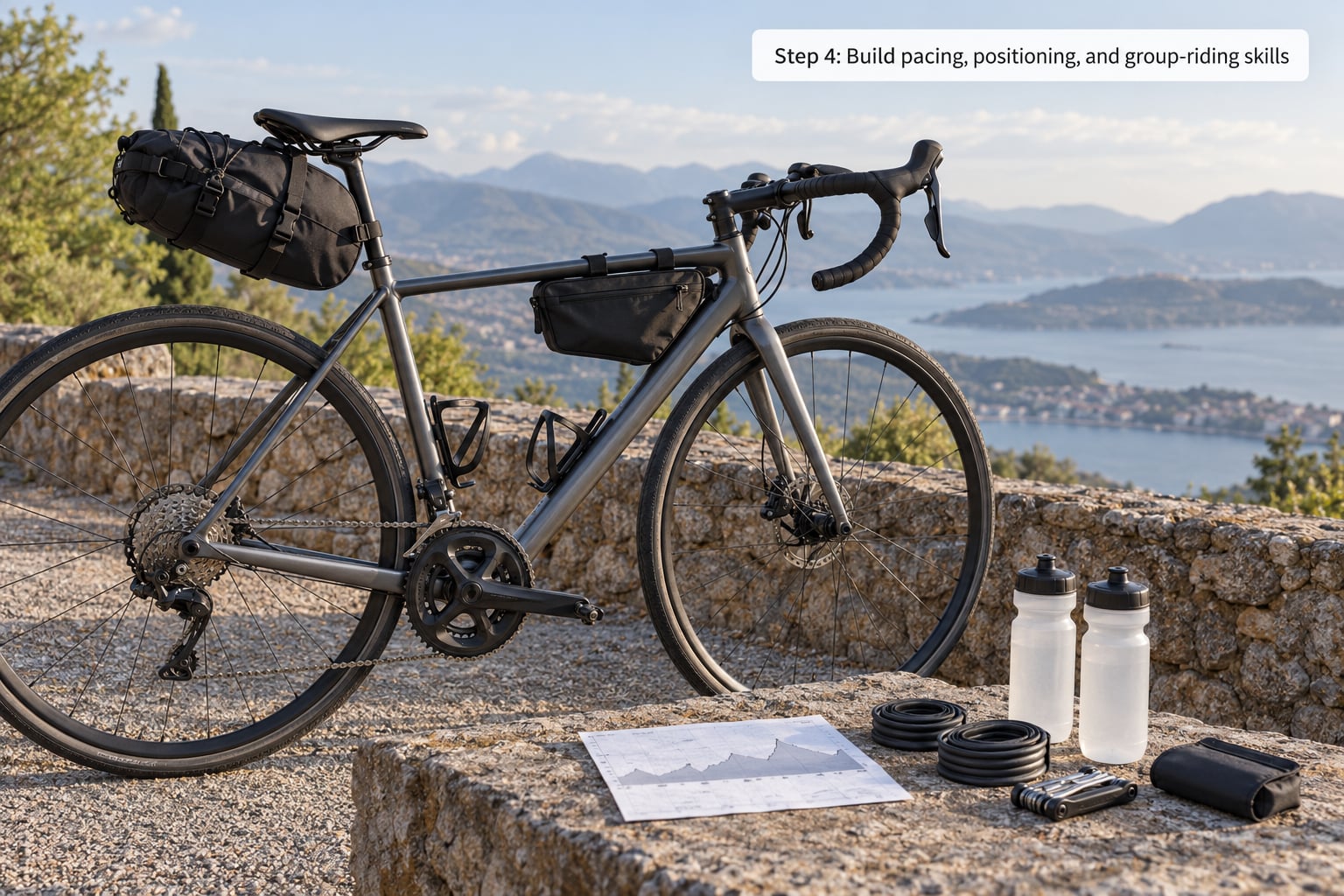
Descents and mechanicals deserve their own practice. Find a descent you can take at a controlled speed early in a training ride, before you are tired, and learn how to brake in a straight line. For mechanicals, do a roadside repair drill: tube out, tire booted, tube back in, pump to pressure, all done in under ten minutes. Riders on forums regularly talk about riding a 200 with two spare tubes, and the reason is that flats cluster.
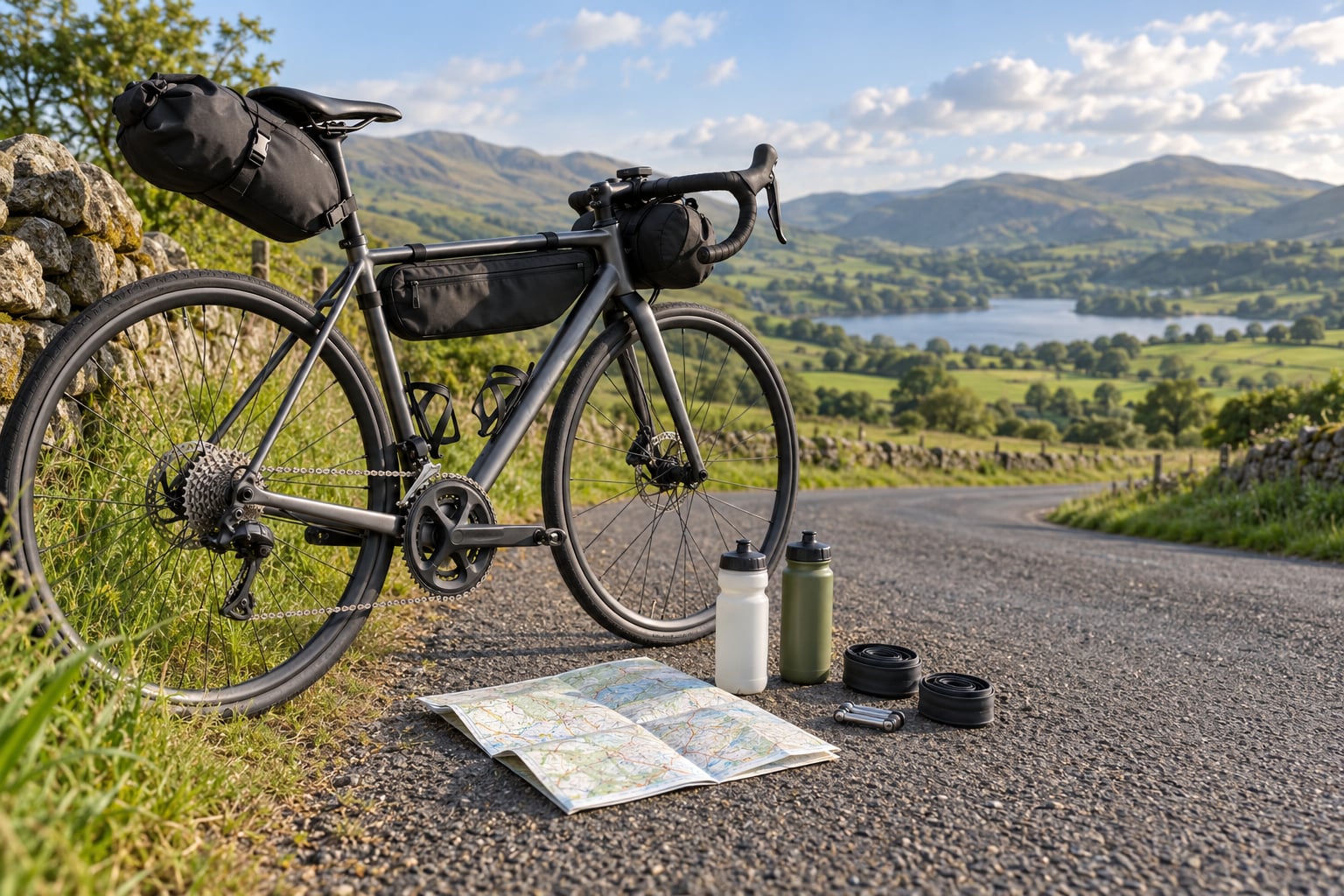
Carry two spare tubes, a compact pump, tire levers, a multi-tool with a chain breaker, and a tube of sealant if your tires take it. A single failed repair at mile 120 with nobody around is a very different afternoon from one at mile 60 with a group.
How to tell it worked: you can change a tube without searching for the patch, and you rode a full long ride without your heart rate drifting above your easy ceiling.
Step 5: Train your fueling and hydration routine
Fueling is a skill, not a preference, and it is the one most people leave to ride day. Aim to take in 60 to 80 grams of carbohydrates an hour, starting early enough that your stomach is trained well before it matters. Practice consuming that amount during every long ride from week one onward.
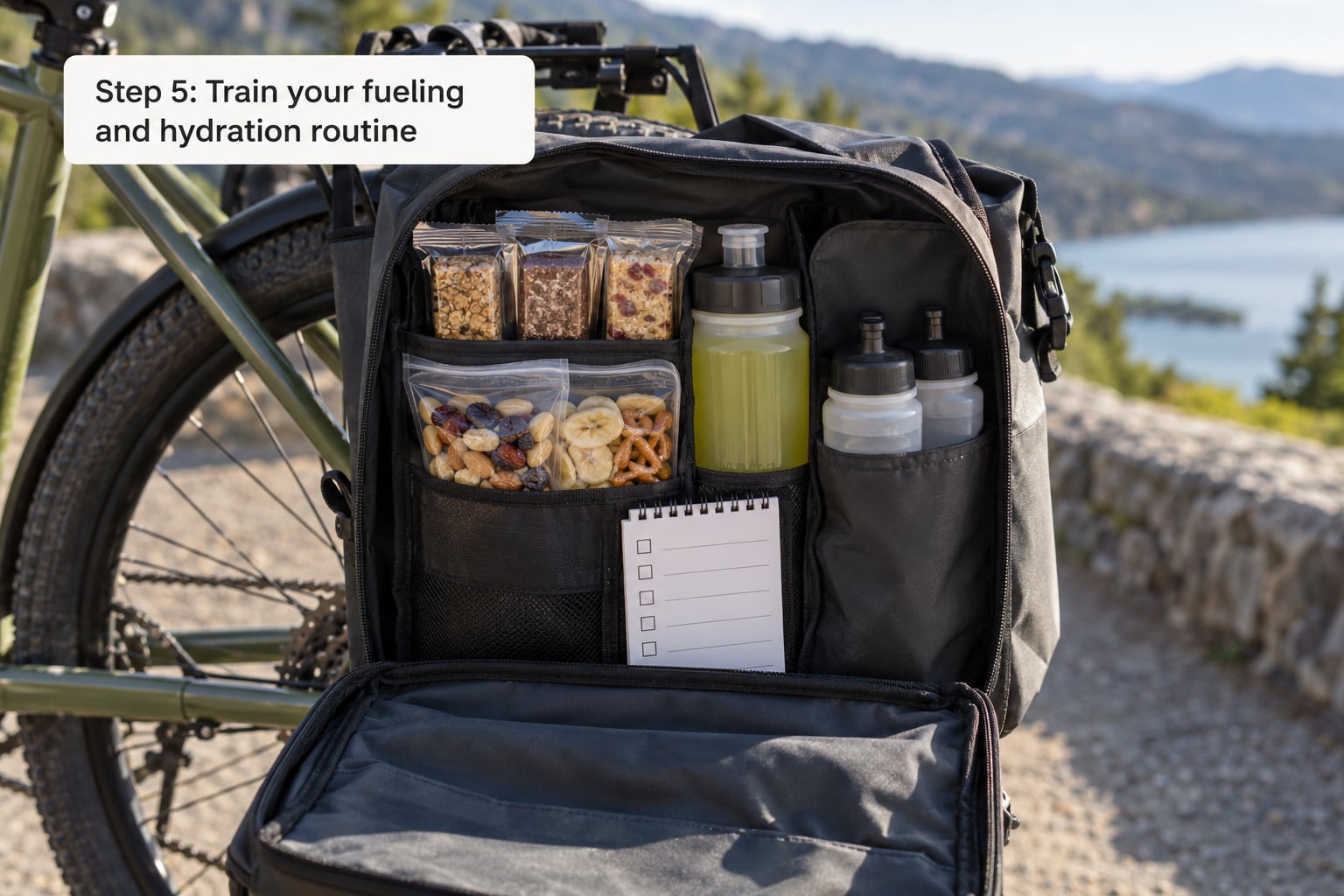
Measure real portions. Most riders underestimate. A couple of dates and a handful of raisins is not a serving, and half a bottle of sports drink is not hydration. If you use bottles, pre-mix your drink so you know the carbohydrate and sodium per bottle.
Change up the food. Palate fatigue is one of the most commonly reported causes of late bonking: riders eat the same three things for sixteen weeks, get sick of them, stop eating, and run out of fuel past mile 160. Rotate flavors and textures and keep something you genuinely like in the mix.
On ride days, aim for roughly 6 to 12 grams of carbohydrate per kilogram of bodyweight. Use a sweat test to find your fluid rate: weigh yourself before and after a one-hour ride without drinking, and the difference in kilograms approximates your hourly fluid loss in liters. Everything past that is personal diet territory, so if you have diabetes, kidney issues, gastrointestinal problems, or a history of disordered eating, ask a registered dietitian or your doctor for an individualized plan rather than copying a number from a forum post.
How to tell it worked: after a long ride you can describe what you ate at hour one, three and five without guessing.
Step 6: Complete a dress rehearsal ride
Three to four weeks before the event, do one long ride that simulates the whole day: your intended bicycle, your planned kit, your pacing plan, your actual food, and the stopping routine you expect to use. Time it, and stop at the duration you expect to need rather than pushing to a new personal best.
The goal is finishing challenged but not wrecked. If you feel destroyed, something is off: you went too hard, you under-fuelled, or your kit is wrong. All three are far cheaper to fix now.
Run the night segment too if the event finishes after dark. Starting a training ride later so you roll into the evening is the least glamorous and most useful thing you can do in the final month. Riders who never practice riding after sunset tend to describe the same experience: fine for twenty minutes, then a strange jolt of panic that costs them a lot.
Step 7: Taper without losing fitness
Cut volume by roughly 30 to 50 percent in the final two to three weeks while keeping the intensity short and sharp. A 45-minute ride with three or four hard efforts keeps your legs sharp. An eight-hour ride the week before the event does not, and it usually costs you the race.
Lower the stress elsewhere. Skip the big climbs, handle the obligations that steal sleep, and get to bed early. Your fitness is already banked; the goal now is to arrive on the start line not exhausted.
Sort the bike, organize your supplies, confirm the route and the cutoff time, and pack your bags the night before. Do not attempt a fitness test in the final week. You will produce a number that tells you nothing useful and a bad night’s sleep.
Step 8: Execute the double century safely
Start earlier than feels necessary. Most 200s begin in the dark, and the riders who finish comfortably are the ones who banked miles while everyone else waited for sunrise.
Hold the conservative pace through the first 50 to 60 miles. Eat and drink on a schedule, not on hunger. Check your rear tire pressure and your light batteries at every stop, even if everything is fine.
Stop early and often rather than pushing to empty. A ten-minute stop with food, a bathroom break and a check of your bike will do more for the last 60 miles than a 20-minute stop at mile 170 after you have already started to fade.
Say what you are feeling out loud to your group. Riders describe finishing alongside people far faster and feeling destroyed by their pace, and most of that is avoidable by talking early rather than suffering quietly.
Know your exit lines. If you develop chest pain, severe dizziness, confusion, difficulty staying upright, or a headache with nausea, stop riding and get medical help. It is a long way from anywhere, and a 200 is not worth a hospital trip.
Common Mistakes
Training by weekly mileage alone. A rider can hit 150 miles a week in six separate rides and still be unprepared, because the long day is what breaks people. Track your longest ride duration and your second-longest, not just the weekly total.
Riding every long ride hard. The temptation is to make Saturday count. The long ride is an aerobic endurance session; intervals are the speed session. Mixing them means you get neither well.
Practicing fueling only on event day. Your stomach has to meet 60 to 80 grams an hour before it does it for 90 miles. Fix: eat a planned amount on every long ride and write down what you actually finished.
Increasing duration too quickly. Jumping from four-hour to eight-hour long rides inside a week is a recipe for the soreness-and-insomnia spiral. Fix: add 20 to 30 minutes a week, and repeat a week when recovery lags.
Ignoring descents and mechanicals. A tired rider on a steep descent at speed is where a good day becomes an ambulance. Fix: practice a controlled descent and a roadside tube change every few weeks.
Tapering too little. Showing up fresh beats showing up fit. A hard week of extra riding in the final ten days buys nothing you cannot already have.
Waiting to get comfortable with darkness. If your event ends after sunset, do not meet that for the first time on the night. Fix: start one training ride at an unusual hour and ride into the evening.
A few tips that make the whole thing easier: pick a supported or calendered event for your first 200, because the feed zones and mechanical support are worth a lot; choose a course that matches your climbing comfort rather than the most scenic profile; and pick a date early in the season with a generous cutoff so you are not racing the clock as well as the road.
Frequently Asked Questions
How long does it take to train for a first double century?
Plan four to six months, which is roughly 16 to 24 weeks. Twelve to sixteen weeks works if you already ride 100 miles in about six or seven hours, because the plan only extends duration and skills. Under 12 weeks, most riders cannot build a long enough engine and arrive at the start line already tired. Work backwards from a fixed event date rather than starting whenever you feel motivated.
How many miles per week should I ride before a double century?
Most committed riders land between 60 and 100 miles a week, with a long ride of six to eight hours once a week and the rest easy. Weekly mileage matters far less than the length of your longest ride and how well you recover. If you cannot hold a consistent weekly number for eight weeks straight, adding a 200 on top of that will not go well.
Should I train on back-to-back days for a 200-mile ride?
Yes, because the hardest part of a 200 is riding in the last third of the day on tired legs. A long Saturday ride followed by a two to three hour Sunday ride at easy pace teaches you to keep cadence and fuel up when you feel tired. Keep the second day genuinely easy. If your cadence collapses or you cannot stop thinking about quitting, shorten it.
How fast should I ride during long training rides?
Easy enough to hold a conversation for most of the ride. The long session builds endurance, and hard efforts on a fatigued body mostly build the wrong thing. Keep one short interval session a week to hold your speed. On the day itself, hold a conservative pace through the first 50 to 60 miles and resist following riders who are clearly above your effort level.
What should I eat and drink during double-century training?
Aim for 60 to 80 grams of carbohydrates an hour during long rides, starting from the first hour, and about 6 to 12 grams per kilogram of bodyweight on ride days. Pre-mix your bottles so you know what you are drinking, and rotate flavors so you do not get sick of the same three foods. Ask a registered dietitian for individual advice if you have any medical condition.
Start Your First Double Century Training Plan
Four things to do this week, in order. Pick your event date, then work backwards 16 weeks. Write down your current weekly mileage and your longest ride in the last 90 days, and be honest about both. Block the weekend time for a long ride and put the Sunday recovery ride in the calendar next to it. Then buy the food, the tubes and the spare tubes, and do the first long ride at easy pace.
Do not do a 200-mile training ride. Train the hours, the eating, the darkness and the patience, and 200 miles takes care of itself.