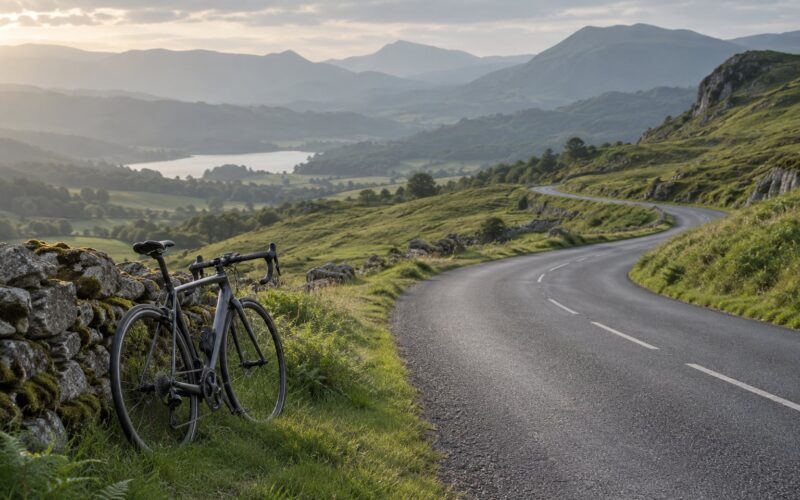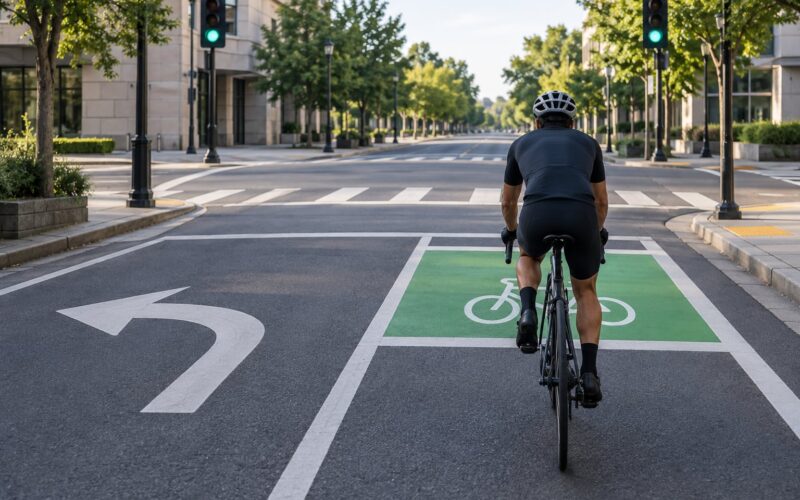
Ride on roads with no shoulder by holding a straight line about 0.5 to 1.0 metre from the edge of the pavement, far enough in that you can steer around gravel, drain grates and cracks without crossing into traffic. Move toward the centreline and take the lane whenever a driver behind you cannot pass with at least 3 feet of clearance. That single rule, applied consistently, turns a road with no shoulder from a hazard into a manageable one.
Most riders who dislike these roads make the same mistake. They hug the white edge line out of politeness, which puts them exactly where debris collects, where they are hardest to see in a mirror, and where a driver drifting half a metre toward the shoulder has no room left to correct.
The techniques below are what I use on rural two-lane roads with a posted limit of 45 to 55 mph, and they are the ones experienced riders describe in the BikeForums and r/bicycling threads on the same problem. Updated for 2026, the numbers are still the numbers.
Table of Contents
- What You Need to Ride on Roads With No Shoulder
- Route research
- Bike setup
- Visibility gear
- Repair kit and a fallback
- Step-by-Step: Positioning, Traffic and Hazards on a Shoulderless Road
- 1. Inspect the Route and Check the Road Conditions
- 2. Choose a Visible and Predictable Position
- 3. Ride in Single File with Clear Spacing
- 4. Select a Line That Accounts for Traffic and Debris
- 5. Pass Only When the Road and Group Allow It
- 6. Use a Simple Hazard and Emergency Plan
- Common Mistakes Riders Make on Roads With No Shoulder
- Riding in the gutter pan
- Holding a line that is too close to the edge out of politeness
- Never taking the lane
- Letting a group stretch out
- Waiting for eye contact before moving
- Ignoring the legal framing
- Frequently Asked Questions
- Where do you ride a bike if there is no bike lane?
- How far from the curb should cyclists ride?
- When should a cyclist take the lane?
- Is it legal to ride on the shoulder of a road?
- What can’t you do on a paved shoulder?
- How do I feel safer cycling on a dangerous road?
What You Need to Ride on Roads With No Shoulder
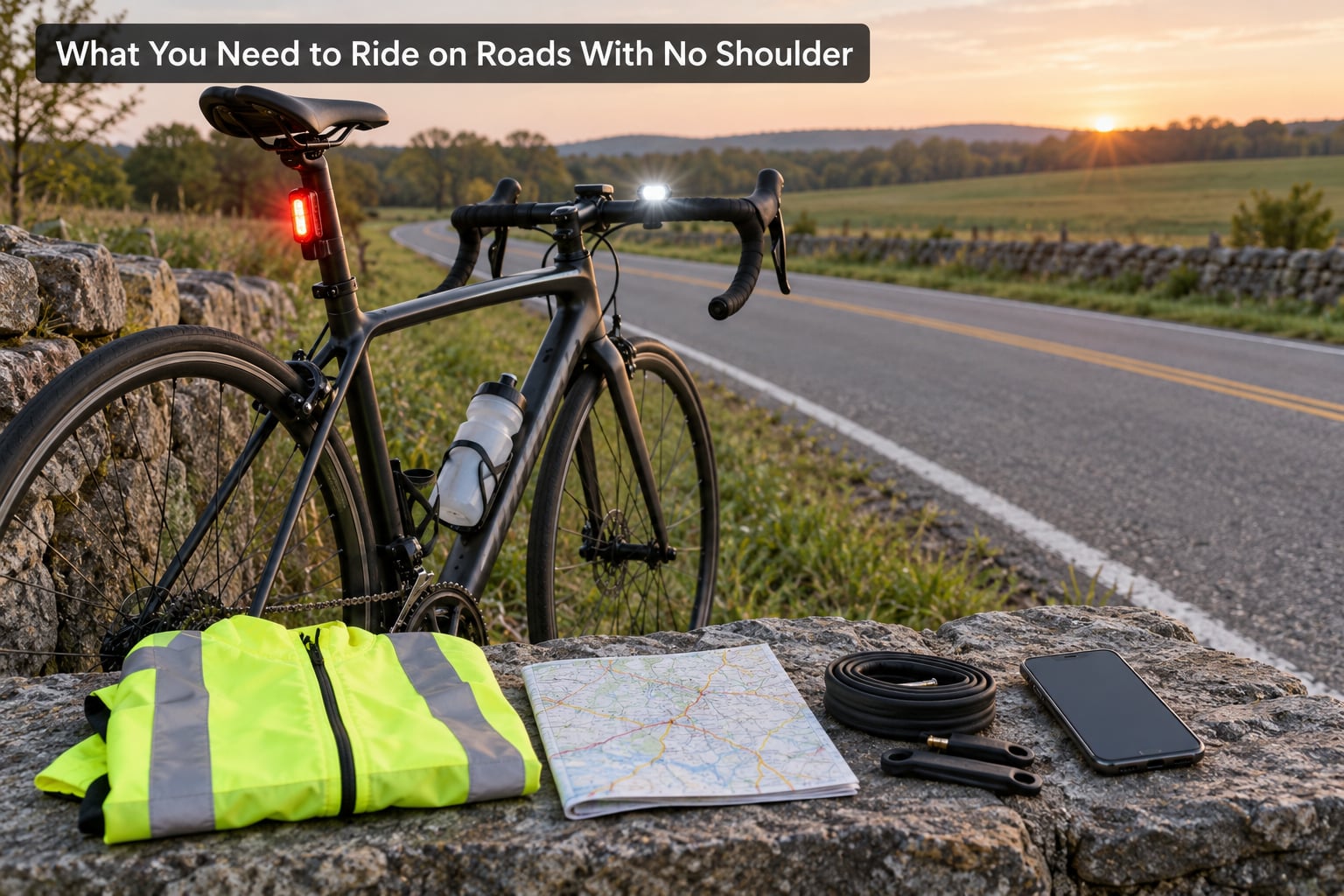
Ride preparation matters more here than on any other road type, because a mechanical problem on a shoulderless road means stopping in a live traffic lane. Anything that can be fixed before you roll should be.
Route research
Look at the route on a map before you ride it, then check street-level images along the segments you do not know. What you are hunting for is width: places where the road narrows at a bridge, a cattle grid, a guardrail pinch, or a curve with a banked camber that will push you toward the ditch.
Note the posted speeds too. A 55 mph road is a different commitment from a 35 mph road, and a wide painted shoulder that appears on the map may turn out to be gravel, blind entrances, or a mess of driveway cuts every 50 metres.
Bike setup
Tires slightly wider than your minimum give you a bigger contact patch and a lower pressure, which is the difference between steering around a pothole and dropping into it. A tubeless setup with sealant buys you time with a slow puncture from a thorn or glass.
Check the brakes properly, not just the pads. Road edges collect gravel, oil and glass, and a long descent on a road with no shoulder is where a weak front brake matters most.
Visibility gear
A white front light and a red rear light, both running, are the minimum from dawn to dusk and the bare minimum after dark. A mirror on the helmet or bars means you check behind without turning your head and drifting your line, which matters enormously when your position is only a metre wide.
Bright or reflective clothing does not make a driver see you sooner, but it makes them hold a better image of you once they look. The League of American Bicyclists puts it plainly: on a road with no shoulder, most drivers never had a reason to expect a cyclist at all.
Repair kit and a fallback
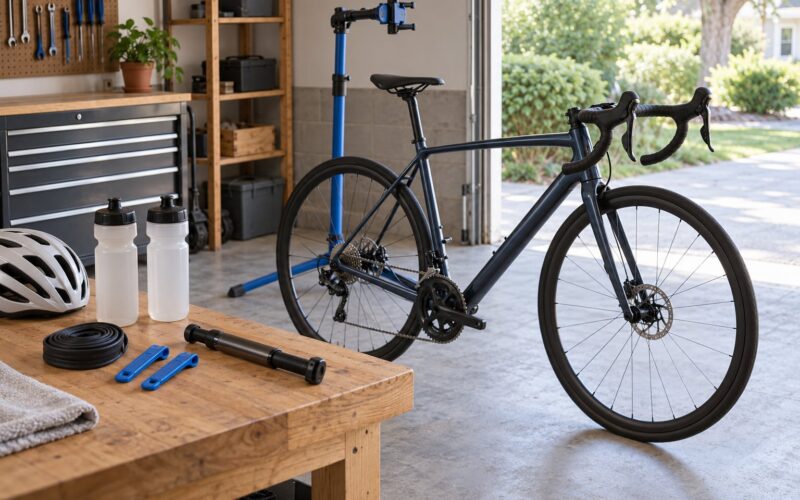
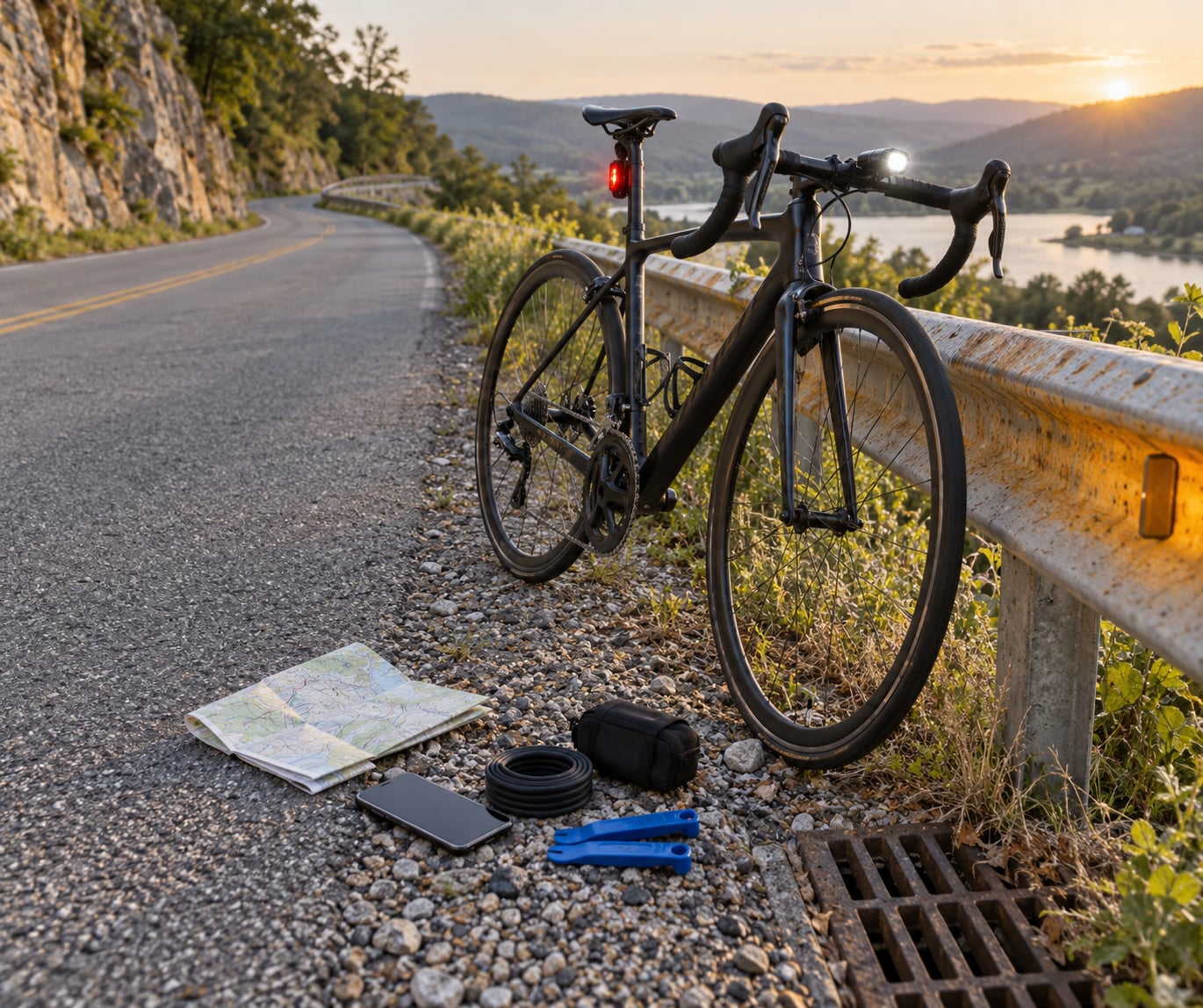
Carry two tubes, a compact multi-tool, tire levers, a pump or cartridges, a bell, and identification with an emergency contact. Ride with a partner where you can, or tell someone the route and your expected arrival time.
Decide in advance what makes you turn around: darkness arriving before you are back, rain heavy enough to drop visibility, a mechanical problem you cannot fix in five minutes, or a truck route with no usable shoulder at all. Having the bail-out decided in advance is what keeps you from grinding through a bad decision at kilometre 40.
Step-by-Step: Positioning, Traffic and Hazards on a Shoulderless Road
1. Inspect the Route and Check the Road Conditions
Before you roll, identify the three things that will decide whether the day goes well: narrow sections, blind curves, and rough pavement. Blind curves matter most because you need time to react to oncoming traffic, and a road with no shoulder gives you nowhere to move when that traffic arrives early.
Construction zones deserve their own check. Look for where traffic is funnelled into one lane with cones, where flaggers work, and where the paved surface has been milled. A milled surface looks like pavement and rides like ice, and it often extends past the cone taper into a section with no barrier.
How do you know it worked? You arrive at the first pinch point already knowing what it looks like, so you are not making a route decision at speed in traffic.
2. Choose a Visible and Predictable Position
Your default position on a road with no shoulder is 0.5 to 1.0 metre in from the edge line, in the outer part of your lane. That is close enough to be efficient and far enough in that you have room to move when something appears in the road. It is the number that comes up again and again in rider discussions, and it exists for a reason: it is the minimum offset that leaves usable steering room.
Hold a straight, visible line. Wavering between the edge and the middle is what convinces a following driver that you are about to move out and swerve around you, and it is also what makes you hard to read in a mirror at distance.
The edge is not a safe default when the posted speed is high. Most of your risk on these roads comes from the passing side, and the only defence is being far enough from the shoulder that an errant driver has time to see and recover.
3. Ride in Single File with Clear Spacing
Groups are the most effective single change most riders can make on a narrow road, and the effect has nothing to do with safety in the abstract. What the following driver sees changes. A cluster of riders is far more noticeable in a mirror than one isolated cyclist, and drivers slow earlier and pass with more room.
Run a leader and a sweep. The leader picks a speed that matches the worst surface in the group rather than the best, because the rider on a patched section at the back has no margin. The sweep watches for vehicles closing from behind and calls a warning before the group needs to single-track around anything.
Spacing on a narrow road is bumper-to-bumper wheel gap when you are in formation, not the two-second gap you would use with a car ahead. The rule to communicate out loud: single file when a vehicle is within about 10 seconds behind, back to two abreast only when the group is together, the road ahead is clear, and nobody is climbing or descending hard.
Never let the group stretch. If the gap opens past sight distance, stop and wait rather than riding on alone.
4. Select a Line That Accounts for Traffic and Debris
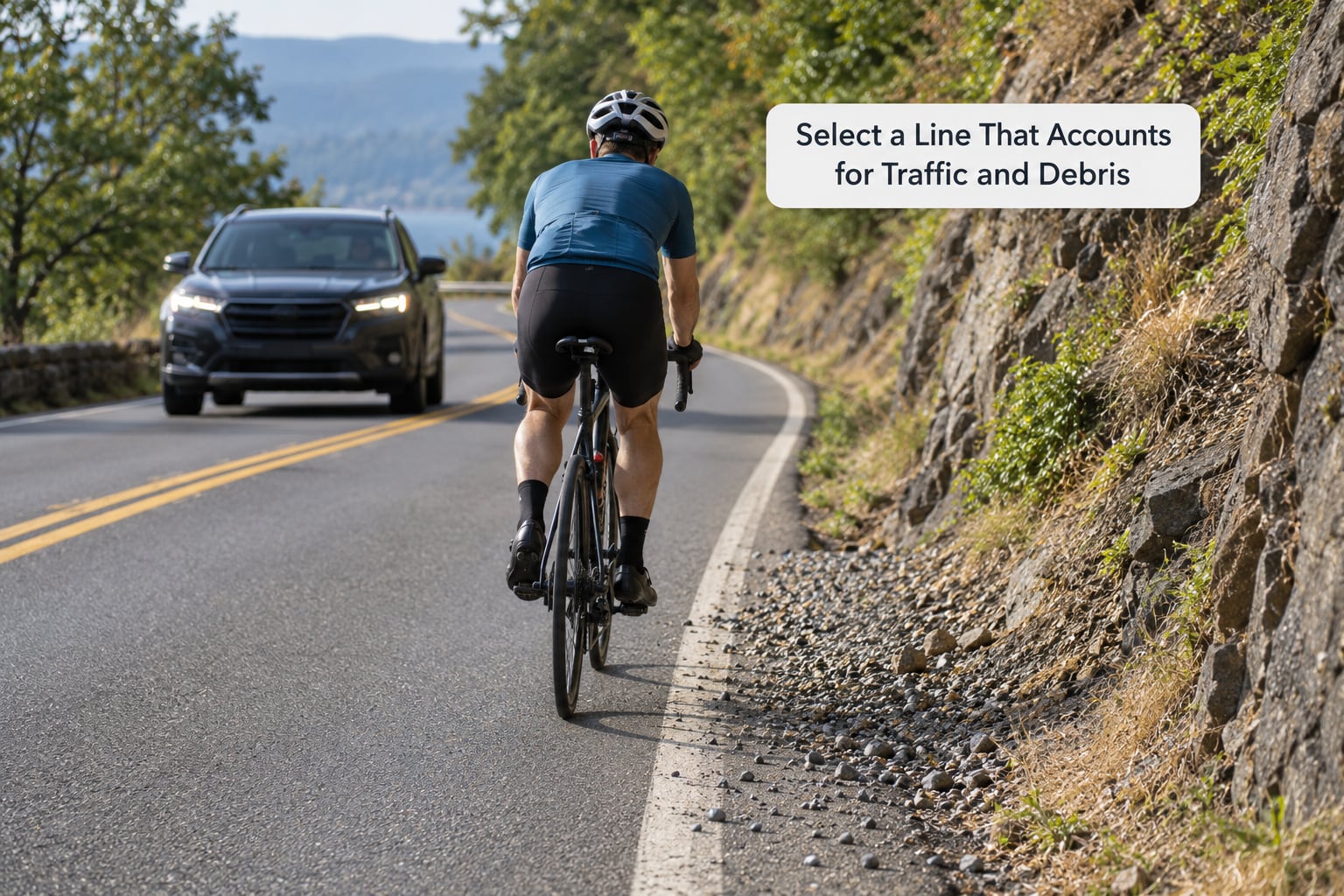
The outer metre of a road with no shoulder is the dirtiest part of the pavement. That is where wind deposits sand and gravel, where vehicle tyres shed rubber and oil, where glass falls from the same cars that are about to pass you, and where longitudinal crack sealing leaves raised tar snakes that catch a front wheel at an angle.
Read the line several car lengths ahead rather than at your front wheel. The hazards worth planning around are drain grates set in a dip, culvert ends, a cattle grid, patched utility cuts, and the seam that runs along the direction of travel just where you least want a wheel to catch.
The rule for moving inward is simple. Move toward the centreline when the hazard is genuinely not passable at your speed, when a vehicle is genuinely not being given 3 feet of clearance, or when the shoulder is genuinely too narrow or obstructed for the length of the hazard. Hold the signal, check behind, make one smooth move, and return to your position once the reason has passed.
One more piece of line discipline: do not make the move and then hug the edge again immediately. Pick a new position slightly further in and hold it, so a second vehicle behind does not have to deal with you moving twice.
5. Pass Only When the Road and Group Allow It
On a shoulderless road, passing is where plans go wrong. There is no shoulder to step into and no room to be overtaken while you wait, so a pass means committing to a vehicle’s blind spot for as long as it takes to clear them.
Pass only on a straight or gently curving stretch with clear sight distance ahead, no oncoming traffic inside the distance you would need to abort, and a vehicle behind that is far enough back to brake for you. Signal, check the mirror, then look over your shoulder before you move. Check again halfway through.
Never pass on the right where an approaching driver’s line of sight is forward. Drivers are not looking for a bicycle on their right, and that is the single most common way a careful pass turns into a side-swipe.
After any stop, re-form as a group rather than trickling back out one at a time. Single riders accelerating into a live lane are the most vulnerable thing on the road, and re-forming at the shoulder with a count costs ten seconds.
6. Use a Simple Hazard and Emergency Plan
Callouts are what turn a group from a collection of riders into a unit. Fix a small vocabulary before you ride: car for a vehicle behind, glass, gravel, grate, hole, narrows, pull out when the sweep wants the group to move as one. One-word calls mean the whole group reacts in the same second rather than each rider noticing something different.
Signal with intent. An arm out to the side at shoulder height means something is coming; an arm angled down points at the hazard. Riders who ride on the shoulder, as on a wider bike facility, adopt that signal differently, so agree on it as a group.
Know the evasive maneuver before you need it. If a vehicle drifts toward the edge of the road in your direction, the sequence is: firm on the bars, move away from the vehicle toward the lane centre, hold the new line even if it means the vehicle has to correct fully, and never swerve back toward the edge once it has passed you. Drifting back is where a lot of side-impact avoidance attempts finish badly.
If you must stop, get off the bicycle and stand on the shoulder side, not the traffic side, and make yourself as small as possible. For a mechanical you cannot fix, walk the bike if the road is narrow enough to walk it, and accept a lift rather than a repair in a live lane.
Common Mistakes Riders Make on Roads With No Shoulder
Riding in the gutter pan
The gutter pan is where the water goes, which is where the debris, the oil and the glass go. Aim for the flat paved area inboard of it and accept that you are riding slightly closer to traffic in exchange for a predictable, clean line. Where a rumble strip runs along the edge, a narrow wheel can drop into it, so move a little inboard of the strip.
Holding a line that is too close to the edge out of politeness
The thinking goes that hugging the edge is courteous. It is not, because it removes your margin and pushes you into a driver’s blind spot. Courtesy is a signal and a predictable line, not a position that leaves you nowhere to go.
Never taking the lane
Some riders take a fast road with no shoulder simply because they are afraid of a driver behind them. Riders on BikeForums put the conditional the other way around: look for a different route when traffic is fast and heavy, and take the lane further in when traffic is light. If the only alternative to taking the lane is a 55 mph road, take the lane.
Letting a group stretch out
Riders at the front feel safe, riders at the back are alone with the closing speed. Cap the group at a size that fits the road, and if the road narrows below that, split the ride rather than compressing everyone into the shoulder.
Waiting for eye contact before moving
Eye contact is a courtesy, not a signal. It is optional for a driver and it costs you seconds you do not have on a high-speed road. Signal, check the mirror, look, move, hold the line.
Ignoring the legal framing
In most US states the bicycle statute says to ride as far to the right as practicable in the same lane as motor traffic, and the same laws usually require motorists to leave at least 3 feet when passing. The word doing all the work is practicable, and it is not defined in the statute. Where a safe pass is not practicable, riding further in is not a violation; it is the law’s own escape clause. Some states also exclude the shoulder from the definition of the roadway entirely, which changes which rules apply to you if you ride there. Rules vary by state and country, so check the statute that governs the road you are actually on.
Two habits cover most of the rest. Ride the same route until it stops being frightening, because familiarity is what turns a road you cannot see into a road you can. And ride it more often than feels necessary, at quieter times, until the road belongs to you rather than the other way around. Riders on r/bikecommuting describe exactly this progression, and a commenter there put the practical version plainly: ride more, wear high-visibility clothing, and ride with a group.
Frequently Asked Questions
Where do you ride a bike if there is no bike lane?
Ride in the travel lane, not the shoulder, and hold the outer part of it about 0.5 to 1.0 metre in from the edge line. That offset leaves room to steer around drains, gravel and cracks without crossing into traffic. Move toward the centreline when a driver behind cannot pass with 3 feet of clearance, when the pavement narrows, or when an obstruction makes the edge genuinely unsafe.
How far from the curb should cyclists ride?
On a road with no shoulder, aim for 0.5 to 1.0 metre from the edge of the pavement. Closer than that and you have no steering room for a drain grate or a pothole. Further out and you drift into the gutter pan, where gravel, oil and glass collect. Where a rumble strip runs along the edge, stay a little inboard of it so a narrow tyre cannot drop into the channel.
When should a cyclist take the lane?
Take the lane when a vehicle behind you cannot safely pass with at least 3 feet of clearance, when the road is too narrow to share, when road conditions or debris make the edge unsafe, or when you need more room to steer or to signal. Holding a position that forces a driver to cross into oncoming traffic to get past you is not riding as far right as practicable; it is the thing that term allows you to avoid.
Is it legal to ride on the shoulder of a road?
It depends on the state or country. Many US bicycle statutes say to ride as far to the right as practicable in the lane with motor traffic, and some define the roadway to exclude the shoulder, which means different rules apply there. Others expressly permit shoulder use with conditions. Check the statute covering the specific road, and treat the shoulder as an option rather than a default when traffic is fast.
What can’t you do on a paved shoulder?
You cannot assume it is safe just because it is paved. Narrow shoulders collect gravel, glass, oil and tar snakes from crack sealing, and they often end at driveways, guardrails and cattle grids. They also offer a driver nowhere to correct a drift toward you. On a shoulder narrower than roughly half a metre, or one with no recovery room, treat the travel lane as the safer option.
How do I feel safer cycling on a dangerous road?
Start by changing the variables you control: ride at a quieter time, pick a route with lower posted speeds, and ride with other riders, since a group is far more visible in a mirror than one cyclist. Then add skill rather than adrenaline: a mirror so you can check behind without wobbling, lights, bright kit, a fixed callout vocabulary and a rehearsed evasive maneuver. Familiarity does the rest over repeated rides.
Start with the first kilometre. Set your position 0.5 to 1.0 metre from the edge, hold a straight line, and check behind with a mirror rather than your head. Everything else in this guide is a refinement of that one habit, and it takes about a week of the same road before it stops feeling like the edge of the world.