If you ride a road bike with 23mm or 25mm tires and wonder whether wider is better, the honest answer is that width alone does not decide it. Wider tires vs narrow tires on road bikes comes down to three things: how rough your roads are, how wide your rims are inside, and what pressure you actually run. On chipped, cracked or wet pavement, 28-32mm is usually both faster and far more comfortable. On glass-smooth pavement at racing speeds, a good 25mm still holds its own.
The old rule that narrow is fast and wide is slow came from tubulars running at enormous pressures. Modern wide road tires at realistic pressures break that rule. What has not changed is that a mismatched setup ruins both. Here is how the two actually compare, width by width.
Table of Contents
- Wider Tires vs Narrow Tires on Road Bikes at a Glance
- What Is the Difference Between Wider and Narrower Road Bike Tires?
- Rim internal width is the number that decides your tire
- Comfort and Ride Quality
- Speed and Aerodynamic Performance
- When wider tires really are faster
- Grip, Cornering, and Wet-Road Confidence
- Rolling Resistance and Pressure
- Pressure bands by rider weight
- Clearance, Fit, and Practical Considerations
- Which Should You Choose?
- Frequently Asked Questions
- Is it better to put wider tires on my road bike?
- Is 32mm too wide for a road bike?
- Which size of road bike tires is better, 28mm or 32mm?
- Are 30mm tires faster than 28mm?
- What tire size should I use with a 25mm internal rim width?
- What are the 3% rule and the 75% rule in cycling tire width?
Wider Tires vs Narrow Tires on Road Bikes at a Glance
| Criterion | Wider (28-32mm) | Narrow (23-25mm) |
|---|---|---|
| Typical labeled width | 28mm, 30mm or 32mm | 23mm or 25mm |
| Comfort on rough tarmac | Noticeably better | Harsh, especially at high pressure |
| Usable pressure range | Wider, forgiving band | Narrow band, sensitive to over-inflation |
| Rolling resistance at equal pressure | Lower | Higher |
| Rolling resistance at equal comfort | Equal or better | Equal or worse |
| Air volume at 70 PSI | Larger | Smaller |
| Pinch-flat risk on rough roads | Lower | Higher |
| Wet and loose-surface grip | Better | Reduced |
| Rotational weight per pair | Heavier, usually 100-250g | Lighter |
| Aerodynamic frontal area | Larger above roughly 30 km/h | Smaller |
| Cornering feel | Calm, stable, slightly slower to turn in | Sharp, quick turn-in |
| Works on old 17-19mm internal rims | Poor profile, not recommended | Excellent match |
| Best for | Long days, rough roads, winter, commuting | Racing, crits, smooth fast routes |
What Is the Difference Between Wider and Narrower Road Bike Tires?
A road tire’s width is its section height, the diameter of the round tube of air inside the casing. Almost every road tire is written as 700x28c, where 700 refers to the bead seat diameter in millimeters and 28 is the nominal width in millimeters. The bead seat diameter, not the width, is what makes the tire a road tire, and it is why 700c, 27.5 and 650b wheels do not mix.
The catch is that 28mm is a label, not a measurement. A tire labeled 28mm can measure 27mm wide on a narrow rim and 29mm on a wide one, and some models run well under their nominal size. Buy by width for shape, but read the printed size and the rim maker’s chart before you commit.
Rim internal width is the number that decides your tire
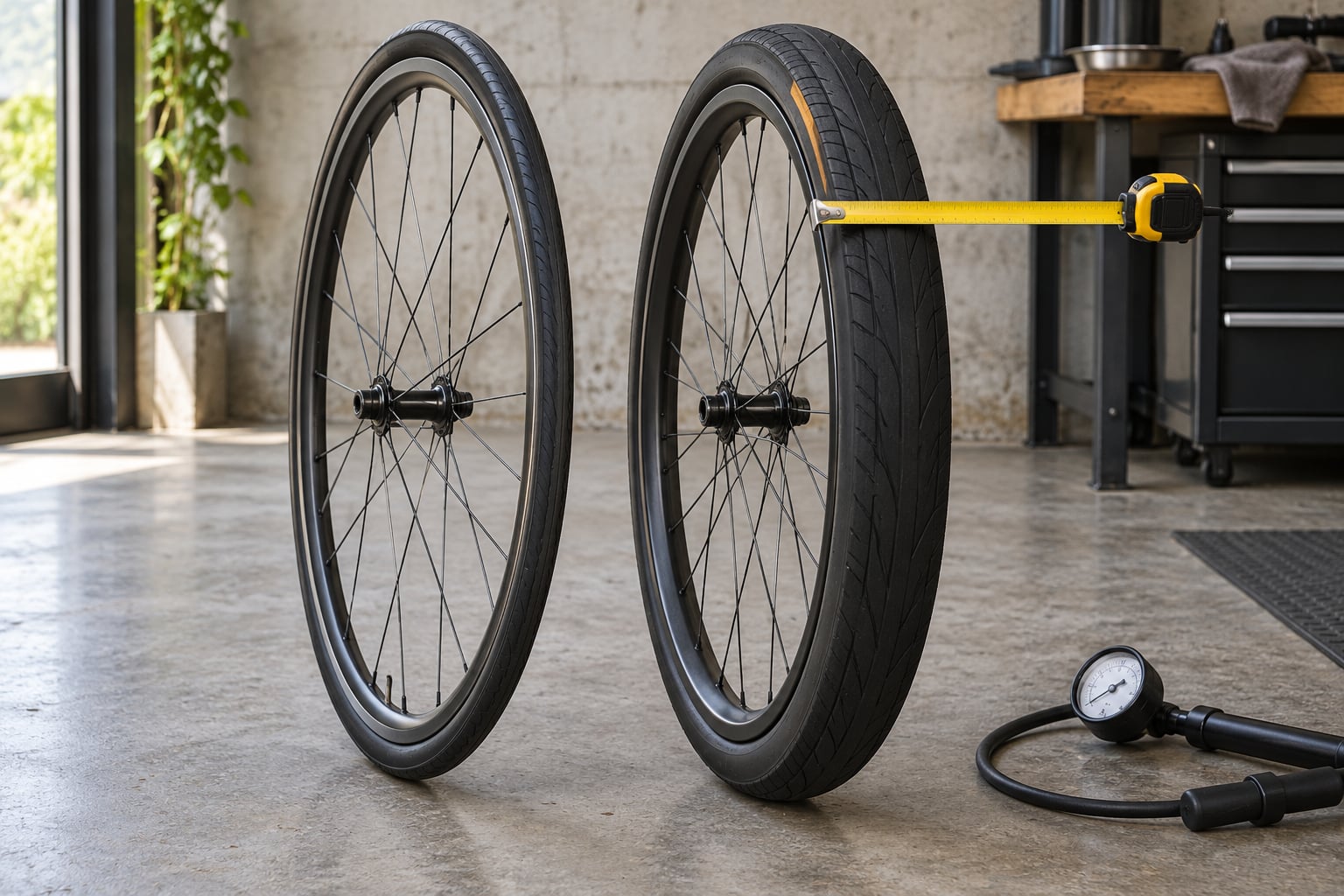
Rim width is specified in two ways. External rim width is the total width of the rim at its widest point, and internal rim width is the distance between the inner walls where the tire sits. The second number is what matters. A 700c rim with 17mm internal width was designed for 23-25mm tires and will make anything wider lightbulb into a vague, wobbly shape. A 21-23mm internal rim is the sweet spot for 28-32mm.
The shape matters more than people expect. On a narrow rim a wide tire bulges outward at the shoulders, so it lightbulbs: sloppy in corners, vague on the front end. On a rim that is too wide for it, a narrow tire flattens out in the middle, sits square against the brake track, and gets pinch-prone. Neither failure is the tire’s fault.
Comfort and Ride Quality
Wider tires are more comfortable for one reason: air volume. A 28mm tire holds more air than a 25mm at the same pressure, and more air means the casing deflects less for every bump, crack and expansion joint it crosses. Less deflection means less energy shaken into your hands, saddle and spine.
The second lever is pressure. A wider tire works across a wider band of useful pressures because there is more air to support the load. A 25mm tire has a narrow window where it is compliant enough to feel good but firm enough not to pinch or squirm; run it 10 PSI too high and it chatters over painted lines and beats you up on chipseal. That single complaint, over-inflation, is the most common thing riders bring to bike shops.
The trade is a little precision. Wide tires have a larger contact patch, so they displace more water on wet roads, and on loose or gravelly surfaces they ride at lower effective pressure and feel vague. That is why a road bike rarely wants more than about 35mm, and why most riders keep saying road bikes have no reason to run anything past 32mm.
Speed and Aerodynamic Performance
Wider tires do cost something aerodynamic. Frontal area grows with width, and above roughly 30 km/h aerodynamic drag starts to dominate the power budget. Past 40 km/h, on smooth pavement, a good 25mm race tire at its correct pressure will beat a 32mm.
There is also a small weight penalty. A pair of 32mm tires typically runs 100-250g heavier than a pair of 25mm tires on the same rim, which matters on steep climbs at the margin and hardly at all anywhere else.
When wider tires really are faster
Three effects work in your favor when you go wider. First, at the same pressure a wider tire has a shorter, wider contact patch and deforms less vertically, so it loses less energy to casing flex, which is the hysteresis loss. Second, at the same comfort a wider tire needs less pressure, and less pressure means a longer contact patch and more of the road’s vibration absorbed by the tire instead of your body.
That second point is the one people miss. On a real road, most of the energy you lose is not the tire’s own deformation, it is impedance loss: the work your body and drivetrain absorb absorbing every chip, crack and rumble. A 28mm at 65 PSI can beat a 25mm at 95 PSI on the same road for exactly this reason. The recurring consensus among road bike reviewers is that two tires of the same type, the wider one run at lower pressure, will be as fast or faster than the narrow one at high pressure.
There is a contrarian camp that claims wider tires take more effort to hold speed. That is true in one narrow set of conditions: smooth, fast roads, inflated to whatever pressure you used to run, with no regard for comfort. Under any pressure chosen properly, it does not hold up.
Grip, Cornering, and Wet-Road Confidence
Width helps grip mainly in the wet, and mainly through water displacement and pressure. A wider contact patch clears more water at a given lean angle, and running lower pressure keeps the patch flat rather than crowned. On damp descents, that is the difference between braking when you want to and finding out late.
Tread and compound matter more than width for dry grip. A slick road tire puts its entire load on a central strip of rubber, so compound choice dominates. Semi-slick patterns with shoulder siping add bite in corners and on wet paint without much drag cost.
Cornering is where the two feel most different. Narrow tires give quick, precise turn-in, which is what you want in a crit or a tight switchback at speed. Wider tires feel calmer and more planted, with less harshness over surface irregularity and more stability when descending fast on rough tarmac. Riders who switch from 25 to 28 frequently report they feel slower at first even when the numbers say otherwise; one rider described a perceived drop from 18 km/h to 15 km/h that turned out to be pressure and expectations rather than speed loss.
Rolling Resistance and Pressure
Rolling resistance comes from three sources: casing hysteresis, deformation of the contact patch, and air losses in tubeless setups. Tire width is not the main variable people think it is. Construction, tread, pressure and surface dominate. Two 28mm tires from different makers can differ by more than the gap between a 25 and a 32 of the same model.
How to think about it: run both tires at the same pressure and the wider one wins on rolling resistance. Run both at the same comfort and the wider one still wins or ties. Run them at the pressure a road racer in 2026 would call normal and the narrow tire wins, badly, because it is bouncing over every piece of road texture instead of absorbing it.
If you want numbers rather than feel, the Rolling Resistance Lab and BicycleRollingResistance.com publish repeatable watt figures, and the SILCA HP Tool will give you a pressure recommendation for your exact weight, rim width and tire width. Those two together settle most arguments in about five minutes.
Pressure bands by rider weight
These are starting points for tubeless, with clincher setups usually needing 5-10 PSI more. Weight is bike plus rider plus kit.
| Total system weight | 25mm | 28mm | 32mm |
|---|---|---|---|
| Under 70 kg (155 lb) | 75-85 PSI | 65-75 PSI | 55-65 PSI |
| 70-85 kg (155-190 lb) | 85-95 PSI | 75-85 PSI | 65-72 PSI |
| 85-100 kg (190-220 lb) | 95-105 PSI | 85-95 PSI | 72-80 PSI |
| Over 100 kg (220 lb) | 105-115 PSI | 95-105 PSI | 80-90 PSI |
If your bike feels harsh, drop 3-5 PSI and ride again before you blame the tire. That single adjustment fixes most complaints about wider tires.
Clearance, Fit, and Practical Considerations
Clearance is the part riders get wrong, because the number is usually printed on the frame somewhere nobody looks. Before buying anything wider, do these four things.
First, check the frame and fork decals for a maximum tire width. Manufacturers publish this to the millimeter and it accounts for the worst case of mud, not just the tire.
Second, measure the gap between the tire and each brake pad with the wheel fully installed and the brake lever squeezed. On a rim brake bike the tire can grow as it warms up, and on a disc bike you need room for the caliper pad and the mud that arrives in winter.
Third, measure your rim internal width. A cheap rim tape or a digital caliper across the inside of the rim gives you the number, and that number tells you which widths the rim was designed for.
Fourth, account for fenders. A full-length mudguard needs noticeably more room than a short race guard, and it needs to be fitted before you size the tire, not after.
Hookless rims change the rules again. They have no hooked bead to hold the tire in place, so the bead relies on the rim profile itself, which means running pressure limits set by the rim maker and a matched width. Ask before you assume a hookless rim will take 35mm. Clincher and tubeless also behave differently at the edges: a latex inner tube adds roughly 20% more air retention than butyl, and TPU tubes sit in between.
Which Should You Choose?
Match the width to the road, the rims and the rider, in that order.
For racing, criteriums and fast group rides on smooth pavement, stay at 23-25mm if your rims are narrow and your weight is low. Aerodynamics and rotating mass still count at those speeds, and this is the one case where the older tire wins on paper.
For centuries, gran fondos and long training weeks, 28mm is the default for most people. It is the widest width that still feels sharp on smooth roads and the narrowest that genuinely protects you on rough ones.
For chipseal, rural back roads, cobbles and winter rain, go 30-32mm if your rims and frame allow it. Lower pressure, more control, fewer punctures.
For commuting and mixed-surface riding, 32-35mm is fair game on a bike with clearance, and the honest answer to whether 28mm is wide enough for gravel is no, it is not.
For beginners and anyone over about 85 kg, wider is the safer direction on every axis except weight. Heavier riders get more comfort and more pinch-flat protection from the same width, and narrow rims punish them more than they punish everyone else.
If your rims are 19mm internal or narrower, do not force 28mm onto them. The profile goes lightbulbed and you get the worst of both. Upgrade the tires, not the wheels, or stay narrow.
Frequently Asked Questions
Is it better to put wider tires on my road bike?
For most riders on imperfect roads, yes. A tire 3-5mm wider holds more air, runs 10-15 PSI lower for the same comfort and absorbs more road vibration, which usually makes it faster on real surfaces. Stay narrow only if you race on smooth pavement, ride at racing speeds, or your rims are 19mm internal or narrower and cannot shape a wide tire properly.
Is 32mm too wide for a road bike?
No, not on most modern road bikes. Endurance and all-road frames are routinely cleared for 32mm or 35mm, and race frames from the last several years usually take 28-30mm. Older frames and anything with rim brakes are the exceptions. Check the clearance marking on the frame, then measure the gap to each brake pad with the wheel installed before you buy.
Which size of road bike tires is better, 28mm or 32mm?
28mm if your roads are decent and you like a sharp, quick-steering front end. 32mm if you ride rough tarmac, carry weight, or want fewer punctures and more control in the wet. Riders who want a compromise often run 28mm in front and 32mm in the rear, because the rear carries more of your weight and drives the rear contact patch.
Are 30mm tires faster than 28mm?
At the same pressure, yes, because the wider tire deforms less vertically and loses less energy to casing flex. At the same comfort, also yes, because 30mm runs 5-8 PSI lower than 28mm and absorbs more road texture. The only case where 30mm is slower is smooth pavement above about 30 km/h, where the extra frontal area costs more than the savings in rolling resistance.
What tire size should I use with a 25mm internal rim width?
An all-road tire in the 35-45mm range. A 25mm internal rim is wide, so a 28mm tire on it sits squashed in the middle and a 32mm rides fine but leaves capacity unused. For a road tire, treat 25mm internal as too wide for 28mm and choose either a narrower road tire on a narrower rim or step up to gravel and all-road widths.
What are the 3% rule and the 75% rule in cycling tire width?
Neither is an official standard; both are community rules of thumb. The 3% rule refers to how much rim internal width should change for each millimeter of tire width, so you move up roughly 1mm of rim per 1mm of tire. The 75% rule says the tire should measure at least 75% of the rim internal width as a minimum sanity check. Both are rough guides, not engineering limits.
The fastest change most riders can make is not a tire purchase. Set your pressure with a gauge you trust, ride the same route twice, and drop 5 PSI the second time. If the road no longer buzzes through your hands and your speed is the same or better, you already have the wider-tire answer for your weight, your rims and your roads.