If you are wondering how long should indoor trainer rides be, the honest answer is that most sessions run 45 to 90 minutes, and anything longer has to earn its place in your week. Recovery spins last 15 to 30 minutes, zone 2 base rides run 60 to 90 minutes, threshold work fits into 45 to 75 minutes, and a long ride replacement is worth 90 to 120 minutes when you are specifically practising pacing and fuelling.
The mistake riders make is picking a duration first and a workout second. A 2-hour session stuffed with intervals is not a long ride, and a 25-minute session is not a base workout.
Total weekly time on the trainer matters more than the length of any single session. Three 60-minute rides spread across a week will do more for you than one 3-hour slog you dread every month. Choose the duration that fits the session you actually need to do, then repeat it.
Table of Contents
- How long should indoor trainer rides be?
- Indoor trainer ride length by training goal
- How long should a beginner indoor ride be?
- How long should a weekly indoor trainer plan be?
- How long should a long indoor ride be?
- How long should indoor intervals be?
- VO2 max work: 30 to 45 minutes total
- Threshold work: 45 to 75 minutes total
- Mixed sessions: 45 to 90 minutes total
- Does riding longer on the trainer replace outdoor rides?
- How to make a long trainer session more effective
- When should you shorten an indoor trainer ride?
- Frequently Asked Questions
- Is an hour on the indoor trainer enough?
- Is 2 hours on the trainer too long?
- What cadence should I hold on a smart trainer?
- How many times a week should I ride indoors?
- How do I make a long trainer session less boring?
- Can indoor training fully replace outdoor endurance rides?
- Conclusion
How long should indoor trainer rides be?
Most indoor trainer rides should last 45 to 90 minutes. Steady endurance sessions run 60 to 90 minutes, hard threshold and sweet spot work fits into 45 to 75 minutes, short VO2 sessions take 30 to 45 minutes including warm-up, and long ride replacements need 90 to 120 minutes. Weekly volume across several sessions counts for more than any single long session.
That one-hour ceiling you will read everywhere has a reason. Coach Fred Matheny, writing on Road Bike Rider, says most riders limit themselves to about an hour indoors because long slogs are mentally tough and, as he puts it, not as beneficial either. He is right about the default, and wrong about the ceiling.
What actually ends most indoor sessions is attention, not lactate. On the road, cornering, braking, wind, surfaces and traffic keep breaking up your focus. On the trainer that variation disappears, so boredom usually arrives long before your legs are done.
One rider on the r/cycling forum described the pattern exactly: after years of indoor training, staying on past an hour and a half indoors still feels harder every season. Another in the same thread rides three to four-hour zone 2 sessions, but always outside on the road or a circuit loop. The difference is not fitness. It is what your brain has to hold onto.
Indoor trainer ride length by training goal
Duration depends almost entirely on what the session is for. This is the table that answers the question for most riders.
| Workout | Intensity | Duration | Example session |
|---|---|---|---|
| Recovery spin | Very easy, conversational | 15-30 minutes | 20 minutes of easy pedalling after a hard outdoor day |
| Zone 2 base ride | Easy, nasal breathing | 60-90 minutes | 10 minutes warm-up, 50-70 minutes steady, 10 minutes cool-down |
| Tempo / sweet spot | Just below threshold | 45-60 minutes total | 15 minutes warm-up, 3 x 12 minutes, 10 minutes cool-down |
| Threshold | Hard, around 95-105% FTP | 45-75 minutes total | 2 x 20 minutes with 10 minutes between |
| Climbing repeats | Hard, lower cadence | 50-60 minutes total | 3 x 15 minutes at threshold with long recoveries |
| VO2 max intervals | Very hard, 3-5 minute efforts | 30-45 minutes total | Warm-up, then 5 x 3 minutes at 120-130% FTP |
| Long ride replacement | Easy to moderate | 90-120 minutes | 2 hours steady with two planned fuelling stops |
| Race rehearsal | Event-specific | Match the event | 90 minutes at race power with kit and full fuelling |
Two numbers matter more than the range itself. If a session has intervals, the total length is the interval work plus ten minutes of warm-up and ten minutes of cool-down. If it is steady, anything past two hours stops buying aerobic adaptation and starts costing you attention and recovery.
A SlowTwitch triathlete training for a half-distance described the same pattern during camp work: most indoor rides were 30 to 60 minutes, and the longer sessions only happened when a specific workout demanded them. That is a sensible default for anyone with a job and a family.
How long should a beginner indoor ride be?
Beginners should start at 30 to 60 minutes and build slowly. The first few sessions exist to teach your legs to pedal at a steady cadence on a trainer, not to build fitness.
Most new riders underestimate how uncomfortable 45 minutes on a saddle is. Add ten minutes of warm-up and five of cool-down and you have an hour of novel positions, sweat and sore muscles. That is plenty for the first month.
Use this ladder and only move up when the current step feels easy twice in a row:
- 20 minutes – 5 minutes easy, 10 minutes at a comfortable steady effort, 5 minutes easy. Cadence work only.
- 30 minutes – add two 3-minute surges at a hard effort, full recovery between.
- 45 minutes – one continuous 25-minute block at moderate effort, then build from there.
- 60 minutes – your first proper base ride, mostly steady with one short block at the top.
- 90 minutes – only once 60 minutes feels routine and you have somewhere to put the extra half hour of attention.
Progress the duration, not the intensity. Riders who jump straight to 90 minutes of hard work tend to associate the trainer with punishment, and that association is hard to undo.
New to cycling altogether, rather than new to trainers? Start even shorter and consider a spin class or a low-resistance session where you can coast. Learning to ride on a stationary bike and learning to train on a trainer are two separate skills.
How long should a weekly indoor trainer plan be?
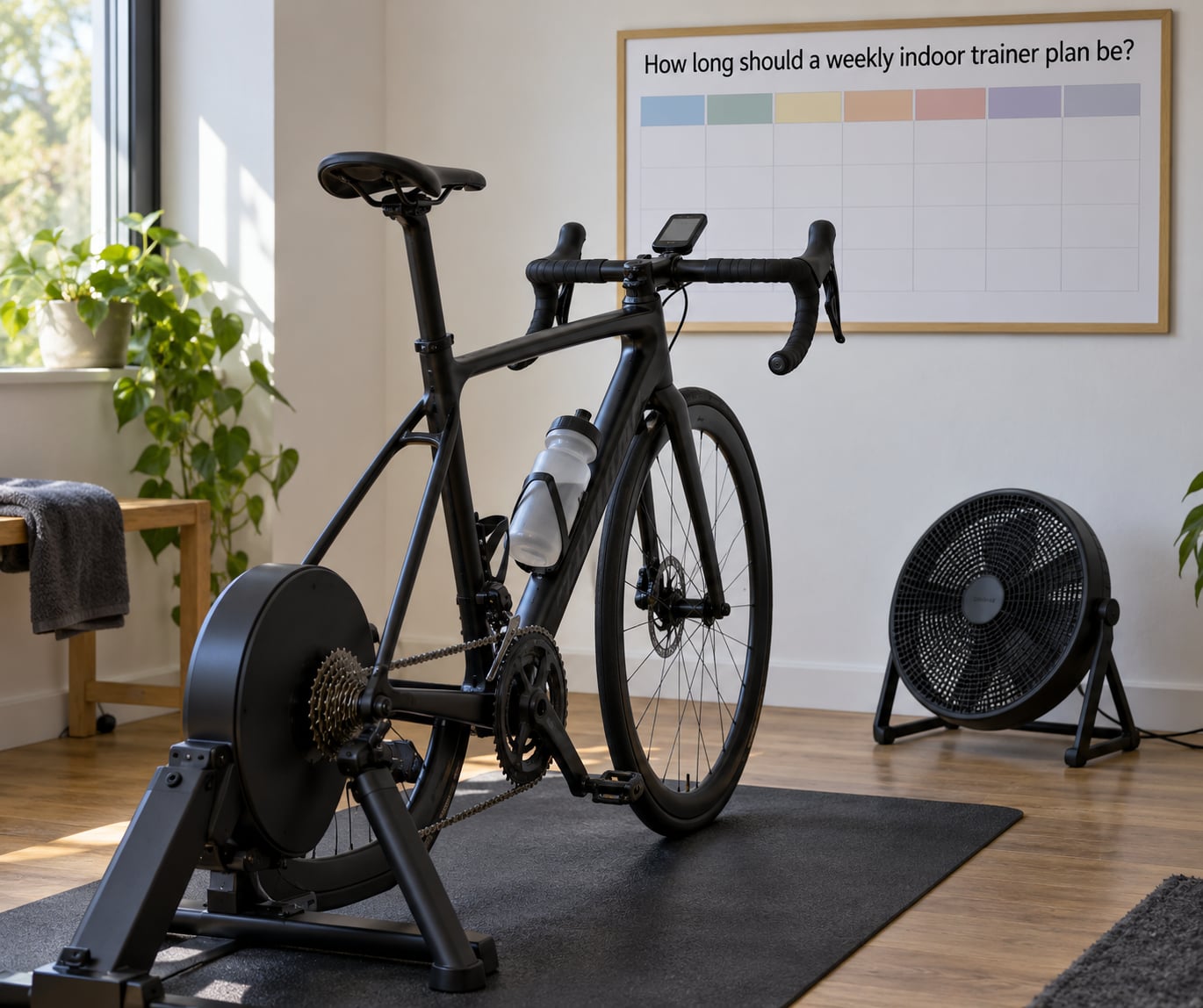
A good weekly indoor plan runs three to six sessions and 3 to 8 hours depending on your level. Duration per session matters less than that spread, because muscles, tendons and the rest of your life recover between days rather than during a long ride.
| Rider | Weekly pattern | Total trainer time |
|---|---|---|
| Recreational, limited weekdays | 2 x 45 min easy, 1 x 60 min with one threshold block | 2.5 hours |
| Club rider, all-season | 3 x 60 min (one with intervals), 1 x 90 min long ride | 3.5 hours |
| Century or double century build | 3 x 60-75 min, 1 x 120 min with fuelling practice | 5.5-6 hours |
| Triathlete in base phase | 2 x 45 min bike, 1 x 60 min brick (bike then run) | 2.5 hours |
A coach on the TrainerDay forums put the frequency floor plainly: three sessions a week is the minimum to stay healthy and keep progressing. Below that, weekly volume drops faster than most riders expect, and the easy indoor work that carries most of the adaptation disappears.
Leave at least one full day between hard sessions. Three hard indoor days back to back on a fan in a closed room is how riders end up resentful of the trainer, and resentment costs more training than any missed workout.
Put one outdoor ride in the week if you possibly can. Even 90 minutes outside keeps your handling, pacing and road sense sharper than any amount of ERG mode.
How long should a long indoor ride be?
A long indoor ride should run 90 to 120 minutes. Past 90 minutes you are no longer doing aerobic work your body cannot get elsewhere, you are practising the specific skill of staying paced and fuelled for hours on a bike.
That skill is worth having before a century or a 200 km day. Riders on the TrainerRoad forum who train most of their weekend volume indoors regularly extend their long sessions to two and a half, sometimes two hours forty-five, and report that it transfers directly to outdoor distance days. That is the existence proof that sessions past 90 minutes are legitimate, when the goal is fuelling and pacing rather than fitness.
There are real costs past two hours. Heat builds with no airflow, boredom compounds, and the small postural errors you hold for 90 minutes become 3 hours of the same error. Your indoor kilometres also say very little about your road handling, so a long trainer session cannot cover the skills part of a long ride.
Three ways to make a two-hour-plus session work better:
- Chunk it. Coach Matheny’s rule is never more than three minutes of one thing at a time. Change the music, the on-screen route, or your position every three minutes and the session stays interesting.
- Split it. A three-hour weekend ride can become two 90-minute sessions on separate days, or one morning and one evening. You keep the volume without the single long block.
- Give it a job. Fuelling practice, race rehearsal, a group ride, or testing a saddle and tyre setup at speed. A session with a purpose is easier to finish than an open-ended one.
One practical note: some hardware stops cooperating. A rider in a cycling Facebook group found her bike computer stopped counting at 99.9 minutes. Check whether your head unit or trainer app has a session cap before you plan a three-hour block around it.
How long should indoor intervals be?
Interval sessions last 30 to 75 minutes depending on the adaptation you want. Shorter and harder efforts build VO2 max; longer and steadier efforts raise threshold and sustainable power.
VO2 max work: 30 to 45 minutes total
Three to five minutes hard, with equal or longer recoveries. The whole session including warm-up rarely exceeds 45 minutes, because the work itself is only 15 to 20 minutes and the rest is support.
Threshold work: 45 to 75 minutes total
Two blocks of 15 to 20 minutes, or three of 10, at roughly 95 to 105% of FTP. Threshold adaptations come from volume at that intensity, so this is where a longer session genuinely helps.
Mixed sessions: 45 to 90 minutes total
Longer aerobic blocks with shorter hard efforts layered on top. These work because the easy minutes let you absorb the hard ones without the session becoming a single test of suffering.
Mode changes how long you can hold the effort. ERG mode holds your wattage steady regardless of cadence, so pacing is automatic and you can coast mentally during recovery blocks. Level mode is a fixed resistance, so you must hold your own output, which adds a cognitive load most riders notice after about an hour.
That is also why some riders prefer an hour in ERG and then a short level-mode block to keep their legs used to managing effort by feel. Wahoo’s indoor cycling guide makes a related point worth taking seriously: ERG mode does not exist in a race, so everything you train indoors in it has to be balanced with some outdoor or level-mode riding.
One warning from the data: not every ride needs to be hard. Riders on cyclingforums who tried to build fitness by stacking intervals indoors hit plateaus and staleness fast. Most of your trainer time should be easy.
Does riding longer on the trainer replace outdoor rides?
No. Longer indoor sessions replace outdoor mileage, not outdoor riding. They cover the same cardiovascular and muscular work, and they do not cover cornering, braking, descending, road position, surface changes, wind or traffic.
On effort metrics the comparison is reasonably close. A TrainerRoad rider asked how to compare a 4-hour-15-minute outdoor ride of 248 TSS at an intensity factor of 0.76 and 2368 kJ with an indoor equivalent, and the useful answer is that indoor and outdoor sessions can be matched on training stress score and work done, with indoor riding typically needing slightly less time for the same load because there is no coasting or wind loss.
What you cannot do is convert indoor kilometres into outdoor kilometres. Trainer distance is an artefact of whatever gear ratio and resistance you picked. Judge the session by minutes, TSS and perceived effort, not by the miles on the screen.
A practical rule: if the session tests pacing, fuelling or output, do it indoors. If it tests bike handling, weather judgement or climbing judgement, do it outside.
How to make a long trainer session more effective
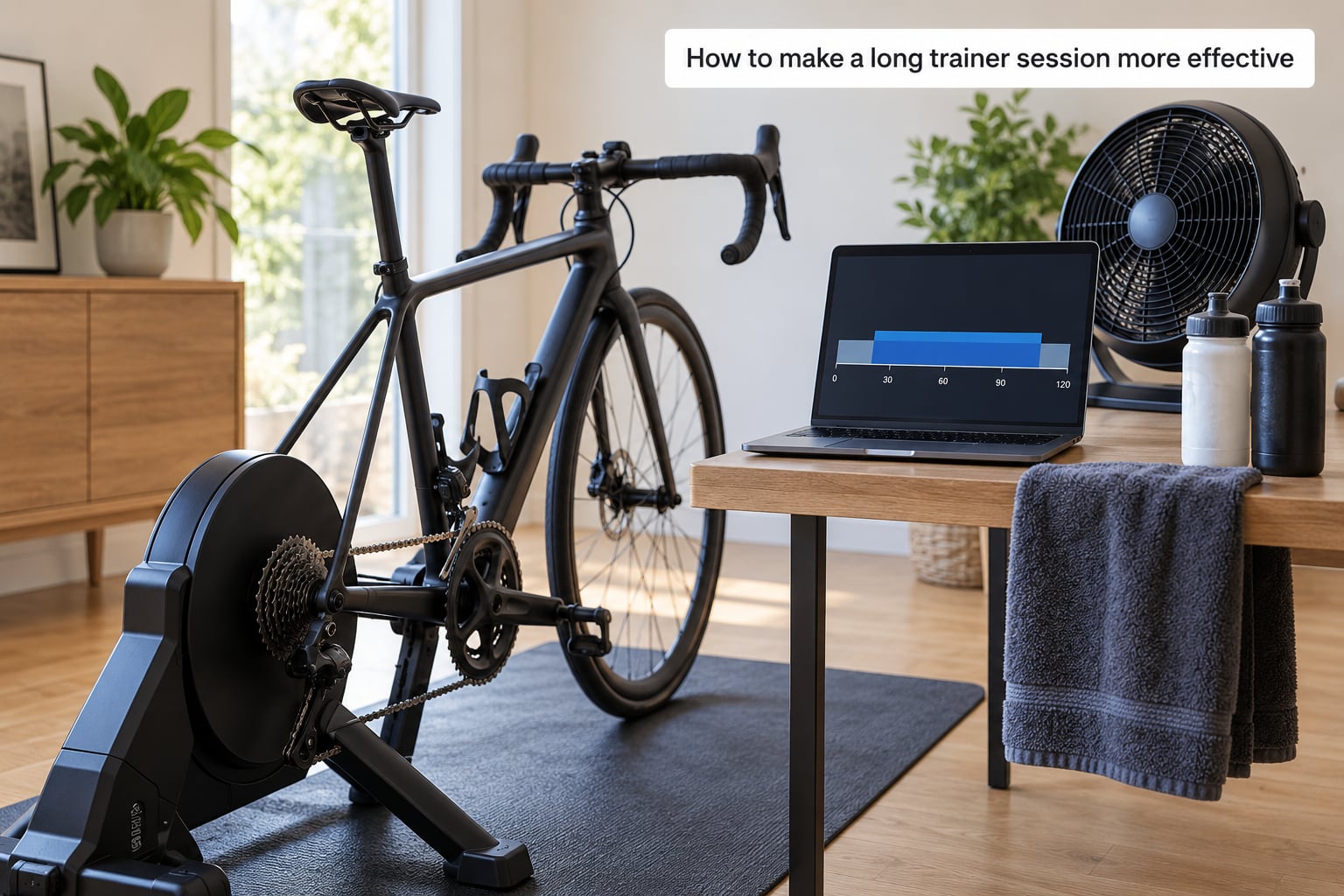
A long indoor session works when it has a structure you can repeat. Set the goal before you get on the bike, use the same workout shape each time, and control the room.
- Write the session down first. A target number, a rough block structure, and a finish time. Riders who wing it tend to drift into a pointless middle hour.
- Use the same repeatable structure. If your long ride is always 10 minutes easy, 80 minutes steady, 10 minutes easy, the repetition removes decisions and makes the session shorter in your head.
- Fix the airflow. A fan pointed at your face makes a two-hour session feel like a 60-minute one. Riders with no airflow report much shorter tolerable sessions than those with a fan.
- Set the room temperature deliberately. Open a window, keep the room cool, and expect to be sweating more than outdoors even at the same effort.
- Eat and drink on time. Indoors you forget. Start taking fluid in the first 20 minutes and eat something every 30 to 45 minutes past the hour mark.
- Move position regularly. Stand, sit, stretch the hands, check the saddle. Every 20 minutes beats sitting rigid for two hours.
A 120-minute endurance session built that way looks like this:
- 0-15 minutes: easy spin, 90 rpm, opening the legs and raising heart rate gradually
- 15-45 minutes: steady endurance, target power held in ERG mode or a fixed gear in level mode
- 45 minutes: first fuelling stop, get off the bike, eat something, reset the fan angle while you are up
- 45-85 minutes: second block, add a few minutes at moderate-hard if you want the session to have some texture
- 85-110 minutes: final steady block, keep the effort honest and finish feeling like you had one more block in you
- 110-120 minutes: cool-down at easy effort, then a few minutes of stretching off the bike
Leave room in the plan for a 120-minute ride to become 135 minutes. Trying to hit an exact finish time is the fastest way to end a good session early.
When should you shorten an indoor trainer ride?
Shorten or stop the session when the signals are about your body rather than your workout plan. Ending early is training; pushing through the wrong signals is not.
- Unusual pain in a joint, a sharp knee ache, numbness in the hands or feet, anything that is not the burn you came for.
- Dizziness, light-headedness or visual changes during a warm-up. Get off, cool down, hydrate.
- Overheating that does not ease when you slow down or open the room. Dizziness and clammy skin are the signals, not the sweat itself.
- Riding quality falling apart – cadence collapsing, feet spinning, torso rocking, or saddle numbness building fast.
- Fatigue that arrives far too early in a session that should have been easy. That usually points to poor sleep, an illness starting, or accumulated training load.
- Symptoms of illness such as a sore throat, fever or chest congestion. Rest days are what make the rest of the plan work.
For pain that persists, or for any symptom that worries you, stop riding and speak to a doctor or a physiotherapist. Training through persistent pain is how a short-term session becomes a months-long break from the bike.
Riding when already depleted also has a training consequence beyond feeling bad. A hard effort on poor recovery creates stress without the adaptation, and it teaches you that the trainer is punishment.
Frequently Asked Questions
Is an hour on the indoor trainer enough?
For most riders, yes. One hour covers a full structured session: 10 minutes of warm-up, 35 to 40 minutes of intervals or steady riding, and 10 minutes of cool-down. Riders training for distance add a second hour or a second session instead of stretching one ride. Three 60-minute sessions across a week deliver more than one long weekend ride.
Is 2 hours on the trainer too long?
No, not if the goal justifies it. Two hours is a sensible long ride substitute when you are practising pacing and fuelling, rehearsing an event, or covering a weekend ride that weather has cancelled. Keep airflow on you, fuel from the first 20 minutes, and use the same repeatable structure each time so the session stays predictable.
What cadence should I hold on a smart trainer?
Most riders settle between 85 and 100 rpm for steady endurance work, dropping lower for climbing repeats and rising for recovery. In ERG mode the trainer handles resistance so cadence stays wherever you put it. In level mode you must hold your own output, which is why cadence drift is more common in longer level-mode sessions.
How many times a week should I ride indoors?
Three sessions a week is the practical minimum for most riders, since it protects weekly volume without crowding out recovery days. Recreational riders can hold steady fitness on two. Anyone building toward a long event usually lands at three to four, with only one of them genuinely hard and one of them a long ride.
How do I make a long trainer session less boring?
Change something every three minutes. That is the rule Coach Fred Matheny recommends and it works better than picking a longer film. Alternate standing and sitting, swap music each interval, follow a route or group ride on screen, and ride with someone when you can. Chunking the session also gives your attention smaller targets to finish.
Can indoor training fully replace outdoor endurance rides?
It can replace the fitness, which is the aerobic work. It cannot replace road-specific skills: cornering, braking, descending, judging wind and traffic, or handling changing surfaces. Match sessions on training stress score rather than kilometres, and keep at least one outdoor ride in your week if the weather and your schedule allow.
Conclusion
Start by picking the training goal, then let the duration follow from it. Recovery work takes 15 to 30 minutes, base riding 60 to 90, threshold blocks 45 to 75, and long ride replacements 90 to 120.
If you are new to the trainer, begin at 30 to 60 minutes and add ten minutes at a time. Progress the duration before the intensity, keep three sessions a week as your floor, and leave a day between hard efforts.
Stop the session when your body tells you to rather than when the timer says to. Consistency and recovery are what produce the results, and a ride you finish happily is worth more than one you force to 120 minutes and never repeat.