A good winter training plan for cyclists is a 12-week block built from three ride types a week, two short strength sessions, and a four-week review you use to adjust the next block. Most of it sits at easy-to-moderate effort. One harder session, not four, and the long ride grows a few weeks at a time.
That matters because winter is the one stretch of the year when you can add fitness without racing fatigue in the way, and the only stretch when most riders actually have free weekday hours. Get the structure right and you arrive in March with a higher FTP than you started. Get it wrong and you arrive in February exhausted, injured, or sick.
The plan below assumes a recreational or club road cyclist with a spring goal event. If your week only holds five to eight hours, use the lower column. This is general fitness information, not medical or coaching advice, and if you are managing an injury, a heart condition or an ongoing illness, talk to your doctor before changing your training load.
Table of Contents
- What You Need to Start a Winter Training Plan
- Your current baseline
- A fixed weekly time budget
- Winter route and daylight options
- Equipment check
- Step-by-Step: Build Your 12-Week Winter Training Plan
- Step 1: Set a Winter Baseline and Goal
- Step 2: Plan Three Ride Types Each Week
- Step 3: Progress Duration Before Intensity
- Step 4: Add Short Strength Sessions
- Step 5: Manage Cold, Dark and Wet Rides
- Step 6: Review Every Four Weeks
- What to eat and drink in winter
- Common Mistakes
- Frequently Asked Questions
- How many hours a week should I cycle in winter?
- Should I do base training or sweet spot this winter?
- Can I train indoors all winter?
- What temperature is too cold to ride a bike?
- How many FTP gains should I expect over winter?
- How do I stay motivated to train indoors?
- Conclusion
What You Need to Start a Winter Training Plan
You need three things before week one, and none of them cost anything: an honest record of your current riding, a fixed weekly time budget, and a route you can ride in the dark.
Your current baseline
Pull the last four weeks out of your ride log and write down the numbers. Total hours, longest single ride, and how hard the hard rides actually felt.
If you have no log, ride three times this week and estimate. An honest estimate beats a blank page, and it takes fifteen minutes.
A fixed weekly time budget
Count what you actually have, not what you wish you had. Work, family, weather and daylight all compete for the same hours, and a plan built on optimistic time fails in January.
Most riders who struggle through winter are budgeting 15 hours and getting six. Pick the number you hit even in a bad week, and build the plan around that.
Winter route and daylight options
Know which routes are lit, which are exposed to crosswind, and which have a bus stop or a cafe within fifteen minutes of the turn-back point.
Riders in northern latitudes often plan around a daylight window of eight or nine hours, which means commuting-style early rides and weekend long rides that start near lunch. Plan around your window rather than against it.
Equipment check
- Tyres at or above the maker’s minimum pressure, with a pump and a spare tube
- Brakes checked in the last month, pads replaced if the wear indicator says so
- Lights that run for two hours minimum, plus a backup light
- Winter layers: base layer, jersey, windproof vest, leg warmers, glove liners, overshoes
- A turbo trainer with a fan if more than a third of your sessions will be indoors
- Two water bottles, a snack, and a change of socks
One note on cold safety. Hypothermia is a real risk on a stationary bike in a cold garage, where sweat has nowhere to go, and it is also a risk on a fast descent with bare skin. See the safety guidance below before either situation.
Step-by-Step: Build Your 12-Week Winter Training Plan
The plan runs in three phases across twelve weeks: a four-week base phase, a five-week build phase, and a three-week specificity phase that points at your goal event. Each phase adds one thing only, which is why it works.
Use the structure below, then scale the hours to your budget. The lower figures suit a rider with five to eight hours a week; the higher figures suit a rider with nine to fifteen.
| Weeks | Phase | Focus | What changes |
|---|---|---|---|
| 1-4 | Base | Easy aerobic volume | Long ride grows 15 to 20 minutes a week. One short tempo block appears in week 3. |
| 5 | Recovery | Deliberate step back | Hours cut by 30 to 40 percent. Everything easy. This week is what makes weeks 6-12 work. |
| 6-10 | Build | Threshold emphasis | Two quality sessions a week, mostly 88-94 percent of FTP, with long easy rides between them. |
| 11-12 | Specificity | Goal event demands | One session mimics the event. Volume drops, intensity stays. If no event, hold steady. |
These power zones appear throughout the plan and the rest of the article.
| Zone | Percent of FTP | How it feels | Winter role |
|---|---|---|---|
| Recovery | Below 55 percent | Very easy, full conversation | Between sessions, after a hard day, week 5 |
| Endurance / zone 2 | 55-75 percent | Can talk in sentences, not sing | The bread and butter of the whole block |
| Tempo / sweet spot | 88-94 percent | A few words at a time | The main winter stimulus, weeks 6-10 |
| Threshold | 100-106 percent | Hard but repeatable in sets | One block a week, never two |
| VO2 | 115-120 percent | Completely out of breath | Optional, one session in weeks 8-9 |
Step 1: Set a Winter Baseline and Goal
Write down four numbers before you plan a single session: weekly hours, longest recent ride, your current FTP or a rough hard-effort anchor, and a one-sentence objective for March.
Then pick one of three goals, because they produce genuinely different plans.
- Maintain. You want to hold fitness through winter and start spring where you left off. Volume drops 20 to 30 percent, one hard session a week, no testing.
- Foundation. You want an aerobic base for a spring fondo or sportive. Steady volume with a slow, long rise in the long ride.
- Spring readiness. You have an A-race eight to sixteen weeks out. Add threshold work, test at weeks 1, 5 and 10, and cut volume in week 11.
You will know the goal is working if by week four you can hold zone 2 for 90 minutes outdoors at the same heart rate you had in week one.
Step 2: Plan Three Ride Types Each Week
Three ride types cover almost every rider: one long endurance ride, one aerobic or tempo effort, and one short easy recovery ride. Everything else is optional.
A realistic week for nine to twelve hours looks like this.
- Long ride, weekend. 2 hours 30 to 3 hours 30 at zone 2, with a 20-minute tempo block in the middle if you have a base already.
- Quality session, midweek. 60 to 90 minutes indoors, 3 x 12 minutes at 88-94 percent FTP with 8 minutes easy between.
- Recovery ride. 45 to 60 minutes below 55 percent, usually commute-friendly and often at dusk.
- Strength. Two 25-minute sessions, Tuesday and Friday.
For five to eight hours a week, cut the long ride to 90 minutes, keep the quality session, and make the recovery ride 40 minutes. That is still a complete winter week.
Two hard days a week is the ceiling for almost everyone in winter. A common pattern among club riders is two hard days staggered by two days of zone 2, which is exactly why the recovery ride exists.
Step 3: Progress Duration Before Intensity
Add time before you add speed. The long ride should grow 15 to 20 minutes a week, capped at the longest ride you have done in the last two years.
Intervals belong in the build phase, not the base phase. If your longest recent ride is under two hours, spend weeks 1-4 on endurance only and add your first tempo block in week 5. Doing hard sessions on a weak base is how riders end February flat.
One practical rule: if a planned session makes your resting heart rate higher the next morning, or your legs feel heavy for more than a day, cut the next week’s volume by a third. Do not make the session up later.
Cold and wet weather deserves extra caution with load. Wheel traction drops, braking distances lengthen, and the effort of riding feels higher to your body than the numbers show. Keep the same planned load but move the intensity to days with good conditions.
Step 4: Add Short Strength Sessions
Two 25-minute sessions a week, Tuesday and Friday, is enough to maintain or build useful strength. Longer sessions add fatigue without adding much benefit for a cyclist.
A twelve-week cycling strength routine that fits into half an hour:
- Session A, lower body. Goblet squat, Romanian deadlift, step-up or split squat, calf raise, 3 sets of 6-10 reps with two minutes rest.
- Session B, core and stability. Side plank, dead bug, bird dog, single-leg glute bridge, Pallof press, 3 sets of 8-12 per side.
- Mobility, every session. 5 minutes of hip flexor stretch, hamstring stretch and thoracic rotation, plus 10 slow body-weight squats to raise blood flow before riding.
Stop each set with two reps in reserve. Legs that are wiped out on Saturday cannot do the long ride, and a strength session is not worth a ruined weekend.
Balance work pays for itself in winter: single-leg deadlifts, single-leg balance work and controlled single-leg descents all reduce the wobble that comes with a tired rider in a wet corner.
Step 5: Manage Cold, Dark and Wet Rides
Winter riding is a risk-management problem before it is a training problem. Layering, visibility and conservative pacing decide whether a cold session stays worthwhile.
Use this rule for deciding outside or indoors: if the road has standing water, packed snow or ice, ride indoors. If it is simply cold and dry, ride outside if you have the layers. If it is cold and windy, shorten the ride and turn back early.
For temperature, treat anything below about minus 7 degrees Celsius as the point where most riders should not be out on the road unless they have full winter kit and a short, sheltered route. Between 0 and minus 7 degrees Celsius, kit and route choice make the difference. Above zero, the main hazards are black ice and reduced visibility, not cold.
Dress in layers you can add and remove while riding, and keep your hands and feet warm before you feel cold everywhere. Cotton against the skin stays wet and cold; merino or a synthetic base layer does not.
On visibility, front and rear lights are non-negotiable after dusk, and reflective or bright clothing matters more than any other gear choice in a short daylight window.
Before every outdoor winter session, check tyre pressure, brake feel, lights, and the forecast for the return leg as well as the outbound. Cold weather also means cold fuel: see the fuelling table below, because you will not feel thirsty until you are already behind.
Step 6: Review Every Four Weeks
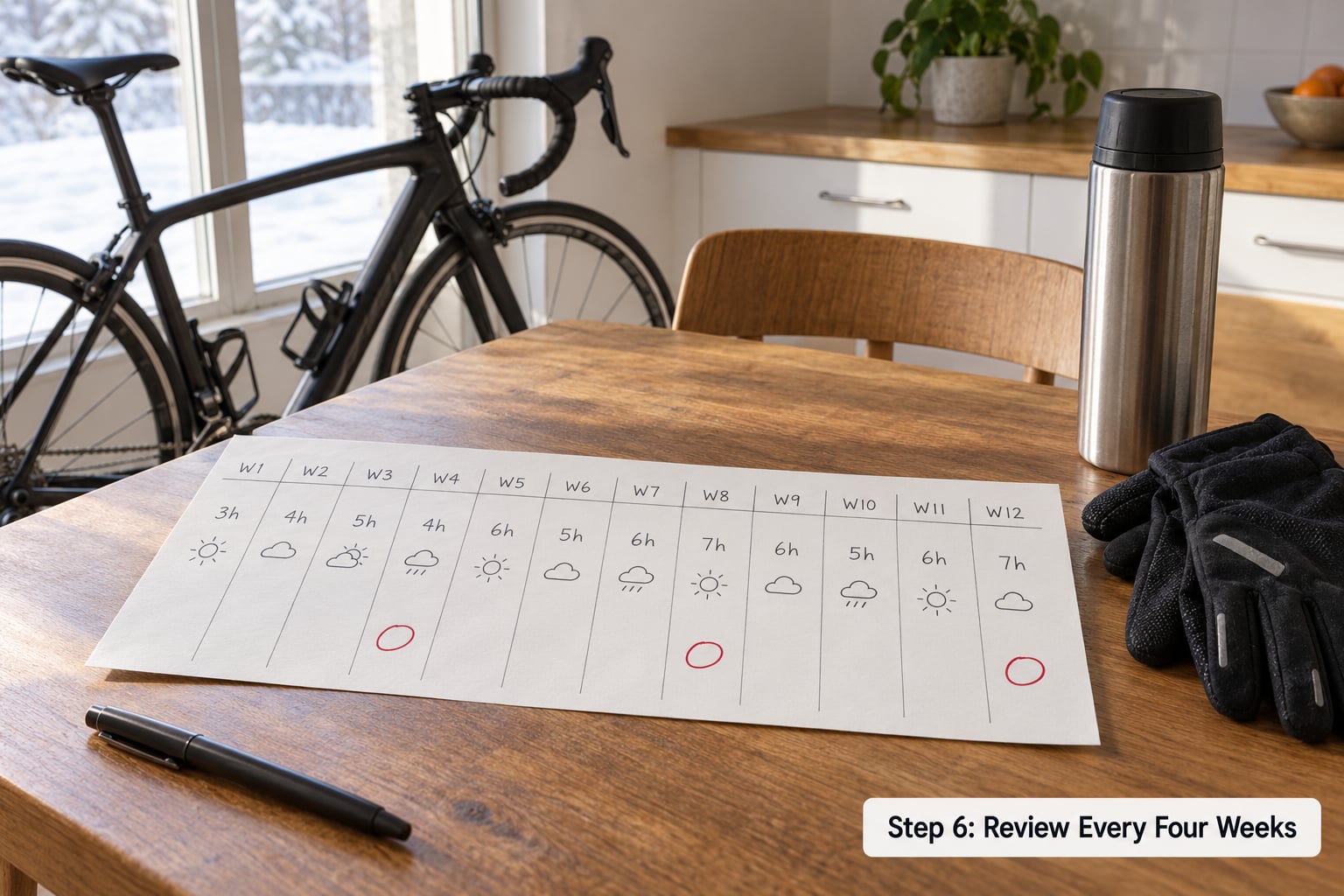
Review at the end of weeks 4, 8 and 12, and it takes fifteen minutes. Compare planned hours with actual hours, and look at three things: your long-ride duration, your fatigue between sessions, and your pace at a fixed heart rate.
That last number is the most useful thing in this whole article. If you ride 45 minutes at the same heart rate in week 8 as in week 1 and your speed is up, the plan is working, even if you missed a session.
Then adjust the next block. If you completed the planned hours and felt reasonable, add 5 to 10 percent to the long ride. If you missed more than two sessions or felt flat all week, hold the same volume for another week.
Never make up missed sessions. If you lost a week to illness or a holiday, drop back to the last completed week’s duration and build forward again from there. A missed week costs very little; a compressed re-entry costs a lot.
One protocol for illness, since winter is peak season for it: reduce training, keep fluids up, and if symptoms persist beyond a week or include chest pain or breathlessness at rest, see a doctor before returning. If you were genuinely unwell, restarting with a week of easy riding is faster than trying to catch up.
What to eat and drink in winter
Winter training fails more often on fuelling than on fitness. You are colder, you often ride indoors with no wind chill, and you under-fuel because you feel less hungry than in summer.
| Session length | Carbohydrate per hour | Fluid per hour | Notes |
|---|---|---|---|
| Under 60 minutes | None needed | 400-600 ml | Water is enough |
| 60-90 minutes | 30-60 g | 500-700 ml | One bottle with a mix |
| 90 minutes to 3 hours | 60-90 g | 500-750 ml | Eat every 20-30 minutes, start early |
| Over 3 hours | 90 g plus | 600-800 ml | Add sodium in the last hour |
Across the day, aim for roughly 5 to 7 grams of protein per kilogram of body weight, spread over three or four meals, with 25 to 40 grams after the long ride. Carbohydrate needs drop slightly on easy indoor sessions and rise on weekend long rides.
The indoor-specific mistake is under-drinking. In a cold room you feel little thirst while sweating steadily for 90 minutes, which is exactly the setup for arriving home mildly dehydrated. Drink on a timer rather than on thirst.
Common Mistakes
Most winter plans fail for six recurring reasons, and every one of them has a simple correction.
1. Copying your summer volume. The fix: cut hours by 20 to 30 percent from your summer average and keep the intensity distribution the same. Winter training adds fitness slowly, and the slower you go the less you lose.
2. Riding every session hard. The fix: hold to two quality sessions a week and fill the rest with zone 2. Riders who pile on three sweet spot sessions a week in winter often find themselves flat by February.
3. Skipping the recovery week. The fix: keep week 5 in the plan whether or not you feel like it. Cutting 30 to 40 percent for a week is the cheapest performance gain in the whole block.
4. Ignoring daylight and weather. The fix: schedule the quality session indoors and the long ride at the best-lit time you have. A plan that only works in July is not a winter plan.
5. Under-fuelling indoors. The fix: use the table above and drink on a timer. Bonus points for eating a normal dinner on long indoor days, since indoor sessions are easy to leave un-fed.
6. Progressing too quickly after a break. The fix: go back to the last week you actually completed and rebuild from there, adding 15 minutes a week. A lot of riders try to restart at their spring load in January and lose the winter to injury.
One more worth naming: the plan that assumes you are available. If you know a month of evenings are gone, schedule that in now and plan a reduced week, not a missed one. Riders who plan their holidays into the block finish the year; riders who treat them as interruptions usually do not.
And if you genuinely dislike structured winter training, take the break. Riders who take four to six weeks off in early winter, return with a short base phase and build through January and February usually lose less than riders who force a plan they resent for five months.
Frequently Asked Questions
How many hours a week should I cycle in winter?
For most recreational riders, six to ten hours a week across three rides is enough to hold or slightly improve fitness over winter. Riders with an eight-to-twelve hour budget can add a second quality session from week six onward. What matters most is consistency and the share of those hours spent easy. A rider who hits five hours weekly for twelve weeks will finish spring ahead of someone who plans twelve hours and delivers four. Cut volume by 20 to 30 percent from your summer average and keep the intensity split the same.
Should I do base training or sweet spot this winter?
It depends on your long-ride duration. If your longest recent ride is under two hours, spend the first four to six weeks on endurance work only and add sweet spot later. If you regularly ride three hours or more, you already have an aerobic base and can run one or two sweet spot blocks a week from week six, filling the rest with zone 2. Riders on forums who pushed sweet spot all winter without a base report going flat; those who added it once the base existed kept progressing.
Can I train indoors all winter?
Yes, with two adjustments. Your indoor FTP usually reads lower than outdoor because cooling and focus are worse, so test outdoors when conditions allow and do not panic about a drop. Second, indoor riding carries less proprioceptive and balance demand, so add single-leg strength work and controlled descents once conditions clear. Everything else, including long sessions, fuelling and intensity distribution, transfers directly. Riders in cold climates train indoors for months and still improve FTP.
What temperature is too cold to ride a bike?
There is no single cut-off, but below about minus 7 degrees Celsius most riders should stay off the road unless they have full winter kit, a short sheltered route and a low wind chill. Between 0 and minus 7 degrees Celsius, cold is manageable with proper layering. Above freezing, cold is rarely the limiting factor: packed snow, black ice and water on the road are. If the surface is wet or frozen, train indoors regardless of the thermometer. Cold plus a stationary bike in an unheated room is also a real hypothermia risk.
How many FTP gains should I expect over winter?
An already-fit rider should expect roughly five to ten percent, and most of that comes from the long ride and the sweet spot blocks rather than from more hours. Beginners can improve faster because the aerobic system responds to volume quickly. Test at the start, at week five and at week ten, and always in the same conditions: same bike, same duration, outdoors if you can. A four-week recovery week will make the week-ten number look like a dip, so judge the trend across the three tests rather than any single result.
How do I stay motivated to train indoors?
Set a fixed weekly slot and protect it like a meeting, because the sessions that get skipped are the unplanned ones. Ride outdoors whenever conditions allow, even if it is a short commute ride, and keep one session a week that is genuinely enjoyable rather than a test. Change the format, not just the playlist: a two-hour ride with three tempo blocks feels completely different from two hours of steady zone 2. Training with a friend, even remotely, is the most reliable fix riders report.
Conclusion
Five things to do this week, in order: write down your baseline numbers, choose your goal as maintain, foundation or spring readiness, block out three ride types and two strength sessions for the next seven days, put weeks 4, 8 and 12 in your calendar as reviews, and settle the indoor-versus-outdoor rule before the first cold morning arrives.
Progress slowly enough that you are still riding in week twelve, and adjust from the data rather than from how the plan was supposed to go. That is the whole winter training plan for cyclists: three ride types, two strength sessions, one review every four weeks, and a bias toward easy riding.