A cycling training plan for busy schedules works best when it is built small: about four to five hours across three sessions a week. Most time-poor riders get faster doing that than squeezing in daily sessions they never finish.
The trick is structure rather than volume. You need one long easy ride, one short hard session, and a third ride that fills whatever gap is left. Get those three in most weeks and you will build fitness; get six half-hearted rides in and you will just stay the same.
This guide covers how much time is realistic, which sessions matter, and how to build a plan you can adjust when work shifts, weather turns or the week falls apart. It is written for the office worker finishing late, the parent with a Saturday morning free, and the shift worker whose weekend is sometimes a Tuesday.
Table of Contents
- How Much Time Should You Cycle Each Week?
- What Makes a Cycling Training Plan Work on a Busy Schedule?
- Which Workouts Should You Prioritize?
- The weekly long ride
- The intensity session
- The third ride
- Strength work, if you have twenty minutes
- How Do You Build a Weekly Cycling Training Plan?
- What Can You Do in 30 Minutes?
- How Do You Use Intervals Without Recovering for Hours?
- How Do You Train for a Century or Double Century?
- What If Your Schedule Changes Every Week?
- How Do You Recover When Training Time Is Limited?
- How Do You Track Progress Without Extra Time?
- Frequently Asked Questions
- Is cycling 3 hours a week enough?
- What is a good training schedule for cycling?
- How many intense sessions per week should I do?
- What is the 80/20 rule in biking?
- Is indoor training as good as outdoor?
- Does cycling to work count as training?
- Start With the Session You Can Actually Finish
How Much Time Should You Cycle Each Week?
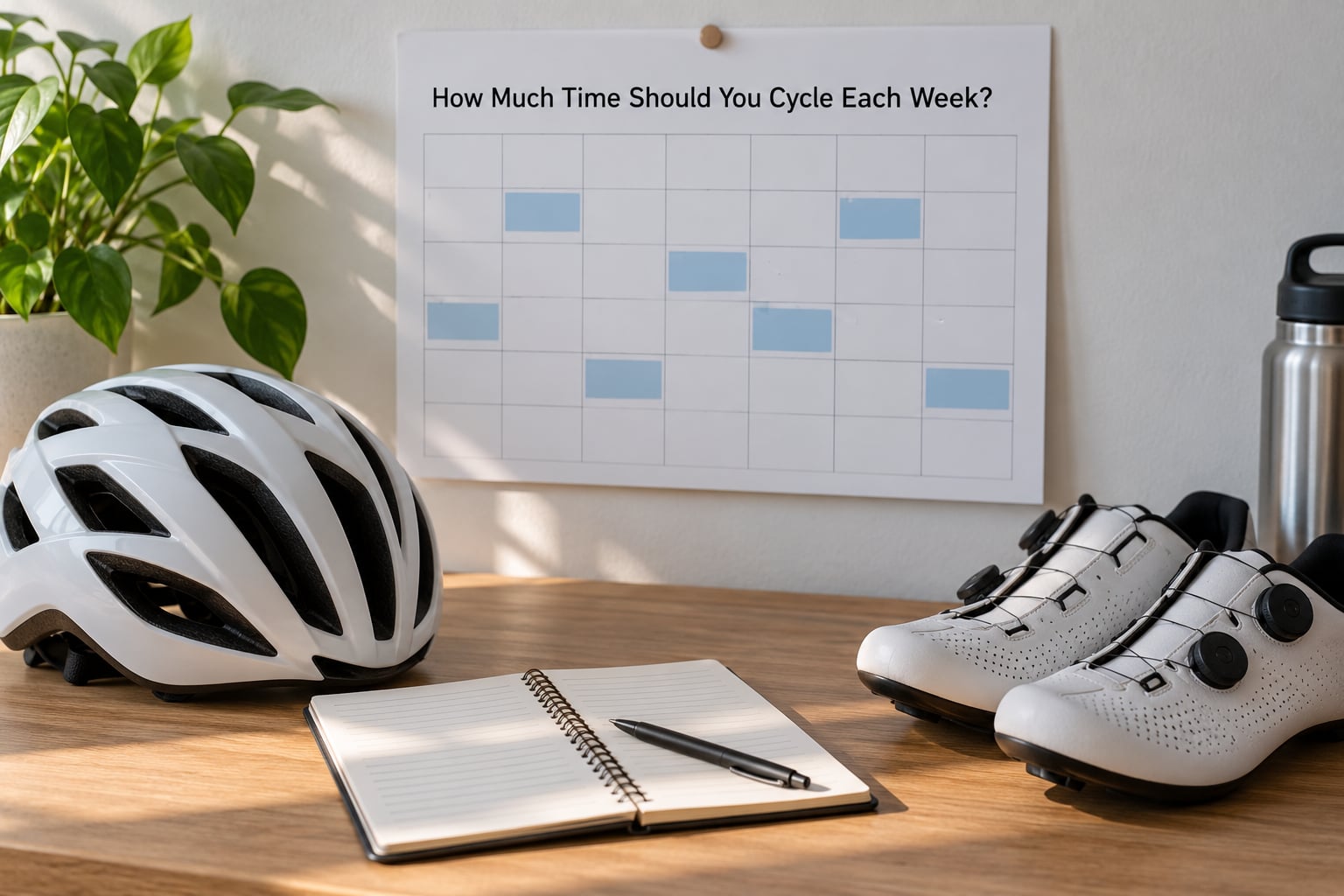
Three hours a week is enough to improve if the sessions are placed well. Below that, you are maintaining rather than building, and you need at least two separate hard efforts plus one longer ride to keep moving forward.
| Rider situation | Weekly hours | Sessions | What it builds |
|---|---|---|---|
| New rider, one free block a week | 2 to 3 hours | 1 to 2 | Habit, bike handling, general fitness |
| Committed through the week | 1 to 2 hours | 3 to 4 | Maintenance only |
| Busy schedule, steady training | 4 to 5 hours | 3 | Aerobic base, threshold, steady progress |
| Standard week with room to move | 6 to 8 hours | 4 to 5 | All-round development, long-ride prep |
| Plenty of time, club racing | 9 to 12 hours | 5 to 6 | Race-specific fitness, repeated hard days |
Two caveats worth holding onto. First, the 1 to 2 hour row is what most weekday riders actually produce, and a week of that is not a training week at all, it is a holding pattern. Second, quality outruns quantity almost every time: five hours with two well-placed hard efforts beats eight hours of everything in the grey zone.
What Makes a Cycling Training Plan Work on a Busy Schedule?
A plan survives contact with a real week when it is built on four principles:
- Consistency over perfection. A six-week run of decent weeks beats one perfect block followed by three empty ones. Design for your worst realistic week, not your best one.
- Two anchor sessions. Decide in advance which two rides matter most and defend them first. Everything else is negotiable around them.
- Minimum-effective sessions. When a session has to be short, shorten it honestly. Thirty focused minutes beats a cancelled hour.
- Flexible recovery. Hard days need 36 to 48 hours between them. If the calendar will not give you that spacing, move a session rather than stacking.
Here is how it works for a rider with a demanding Monday to Thursday and a free Saturday morning. The anchors are the Saturday long ride and a Thursday evening threshold session. Tuesday becomes a short hill or interval workout because the body is still fresh. Monday, Wednesday and Friday stay easy, and Sunday is rest.
Now suppose Thursday’s overtime lands. The rider drops the threshold session rather than pushing it to Friday, which would have squeezed hard efforts together. The long ride stays. One lost session out of six is noise; two hard days back to back is a trend that ends in a bad week and a few days off the bike.
Which Workouts Should You Prioritize?
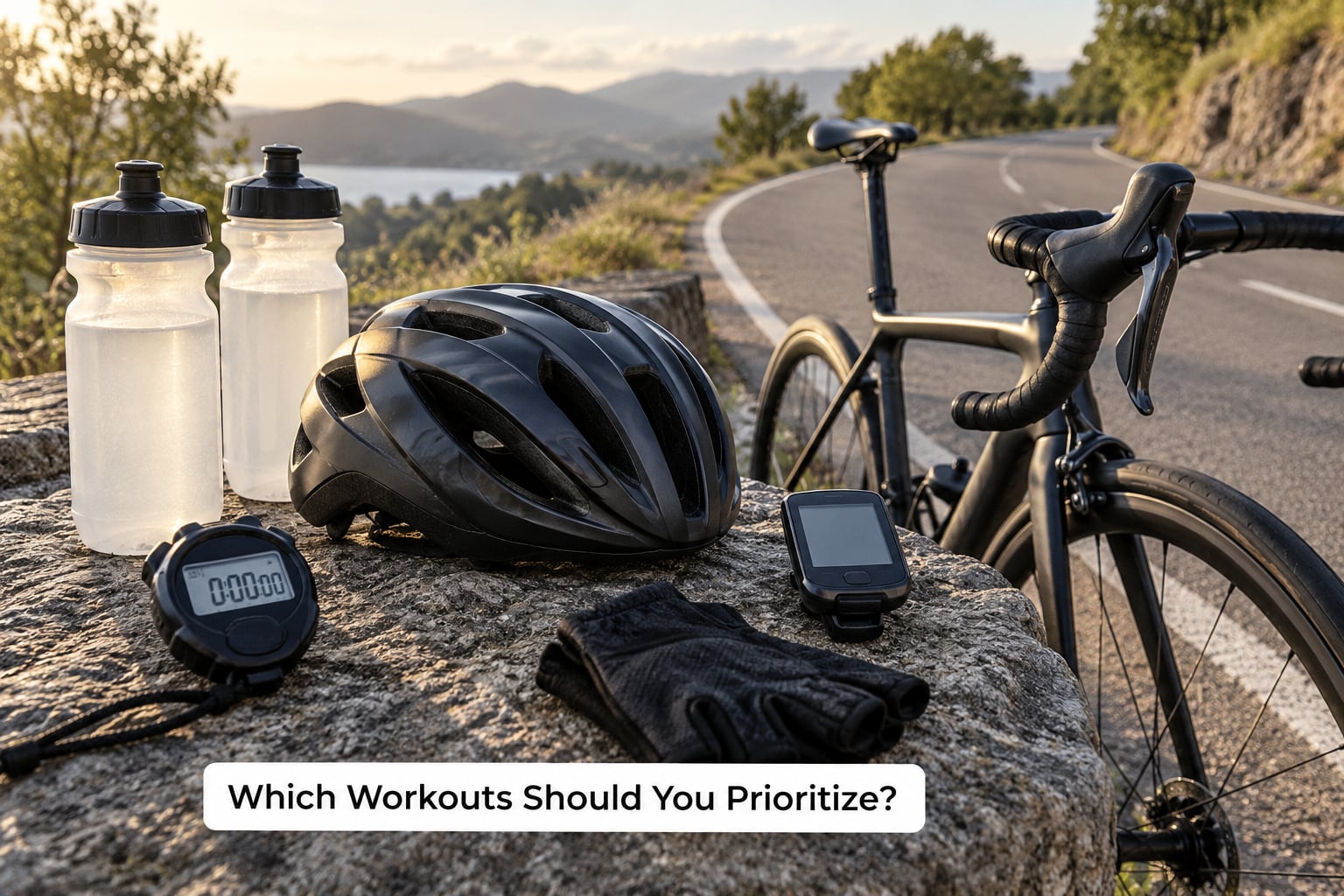
If you can only protect a handful of sessions, protect these. Everything else on your list is optional.
The weekly long ride
Two to three hours of steady riding at a conversational pace, roughly 75 to 80 percent of your threshold power or comfortably under your maximum heart rate. Its purpose is aerobic base and the specific endurance of staying out for hours, not speed. Shorten it to ninety minutes and you keep most of the base work. Cut it below an hour and you are better off doing steady volume that day instead.
The intensity session
Sixty to ninety minutes total including warm-up, with twenty to forty minutes of the actual work. Options include threshold intervals of four by four minutes hard, long hill repeats of three by eight minutes, or short VO2 work such as five by fifteen seconds at near-maximum. This is the session that moves your ceiling, and it is the first one to protect when a week gets tight.
The third ride
Whatever is left, almost always easy. Sixty to ninety minutes of relaxed riding, a commute, or a lunchtime loop. It builds consistency, keeps the legs remembering what riding feels like, and costs very little emotionally.
Strength work, if you have twenty minutes
Two short sessions a week of squats, hinges, rows, presses, lunges and core work do more for your riding than most riders expect, because cycling asks for repeated force production and a stable torso rather than raw power. Keep it to two or three sets of 5 to 8 reps and stop before you are wrecked.
How Do You Build a Weekly Cycling Training Plan?
A cycling training plan for busy schedules takes about ten minutes to build once you have a calendar in front of you. Do it in this order.
- Set one primary goal. General fitness, a century, faster club rides, or coming back after a layoff. The goal decides how much intensity you need.
- List your fixed commitments. Work hours, school runs, shift pattern, anything recurring. Be honest about the worst week, not the average one.
- Place the anchor sessions first. Put the long ride and the intensity session on the calendar as appointments, then build around them.
- Fill the gaps with easy riding. Assign shorter workouts to whatever remains, keeping at least two days clear of riding entirely.
- Space the hard days. Leave at least a day between intensity sessions. Non-negotiable.
- Plan a lighter week every third or fourth week. Cut duration, keep one or two sessions, ride everything else easy. This is what makes the hard weeks work.
A sample week for a rider with limited weekday time:
| Day | Session | Duration | Focus |
|---|---|---|---|
| Monday | Easy spin or rest | 30 to 45 min | Recovery, circulation |
| Tuesday | Intervals or hill repeats | 60 min | The week’s intensity |
| Wednesday | Commute or easy ride | 40 to 60 min | Consistency |
| Thursday | Easy endurance | 60 to 75 min | Aerobic base |
| Friday | Rest | 0 | Recovery |
| Saturday | Long ride | 2 to 3 hours | Endurance, fueling practice |
| Sunday | Rest or easy walk-ride | 0 to 45 min | Recovery |
Notice what is missing: a second hard day. For a rider with a demanding workweek, one quality intensity session plus a long ride is a solid week. Add a second hard session only when the calendar genuinely supports the recovery it requires.
What Can You Do in 30 Minutes?
Thirty minutes is enough for a real session if you treat it as one.
- 30-minute steady endurance. Ten minutes easy warm-up, fifteen to eighteen minutes at steady conversational effort, easy cool-down. This is your default weekday filler and it works well on a trainer when the weather or the light is bad.
- 30-minute hill or tempo block. Easy spin for ten minutes, then three or four efforts of three to five minutes at a hard but controlled pace with equal or slightly shorter recoveries, then spin down. Nothing here needs a full day of recovery, which is exactly why it fits a Tuesday.
- 20 to 30 minutes of strength. Squats, Romanian deadlifts, rows, overhead press, lunges, plus a short core set. Twice a week beats an hour once a month.
One thing short sessions do not do: replace long rides when you are preparing for a century. Fitness gains come from intensity, but the specific ability to sit on a bike for six hours is built only by riding for six hours. If your week contains one long session, make that the one you keep.
How Do You Use Intervals Without Recovering for Hours?
The standard recovery ratio of two to three times the work interval is a guideline, not a law, and it comes from training age and accumulated fatigue rather than a calculator. Riders new to structured training, returning from a layoff, or holding a demanding job usually recover better than the textbook suggests.
Try this structure, which fits inside 60 to 75 minutes including warm-up and cool-down:
- Warm-up: 15 minutes easy, with three or four 30-second high-intensity efforts in the last five minutes to get the legs switched on.
- Main set: 3 by 8 minutes at 88 to 94 percent of threshold power, with 4 to 5 minutes easy between efforts. This is sweet spot work, it builds sustainable speed, and it is not exhausting enough to wreck your week.
- Cool-down: 10 minutes easy.
On a day when you have less recovery in you, drop to two efforts of 15 minutes at around threshold with five minutes easy between them. Same intent, smaller dose, and you still finish the week healthy.
Stop the set if you see unusual pain, feel dizzy, get a headache, notice your breathing is ragged in a way that is not effort, or feel your cadence collapse. Mild burning in the legs during a hard effort is normal; sharp joint pain, chest pain or anything that does not settle in a few minutes after stopping is a reason to end the ride and speak to a doctor or other qualified clinician about it.
How Do You Train for a Century or Double Century?
Long events are trained with long rides, not with more intervals. Build the long ride up gradually, keep the intensity work alongside it, and practice fueling and pacing on every one of these rides.
| Phase | Longest ride | Weekly hours | Notes |
|---|---|---|---|
| Weeks 1 to 4 | 90 min to 2.5 hours | 4 to 5 | Steady pace, one hard session |
| Weeks 5 to 8 | 3 to 3.5 hours | 5 to 6 | Practice eating and drinking on the bike |
| Weeks 9 to 11 | 4 to 4.5 hours | 6 to 7 | Hold effort steady, resist heroics |
| Final week | 60 to 90 min | 3 | Stay sharp, arrive fresh |
Nobody should jump from three-hour weekend rides straight to a double century. The damage usually shows up in week two of the event, not in the first 80 km, which is why a long-event plan for a busy rider needs a real base underneath it.
If your week only allows four hours total, a double century is a serious undertaking and you would be better served by shorter events this season. If you have six or seven hours, most recreational riders can get there with steady progression.
Once you are consistently riding three hours, you can add one back-to-back block: a shorter ride the morning after a long one, done entirely easy. It trains the tired-ride feeling that long events expose, and it is the first thing to cut if your week goes sideways.
What If Your Schedule Changes Every Week?
Use a rolling three-level week instead of one fixed plan.
- Minimum week: 2 to 3 hours. One long easy ride plus one short session. Use it during illness, exam periods and heavy deadlines.
- Standard week: 4 to 5 hours. The plan above. This is your normal.
- Ideal week: 6 to 8 hours. Add a second hard session and a longer ride when time opens up.
Plan for the minimum week and treat anything better as a bonus, and you will never feel like you failed. That is the whole trick of a plan for a rotating roster: anchor sessions float, the rest moves around them.
For shift workers, map your pattern before you plan. A week of four early shifts is a minimum week, so the long ride and the intensity session need to land on your days off, and Thursday-and-Friday intensity spacing does not apply to a Tuesday-to-Friday block. Treat the first day back as a hard day and the last as a recovery day.
On travel weeks, keep whatever you can: two short sessions on a hotel gym bike or a rental, and some walking. On exam weeks or a brutal fortnight at work, ride easy or not at all.
What never works is making up missed training. Two hard sessions on consecutive days to recover a missed week is how riders end up grey and tired for a month. Lost sessions are not debt to be repaid.
How Do You Recover When Training Time Is Limited?
Recovery is the cheapest part of a plan and the first thing busy riders sacrifice. Keep it simple.
Sleep is the biggest lever. Most riders train on six hours and then wonder why their heart rate drifts upward in week three. Protect a consistent bedtime, and if you are on an early shift, treat sleep before the ride as part of the session, not a reward after it.
Keep easy days genuinely easy. An hour of relaxed riding at the low end of Zone 2 lets you ride again tomorrow. Ninety minutes of grey-zone effort does not, and it is the most common reason otherwise good plans stall.
Refuel on the bike for anything past about ninety minutes: carbohydrates and fluids at regular intervals rather than when you first feel hungry. A simple pattern is a bottle of mix and something to eat every 30 to 45 minutes, and a proper meal with protein within the couple of hours after you finish.
Ten minutes of mobility work, light stretching or easy walking does more for stiffness than a long cool-down ride. If pain, swelling or fatigue persists for more than a few days, stop pushing and talk to a doctor, physiotherapist or other qualified clinician rather than training through it.
How Do You Track Progress Without Extra Time?
Five fields, thirty seconds each, once a week. That is the whole log.
| Field | What to record | Why it matters |
|---|---|---|
| Total time | Hours ridden this week | Shows whether the plan is realistic |
| Longest ride | Duration of your longest session | Tracks your long-ride progress |
| Intervals completed | Sessions finished as written, or short | Shows consistency under fatigue |
| Perceived effort | Rate each ride 1 to 10 | Catches fitness drift without a power meter |
| Recovery | Sleep, soreness, energy, one word | Tells you when to back off |
Look at the trend across three weeks, not the numbers on any one day. If your longest ride is growing and your effort ratings are steady or falling, the plan is working. If effort climbs while output sits still, you need an easier week, not a harder one.
When something needs to change, change only one thing: add a minute, add a repetition, or lengthen the long ride. A power meter is useful once the plan is working, but perceived effort plus total time and longest ride will tell you everything you need in your first year.
Frequently Asked Questions
Is cycling 3 hours a week enough?
Three hours a week is enough to improve if the time is placed well: one long easy ride of about ninety minutes, one quality interval session of about an hour, and one shorter easy ride. Below three hours you will mostly maintain what you have rather than build. Two hard sessions in a single week is plenty for a busy rider, and at least 36 to 48 hours between them.
What is a good training schedule for cycling?
A good weekly schedule puts one long easy ride on the weekend, one hard interval or hill session midweek, and one or two shorter easy rides in the gaps. Keep at least one full rest day. Spacing hard days by 36 to 48 hours matters more than the exact day of the week, and a lighter week every third or fourth week keeps the harder ones productive.
How many intense sessions per week should I do?
For a time-poor recreational rider, one or two intense sessions per week is the realistic number. More than that, stacked without recovery, produces fatigue rather than fitness and is the most common reason a good plan collapses. Count an effort as intense if your breathing is hard and you cannot hold a conversation, regardless of how short the session is.
What is the 80/20 rule in biking?
The 80/20 rule means roughly 80 percent of your weekly riding time sits in easy endurance work and 20 percent in genuinely hard efforts. It fits a busy rider well, because the easy sessions are short and the hard ones are deliberately limited. The related 75 percent rule is a looser version used for beginners, where about three quarters of the time is easy and one quarter is hard.
Is indoor training as good as outdoor?
For structured intensity work, indoor riding is hard to beat, because resistance holds steady and you are not fighting wind or traffic. For endurance and pacing practice outdoors is better, since real roads involve hills, drafts and feeding yourself at speed. On a smart trainer in ERG mode, a 60-minute session indoors can carry most of the load of a two-hour outdoor ride.
Does cycling to work count as training?
Commuting counts, and many riders with full-time jobs get most of their base from it. Ride it at an easy, steady pace most days and it is genuine aerobic work. If you race to work hard and redline intersections, you get the fatigue of a hard day with none of the structure, so treat a few hard commutes a week as your intensity sessions and keep the rest easy.
Start With the Session You Can Actually Finish
Pick two sessions you can complete even in a bad week: one long easy ride and one interval session. Put both in your calendar as appointments, add a short easy ride wherever there is room, and start from there.
A cycling training plan for busy schedules is not about finding more hours, it is about protecting the right ones. Build four to five hours around the sessions that matter, keep the rest flexible, and adjust the plan instead of abandoning it.