Rate of perceived exertion, or RPE, is a 1 to 10 scale cyclists use to rate how hard a ride or interval feels, where 1 is almost no effort and 10 is an all-out maximal effort. You assign the number from how the effort feels, not from the number on a head unit. Practicing how to use RPE in cycling training takes about three rides to become useful and a full season to become accurate.
The idea is deceptively simple: anchor each number to something you can actually feel, mainly breathing and the ability to speak a full sentence, then steer training off those anchors. That is enough to run a structured season without a power meter. It is also the fastest way to know when a familiar ride has started costing more than it used to.
A heart rate strap helps. A power meter helps more. Neither one is required, and both will eventually argue with you. Perceived effort is the layer that says what the numbers cost you on the day, and that is information a wattage or a beat-per-minute reading cannot give you on its own.
Table of Contents
- What You Need
- Step-by-Step
- Set Your Baseline RPE
- Rate Every Major Effort Zone
- Use RPE to Set Ride Intensity
- Apply RPE to Common Cycling Workouts
- Track RPE and Progress Over Time
- Common Mistakes
- Frequently Asked Questions
- Should I use RPE instead of power or heart rate when cycling?
- How do I know what RPE means on a bicycle?
- What RPE should I use for a long century ride?
- Is RPE accurate for beginners who do not know their fitness level?
- How do I use RPE for interval training?
- Does heat, hills, or fatigue change the RPE for the same workout?
- Conclusion
What You Need
You need three things, and all three are free.
First, a working effort scale in your head. Ten numbers is enough. Second, a way to take notes, whether that is a phone note in the saddle bag or a line in a training log. Third, an honest read on your current fitness, because an RPE of 7 in week one of a block and an RPE of 7 in week five are not the same ride.
Everything else is optional but useful. A heart rate monitor gives you a second signal, especially on long steady rides where your perception drifts upward. A power meter turns effort into something you can repeat exactly, which is how most riders eventually find their anchors. A cadence sensor is nice for pacing intervals.
What you do not need is a fitness benchmark. You do not need to know your FTP, your threshold heart rate, or what good looks like for someone your age. Perceived effort works precisely because it is relative to you, on the day, at your current level.
Step-by-Step
Set Your Baseline RPE
You cannot rate effort until you know what your own numbers mean, and most riders are guessing. Build the anchors over about six rides rather than in your head.
Ride one flat, familiar loop three times at three different intentions: as easy as you can ride while still pedalling, genuinely steady, and as hard as you can hold for ten minutes. After each one, write down the number you would have given it. Do not look anything up. Three numbers is all you need to start.
Then find a climb you know well. Ride it three times: seated and relaxed, at a hard sustainable pace, and at a pace that leaves nothing. Write a number for each. Climb effort often feels different from flat effort at the same physical output, mostly because of the leg load, so it is worth anchoring on its own.
The calibration is done when you can repeat a number on the same effort three weeks later. Riders on the TrainerRoad forum describe the most common version of this problem as a workout that consistently feels easier than the prescribed number, and the fix is almost always that the target was copied from a training partner’s scale rather than anchored to their own. Your 7 is not his 7. Nobody is lying; you are just using borrowed numbers.
One trap to avoid early: riders coming from running or triathlon should start over. A 7 out of 10 on the bike can only be held briefly, and the same number on foot is a much longer effort because running carries your own bodyweight and uses a different muscle recruitment pattern. Calibrate the bike scale on the bike.
Rate Every Major Effort Zone
Here is the reference most riders are looking for, and it is worth printing.
| RPE | Training use | What it feels like | Talk test | Approx. % FTP |
|---|---|---|---|---|
| 1 | Nothing | Flat out on the sofa | Sing a song | 0% |
| 2 | Active recovery spin | Easy pedalling, no resistance worth naming | Sing a song | 30% |
| 3 | Recovery ride, post-interval cool-down | Comfortable for hours, legs loose | Sing a song | 40% |
| 4 | Long endurance, zone 2 | Steady, relaxed, could chat all day | Full sentences, easily | 50% |
| 5 | Steady endurance with some bite | Breathing noticeably up, holding form | Full sentences, some pauses | 60% |
| 6 | Tempo, sweet spot | Pushy but controlled, shoulders tense | Short phrases | 70% |
| 7 | Sustained hard, threshold climbing | Deep breathing, focus narrowing | A few words at a time | 80% |
| 8 | Threshold intervals, hard efforts | Committed, powerful, limited thoughts left | Single words | 88% |
| 9 | VO2max work, racing effort | Very hard, digging, sight narrowing | No words | 95% |
| 10 | Maximal, sprint or all-out finish | Everything you have, seconds not minutes | Silence | 100% |
The percent of FTP column is a rough guide for riders who have a power meter, not a conversion rule. Individual responses vary a lot, and research by Chen and colleagues in 2002 found correlations of roughly 0.62 with heart rate, 0.57 with lactate, 0.64 with percent VO2max and 0.72 with respiration rate. Useful, and not exact.
Mind the scale you are reading. Gunnar Borg’s original scale runs 6 to 20, and a coach saying RPE 15 is not describing a fifteenth effort. On the 6 to 20 scale, 15 to 16 is heavy work and 17 to 18 is very hard. The modified 1 to 10 scale is the one used almost everywhere in cycling. Numbers are not interchangeable across scales, so convert before you compare.
Use RPE to Set Ride Intensity
Pick the target RPE first, then decide whether to hold it. To use RPE in cycling training properly, the number sets the intention and your judgement decides whether the terrain lets you keep it.
When a workout feels off, the sequence matters. Check fueling, heat and fatigue before you touch your training zones. Under-fuelled, hot or sleep-deprived, the same wattage genuinely costs more, and moving your zones to chase the feeling trains a weakness. If the cause is in the legs and not the day, adjust the session down.
The rule I use, and the one that settles the most common forum argument about whether to modify the workout or accept the rating: keep the session, change the target. Ride the interval structure you planned, then hold a lower RPE and note the gap. You keep the training stimulus of the workout and you record honest data. Changing the workout mid-session because the number feels wrong usually means the number was wrong at the start.
Two things you should never do. Never chase a number that is moving, and never start an interval set at the number you expect to finish on.
Apply RPE to Common Cycling Workouts
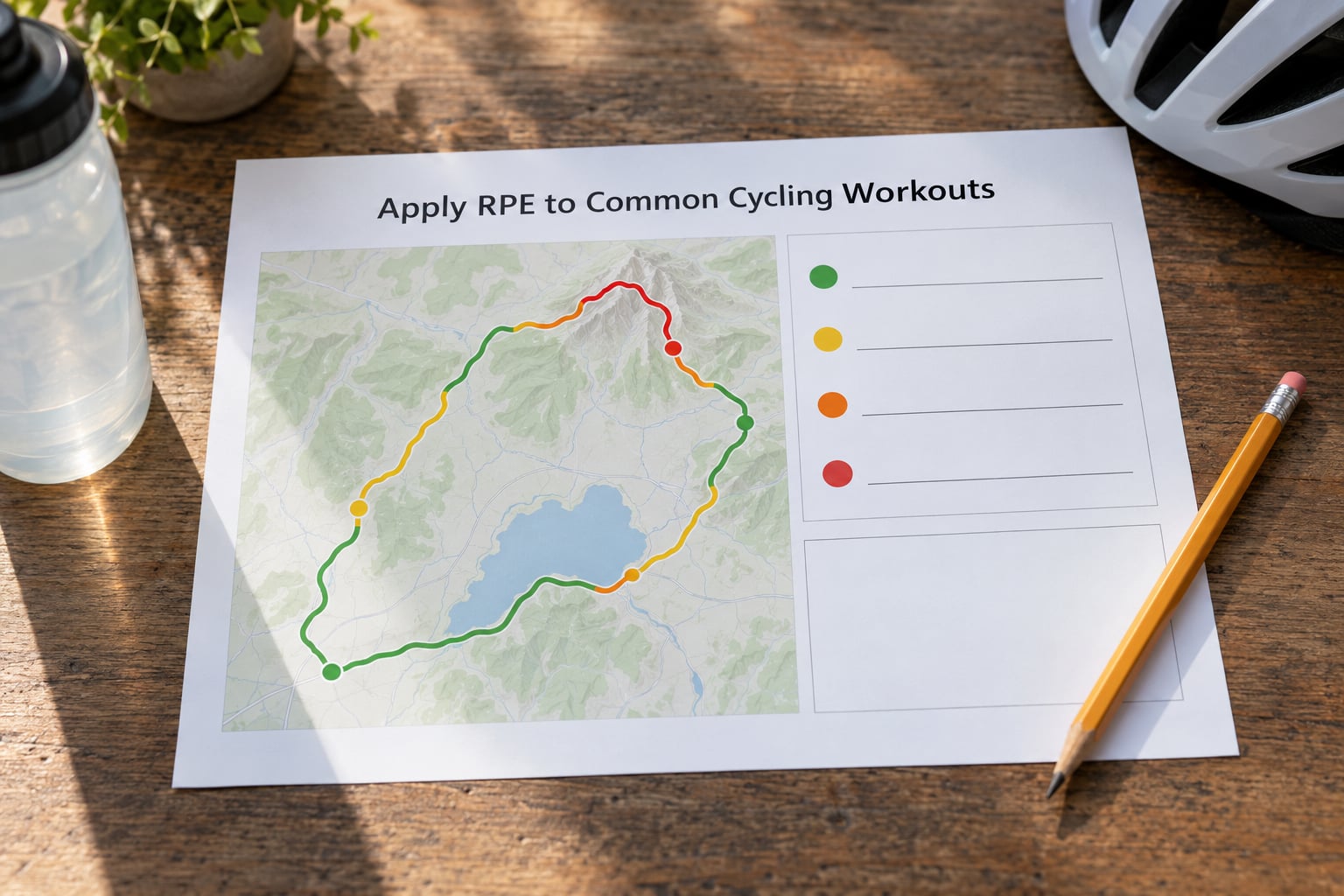
Here are the targets most sessions actually need.
- Recovery spin: RPE 1 to 2. If you cannot hold a full conversation easily, you are riding too hard.
- Endurance and zone 2 ride: RPE 3 to 4 for most of the ride. If it settles at 5 to 6 after an hour, you have drifted into tempo territory and that is worth knowing.
- Tempo or sweet spot block: RPE 6, ten to twenty minutes, controlled rather than desperate.
- Threshold intervals: RPE 7 to 8, three to five minutes each, with the last repetition still able to hold form.
- VO2max work: RPE 9 for three to five minutes. Heart rate is slow to respond here, which is exactly why perception beats the strap for short hard efforts.
- Hill repeats: RPE 7 to 8, and judge repeats on the last one rather than the first.
- Long century or double: RPE 4 early, RPE 5 once settled, and aim to finish no harder than 5.
- Group ride: Decide your number before you roll and let the group go. The usual failure is riding at RPE 6 because everyone else is, and paying for it in the last hour.
Indoor sessions follow the same scale with one adjustment. Trainer resistance is not road resistance, and a set that reads as a moderate push outdoors can feel brutally hard at a low setting indoors. Judge by breathing and by cadence, not by the knob. Riders without any power meter lose nothing here; they only lose the ability to repeat a session exactly, which is a smaller problem than it sounds.
Track RPE and Progress Over Time
To track RPE and progress, log the same few things after every ride, within about fifteen minutes of finishing while the memory is fresh.
Write down the session RPE for the whole ride, which is the average of what the workout cost including warm-up and cool-down, not the hardest moment. Write the effort for the main set separately. Then write a sentence on how it felt, the conditions, and one honest question: would you do this again tomorrow if the plan required it?
Those three numbers together are the load. Multiply session RPE by the minutes you rode and you get a simple load figure you can compare week to week. It is not a laboratory measure, but it trends well, and a week where the same session suddenly costs 20 percent more is a real signal rather than a mood.
Two patterns matter most in the log. First, the same familiar ride rating higher every week for no obvious reason, which usually points to accumulated fatigue, poor sleep, or under-fueling rather than a broken scale. Second, everything feeling unusually easy for a stretch, which is what some riders on the Suunto forums describe when early-season fitness arrives and their calibration looks broken. It is not broken. Your anchor moved, which is the point of doing this over a season.
For strength work inside a cycling week, rate the session on the same 1 to 10 scale and log the minutes the same way. Riders asking about this in cycling forums are usually trying to add a lifting load without guessing, and the session RPE times minutes method answers it.
Common Mistakes
Using someone else’s numbers. You borrowed their 7 and now everything feels off. Fix: recalibrate on your own six rides and never compare numbers across riders.
Rating the same number every week. If your threshold session is always a 7, your scale has stopped moving with you. Fix: expect the same effort to drift downward as fitness improves, and re-anchor when it does.
Ignoring the terrain. A flat hour at RPE 4 and a rolling hour at RPE 4 are not equivalent. Fix: rate the effort, not the ride, and note the terrain next to the number.
Confusing soreness with effort. Legs that are heavy from yesterday make a zone 2 ride feel like a 6. Fix: rate effort, not how your body feels overall, and log soreness as a separate field.
Changing the scale mid-ride. You rate the first hour a 4 and the last hour a 6, so the average is meaningless. Fix: fix the number in advance, and if a number changes, write both with the time you changed it.
Chasing the number when the data disagrees. Power looks normal but you feel terrible, so you go harder next time. Fix: treat a high RPE at normal power as a fatigue, heat or fueling signal and change the plan, not the perception.
Mistaking the 6 to 20 scale for the 1 to 10 scale. A coach says 16 and you write down 16 on a scale that ends at 10. Fix: convert everything to one scale before you log it.
Rating only the workout, not the session. The hard set gets logged and the three hours of easy riding before it disappear. Fix: log session RPE and set RPE on the same line.
Frequently Asked Questions
Should I use RPE instead of power or heart rate when cycling?
No. Perceived effort works best as the layer that tells you what a number cost you, not as a replacement for the number. Power is repeatable and heart rate handles long steady days well, but neither captures heat, under-fueling or accumulated fatigue on its own. RPE catches those, and it is the only one of the three that still works with no hardware at all. Most riders end up using all three, and reach for RPE whenever the data looks wrong or the conditions are unusual.
How do I know what RPE means on a bicycle?
Anchor each number to breathing and speech. At RPE 3 to 4 you can talk in full sentences easily. At 6 you speak in short phrases. At 7 to 8 you manage a few words. At 9 and 10 you cannot speak at all. Calibrate those anchors on your own bike over about six rides, because running and cycling do not share a scale and a 7 on foot is not a 7 on the bike. Write the number down each time so you can see whether it holds.
What RPE should I use for a long century ride?
Aim for RPE 4 for the opening hours, RPE 5 once you are settled, and no harder than 5 for the final hour. RPE 5 is the ceiling, not the goal, because anything above it in the last 60 km is what turns a century into a recovery problem. A negative split on perceived effort is the standard to aim for: the second half should not feel faster than the first, it should simply feel the same while going faster. Practice it on a double first.
Is RPE accurate for beginners who do not know their fitness level?
Beginners tend to overestimate their effort, while very experienced riders tend to underestimate it, so raw numbers mean little without anchors. That is solvable. New riders who calibrate on familiar flat routes and a known climb over about six rides produce RPE values that track their physical output closely, and beginners are exactly the group with the most to gain since they rarely have a power meter at all. Accuracy improves with practice, and the first two months are for building anchors rather than trusting the number.
How do I use RPE for interval training?
Set the target for the work and the hard effort, not the recovery. A typical threshold set is RPE 7 to 8 for three to five minutes, with recovery at RPE 1 to 2. Rate the first repetition and the last separately, and if the last one comes in two points higher, the set was too long or too hard. Do not chase the target by digging deeper in the final minute. Controlled effort that you can repeat is the goal, not a number you hit once.
Does heat, hills, or fatigue change the RPE for the same workout?
Yes, and that is the main practical value of the scale. The same output costs more in heat, in high humidity, on a long climb, after a poor night, or in the last hour of a long ride. If the effort rises for one of those reasons, keep the workout and lower the target, then log the gap. If the effort rises with no explanation across several rides, treat it as accumulated fatigue and build in recovery rather than pushing through. RPE is the only one of your three signals that registers those conditions directly.
Conclusion
Pick one flat, familiar route this week and ride it three times at three different intentions, writing an RPE after each. That is the whole starting point for how to use RPE in cycling training, and those three numbers are the anchors every later session hangs on. From there, rate the main set as well as the session, log both with the minutes you rode, and use the range you get to set the target for next week.
If your training has stalled, effort that used to be comfortable now costing two points more is often the explanation. If you feel light-headed, get chest pain, or notice unusual breathlessness during a ride, stop and get medical advice rather than reading it as a training signal.