Indoor trainer workouts for endurance let you dial in an exact wattage, hold it for an hour, and repeat the same session next week without wind, hills or traffic deciding the outcome. That repeatability is why most serious century riders build their aerobic base indoors and then take it outside. Six session types cover almost everything a long-distance rider needs: steady base, tempo, long endurance, rolling resistance, race-specific work and recovery.
I’ll walk through all six with the warm-up, the main set, the cool-down and the week it belongs in. You’ll also find the intensity methods that work if you don’t own a power meter, and the honest list of ways these sessions go wrong.
Table of Contents
- Indoor Trainer Workouts for Endurance at a Glance
- What Is Endurance Training on an Indoor Trainer?
- Why repeatability beats variety for base miles
- What you lose indoors
- What you gain indoors
- How Do I Choose the Right Trainer Workout?
- How Do I Set Intensity Without a Power Meter?
- Six Indoor Trainer Workouts for Endurance
- 1. Foundational endurance
- 2. Tempo endurance
- 3. Long steady endurance
- 4. Rolling resistance
- 5. Race-specific endurance
- 6. Recovery endurance
- How Should I Build a Weekly Indoor Trainer Plan?
- What Can Go Wrong With Indoor Trainer Workouts?
- Riding at the wrong intensity indoors
- Using an outdoor FTP indoors
- Overuse from a fixed position
- Dehydration and heat
- Skipping the cool-down
- Making every session the same
- Overtraining indoors
- Frequently Asked Questions
- How long should an indoor endurance workout last?
- Do I need a power meter to do endurance workouts on a trainer?
- Should I ride an indoor trainer workout before or after an outdoor ride?
- Is sweating on a stationary trainer dangerous?
- How often should I use an indoor trainer while training for a century?
- Can I use a treadmill instead of an indoor trainer?
- Conclusion: Start With One Sustainable Endurance Session
Indoor Trainer Workouts for Endurance at a Glance
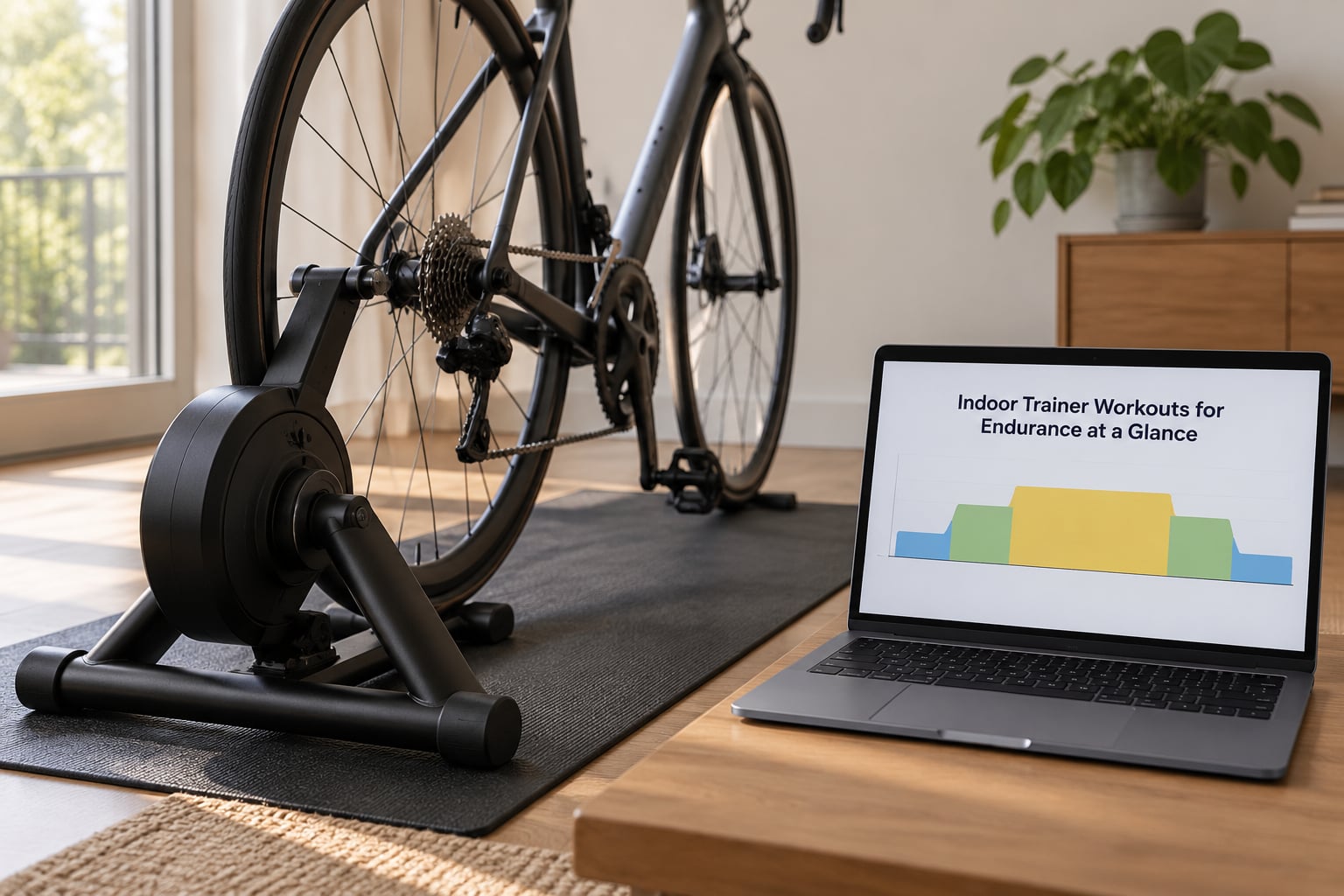
The six sessions below are not six ways to do the same ride. Each one targets a different adaptation, and a training week only works when they are spaced apart.
| Workout | Total time | Intensity | Primary purpose | Best placement |
|---|---|---|---|---|
| Foundational endurance | 60-75 min | Easy, roughly 55-65% FTP | Aerobic base and fat oxidation | Start of the week, or any time you’re fresh |
| Tempo endurance | 75-90 min | Moderate, roughly 75-85% FTP | Steady-state power and lactate clearance | Mid-week, 24 hours after the hard session |
| Long steady endurance | 90-120 min | Easy with small surges | Time on the bike at race pace | Weekend, replacing or supplementing a road ride |
| Rolling resistance | 60 min | Moderate, alternating 3 min hard / 3 min easy | Repeated surges, hills and headwind | After an easy day, before a long ride |
| Race-specific endurance | 2-3 hours | Steady with planned surges | Pacing, fuelling and position on a long event | Once every two or three weeks |
| Recovery endurance | 30-45 min | Very easy, below 60% FTP | Blood flow without adding fatigue | The day after a hard session |
What Is Endurance Training on an Indoor Trainer?
Endurance training indoors is any session where you hold a controlled intensity for long enough to improve your aerobic system, your lactate handling and your ability to sit in the saddle for hours. The trainer removes the variable that makes outdoor endurance work unpredictable: the terrain.
What adapts indoors is not “being outside.” It’s sustained power at a known wattage, a repeatable cadence target, and the ability to reproduce the same numbers in February and in July.
Why repeatability beats variety for base miles
If you ride 90 minutes at 150 watts on the trainer in March and 92 minutes at 152 watts in April, you can see the improvement. On the road, the same two rides might differ by 300 watts of work because of a headwind and a different route.
That’s the honest argument for indoor trainer workouts for endurance: not that they’re better in every way, but that they let you measure progress instead of guessing at it.
What you lose indoors
Bike handling on rough surfaces, cornering, drafting and the mental toughness of a bad-weather ride. If your goal is a single long sportive, keep one long outdoor ride in the schedule each week even in the depths of winter.
What you gain indoors
Consistency in bad weather, no tyre or brake prep, no flat repairs before a session, and the ability to finish a workout exactly as written. Riders on the training forums consistently describe an hour of structured trainer work as worth more than a two-hour unstructured road spin.
How Do I Choose the Right Trainer Workout?
Choose the session that matches what you did three days ago, how much time you actually have, and the distance on your calendar. Picking the workout that sounds most interesting is how riders end up doing threshold work on a Monday after a hard weekend.
Five questions narrow it down fast.
- How long is your current weekly volume? Riders under 10 hours a week should start with foundational endurance and skip the race-specific session entirely. Longer blocks can carry two quality sessions.
- What did you do in the last 48 hours? Hard efforts need at least a day between them. Back-to-back threshold work stalls progress and breeds the overuse problems described later.
- How much time do you have? A 45-minute window is plenty for rolling resistance or tempo. A race-specific block needs two to three hours, which many riders simply do not have on a weekday.
- What are you training for? A century rewards sustained pace and fuelling. A fast club time trial rewards threshold and short efforts. Different events, different emphasis.
- What distance is the event? A common rule of thumb is to train at roughly 80% of your target event distance in one continuous session before the day itself. If the event is 160 km, that means one indoor ride of about 128 km, done at easy intensity.
Write the goal down before you start the session, not after. A session with no purpose tends to drift into either a spin or a sufferfest.
How Do I Set Intensity Without a Power Meter?
You can absolutely train endurance indoors without a power meter, and for long steady work the talk test and heart rate are arguably better than wattage. What you lose is precision on short efforts, and precision is what matters for intervals.
Here are the four practical methods, roughly in order of usefulness.
- The talk test. You should be able to speak a full sentence without pausing for breath on easy endurance work. One or two words at a time means tempo. No words at all means you’re above what an endurance session should be.
- Heart rate zones. Ride at 60-70% of maximum heart rate for base work and 75-85% for steady tempo. Heart rate drifts upward over a long session, so treat a rising number as a reason to ease off rather than a failure.
- Trainer resistance and cadence. Pick a resistance knob setting and a cadence target, then hold both. This is the classic pre-power-meter method and it’s reproducible enough for steady work.
- Perceived effort on a 1-10 scale. Easy endurance sits at 3-4, tempo at 6-7. It’s subjective, but it’s remarkably consistent when you use it session to session on the same bike.
Power meters earn their keep on the short, hard efforts, where a small power difference is the whole difference between the session working and not working. If you use a smart trainer with a built-in power meter, treat its reading as the best available number, but check it periodically with an independent meter since cheap units drift.
One more thing forum riders raise constantly: an indoor FTP test often reads lower than an outdoor one, sometimes by 10-15%. Heat, a fixed fan, and the absence of real airflow all do this. Set your indoor targets from an indoor test, not from a road number.
Six Indoor Trainer Workouts for Endurance
Each block below is copy-paste ready. Warm up and cool down in every session, hold the stated cadence, and back the intensity off if heart rate runs away from the power target.
1. Foundational endurance
Total time: 60-75 minutes. Purpose: aerobic base, the foundation everything else sits on.
- 10 minutes easy spin, ramping from seated to standing once.
- 40-55 minutes steady at 55-65% of FTP, seated, cadence 85-95 rpm.
- 5 minutes at slightly higher cadence (100 rpm) to loosen the legs.
- 5-10 minutes very easy cool-down.
Expect to be able to talk the whole way through. Riders report feeling like they hardly trained, which is the point; this is the work that lets the hard sessions work.
2. Tempo endurance
Total time: 75-90 minutes. Purpose: steady-state power and lactate clearance.
- 15 minutes easy spin with three short 10-second sprints near the end.
- 3 minutes at 80% FTP, then 5 minutes easy spin. Repeat four times.
- 20-30 minutes continuous at 75-85% FTP, cadence 90-95 rpm.
- 10 minutes easy cool-down, no resistance drops needed, just spin.
This is the session that builds the ability to hold a hard pace without blowing up on a long climb. Place it 24 hours after your hardest effort of the week.
3. Long steady endurance
Total time: 90-120 minutes. Purpose: time on the bike at the pace a long event demands.
- 15 minutes easy spin.
- 60-90 minutes at 60-70% FTP, seated, cadence 85-95 rpm.
- Six surges of 1 minute at 90-100% FTP with 4 minutes easy between each, placed in the second half.
- 10-15 minutes easy cool-down.
The surges teach you to respond when a headwind hits without blowing the whole ride. They should feel like controlled effort, not a race. Riders preparing for a century often break these into two 60-minute blocks rather than one long sit.
4. Rolling resistance
Total time: 60 minutes. Purpose: the repeated surges of hills, rollers and gusts.
- 12 minutes easy spin, including three 20-second accelerations.
- 8 repeats of 3 minutes at 85-90% FTP and 3 minutes easy at 55-60% FTP.
- 15 minutes steady at 70% FTP.
- 10 minutes easy cool-down.
Eight short efforts with equal recovery is a good day after a long ride, because it keeps the legs sharp without adding much fatigue. It also works on a dumbbell resistance trainer if you set a fixed gear and pace the effort by feel.
5. Race-specific endurance
Total time: 2-3 hours. Purpose: pacing, fuelling practice and saddle comfort over long distances.
- 20 minutes easy spin, then 10 minutes of race-position holds.
- 90-150 minutes at 65-75% FTP, seated, with planned position changes every 30-40 minutes.
- Every 30 minutes, drink roughly 250 ml of fluid and take in about 30 g of carbohydrate.
- 10 minutes easy cool-down with two 30-second spins at the end.
Do this once every two or three weeks, not weekly. Treat fuelling as training, not a treat: if your gut has never had a gel at race pace, the event will teach you something you would rather not learn.
6. Recovery endurance
Total time: 30-45 minutes. Purpose: move the legs without adding fatigue.
- 5 minutes very easy spin.
- 20-30 minutes at 50-60% FTP, seated, cadence 85-90 rpm.
- 5 minutes progressively easier until you can coast.
Skip the surges entirely. If your heart rate is above your normal easy range, just go for a walk instead.
How Should I Build a Weekly Indoor Trainer Plan?
A good trainer week has one demanding session, two moderate ones, two easy ones and at least one full rest day. Outdoor rides count toward the easy and moderate slots; you do not need to do everything indoors.
Here is a seven-day pattern that works for a rider with a weekend long ride on the calendar.
- Monday: rest or easy spin. Thirty minutes at recovery pace, or nothing at all. Legs from the weekend need a quiet day more than they need another session.
- Tuesday: the demanding session. Tempo endurance, or rolling resistance if the weekend was long. This is the session that sets the week.
- Wednesday: recovery endurance. 30-45 minutes, very easy. It moves blood without costing you recovery.
- Thursday: moderate endurance. Foundational endurance, 60 minutes, or a 60-75 minute outdoor ride if the weather is good.
- Friday: rest. Trainers make it tempting to add a session here. Resist it; the hard days need recovery to work.
- Saturday: the long ride outdoors. Endurance with a social element, which no trainer can replace.
- Sunday: endurance indoors or a full rest day. If Saturday was long and hard, rest. If Saturday was moderate, add 60-75 minutes of foundational endurance.
Riders aiming for roughly 80% of their riding in an easy-to-moderate range follow that polarity, and it maps well onto long-distance goals where the deciding factor is how fresh you still feel in hour four.
What Can Go Wrong With Indoor Trainer Workouts?
Most indoor training problems are not fitness problems. They come from setup, intensity and repetition, and most are fixable with a small correction.
Riding at the wrong intensity indoors
Without airflow, heat builds up faster and heart rate runs several beats higher at the same power. If you chase the power number while your heart rate climbs, the session becomes a low-quality stress. Let the heart rate win on long work.
Using an outdoor FTP indoors
Prescribed targets that look modest on paper can be brutal when your indoor FTP reads 10-15% lower. Set indoor numbers from an indoor test, or lower the setpoint by 5-10% for trainer workouts and adjust from there.
Overuse from a fixed position
Riders on forums repeatedly report numb sit bones and lower back ache on 90-minute-plus sessions. There is no lean into the wind and no natural position change. Stand every 15-20 minutes, shift your saddle position slightly, and get off the saddle entirely during long cool-downs.
Dehydration and heat
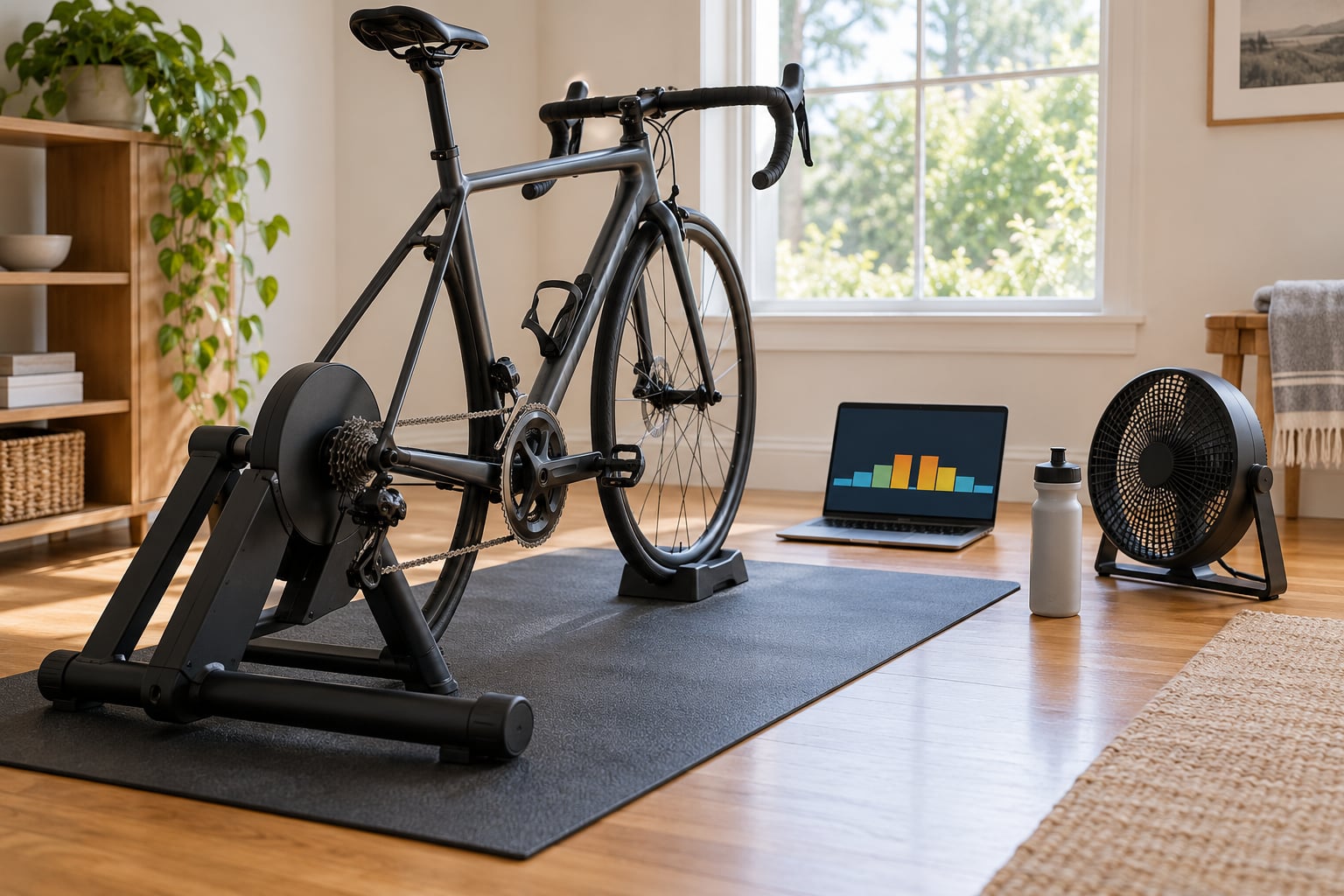
A fan pointed at your torso does more for comfort and performance than any gadget. Riders training in a spare room or garage with airflow report dramatically better sessions than those in a closed office. Aim for roughly 500-750 ml of fluid an hour and 30-60 g of carbohydrate an hour on anything past 90 minutes, and pre-stage bottles and snacks so you never dismount.
Skipping the cool-down
Ending an interval session at full effort leaves you stiff and cuts the adaptation you’re training for. Ten easy minutes costs little and makes the next morning better.
Making every session the same
All easy, or all hard, both fail. Alternating stressors is what builds the ability to hold pace when it matters. If your log looks identical for six weeks, change something.
Overtraining indoors
The real risk of trainer training is that it is so convenient you add volume without replacing anything. Track your hours, and treat indoor training as a substitute for road miles rather than an addition to them.
Frequently Asked Questions
How long should an indoor endurance workout last?
Most indoor endurance sessions should land between 60 and 90 minutes. A 30 to 45 minute session is enough for recovery work, and anything past two hours needs deliberate preparation with airflow, food and position changes planned in advance. Riders with limited weekday time lose nothing by splitting a long session into two blocks rather than forcing one long sit.
Do I need a power meter to do endurance workouts on a trainer?
No. For long steady work, heart rate, the talk test and perceived effort give you everything you need. A power meter matters most for short, hard efforts, where a small wattage difference changes whether the session works. A dumbbell resistance trainer with a fixed gear can carry all six sessions above if you pace the effort by feel.
Should I ride an indoor trainer workout before or after an outdoor ride?
Keep the hard session separate from your long outdoor ride, ideally by at least one day. Mixing a threshold block into the end of a two-hour road ride produces a mediocre version of both. A short easy indoor session the day before a long ride is fine, and a recovery spin the day after one is well spent.
Is sweating on a stationary trainer dangerous?
It is not dangerous, but it is easy to underestimate. Indoor riders generate heat without any cooling airflow, so room temperature rises fast and sweat can soak clothing rather than evaporate. Use a fan, wear moisture-wicking kit, change clothes after long sessions, drink steadily and cool down gradually. Stop and cool off if you feel dizzy or chilled.
How often should I use an indoor trainer while training for a century?
Three to four sessions a week fits most training blocks, provided one long outdoor ride stays in the schedule. Riders with limited time get more benefit from two quality indoor sessions and good weekend riding than from five mediocre ones. Replace road miles rather than adding to them, and keep at least one full rest day.
Can I use a treadmill instead of an indoor trainer?
You can build aerobic fitness, but the bike-specific benefits disappear. You lose the exact power targets, the cadence work and the saddle comfort that a century ride demands. A treadmill is a reasonable substitute on days when the trainer setup is impractical, especially for low-impact recovery work during injury, but it should not be your primary endurance tool.
Conclusion: Start With One Sustainable Endurance Session
Pick a single long, controlled endurance session this week that matches your current volume — 60 minutes at 55-65% of FTP is the sensible starting point for most riders. Write down the duration, average power and average heart rate, then repeat the same numbers next week. Progress by five minutes or five percent, not both, and let indoor trainer workouts for endurance do what they do best: build the base that makes your long outdoor rides feel easier.