To plan an A race for the season, choose one goal event first, count backwards to work out when you need to be at your freshest, then build training blocks that peak and taper into that date. Every other race, rest day and commitment fits around it. Do it in that order and a season plan stops being a wish list and turns into something you can actually ride.
Most riders do it backwards. They sign up for whatever opens first, keep racing through the summer, then arrive at the event that mattered most already tired. A few hours of planning in autumn or winter fixes that.
Three labels do most of the work. An A race is the one event you are peaking for, where a bad day costs you a goal. A B race is a rehearsal a few weeks earlier, raced at controlled effort to test fuelling, pacing and gear. A C race is a low-stakes local event used as training, where the finish is optional and the kilometres are the point.
| Priority | Purpose | Timing relative to the A race | Taper needed | Effort on the day |
|---|---|---|---|---|
| A race | Peak here, full taper, nothing else matters | The anchor date itself | Full, 7 to 14 days | Everything you have |
| B race | Rehearse race day: pacing, fuelling, equipment | 5 to 8 weeks out | None or 2 to 3 days | Controlled, finish strong |
| C race | Training session with numbers on a head | End of a 3 to 4 week block | None | Steady, treat it as a workout |
Before you open a calendar app, gather a few things. That is the next step.
Table of Contents
- What You Need to Plan an A Race for the Season
- Step-by-Step: How to Plan an A Race for the Season
- Step 1: Define Your Main Race and Racing Priorities
- Step 2: Map the Season Calendar and Important Commitments
- Step 3: Set an Honest Starting Point and Training Goals
- Step 4: Build the Training Phases Around the Race
- Step 5: Plan Recovery, Illness and Missed Training
- Step 6: Handle Race Logistics and Race Week
- Common Mistakes
- Frequently Asked Questions
- How many races should I plan in a season?
- How many A races can I peak for in a year?
- How long before a race should I taper?
- What should I do the week before a bike race?
- How do I plan a race season around a full-time job?
- How do I choose between two races on the same weekend?
What You Need to Plan an A Race for the Season
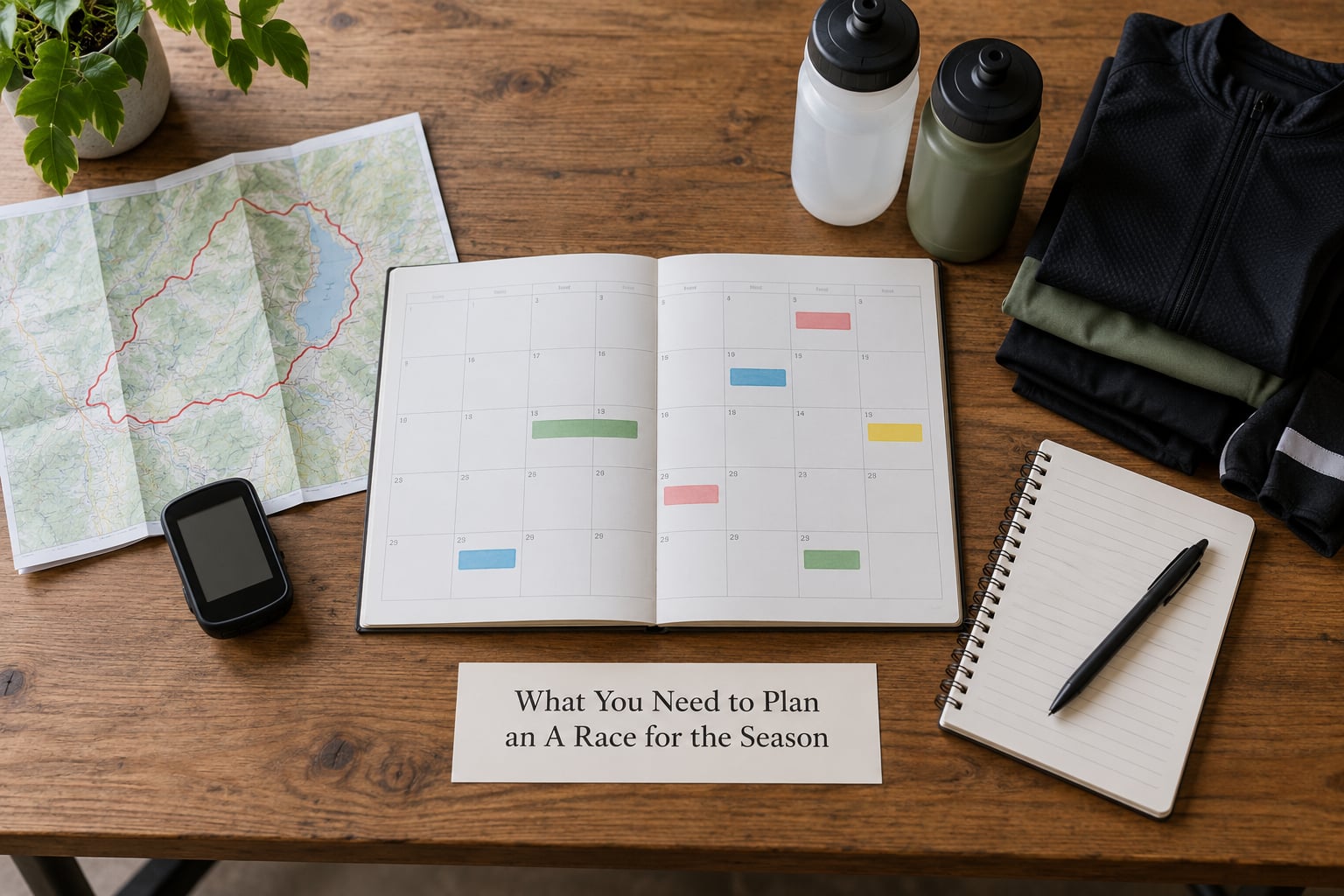
You need a race calendar, an honest picture of your current fitness, and a realistic count of the hours you can train. Without those three, any plan you write is fiction.
- The race calendar. Open dates for the events you are considering, including registration deadlines, entry caps and lotteries where they apply.
- A fitness baseline. Your current weekly riding hours and distance, your longest ride in the last six months, and how you handle a long climb.
- Group riding experience. If you have never done a race start, a mass-start event is a poor choice for an A race on short notice.
- Your weekly time budget. Weekday hours, weekend hours, and which of those are genuinely non-negotiable.
- Your calendar of commitments. Work trips, school holidays, family events, moving house, anything that removes training days.
- Recovery preferences. Do you do well riding tired, or do you need a settled week before anything important?
- Equipment readiness. A bike that has held up, plus a second bike or a plan if the main one is in the shop.
- Travel and budget. Distance to the event, whether you need a hotel, and what the entry costs before you decide it is your A race.
- A training log. Even a spreadsheet. Planning only works if you check reality against the plan every few weeks.
If a rider asks me where to start, it is the log. Two seasons of honest data beats any template.
Step-by-Step: How to Plan an A Race for the Season
Work through these six stages in order. Each one produces a checkpoint you can check before moving on, so the plan stays something you ride rather than something you admire.
Step 1: Define Your Main Race and Racing Priorities
Pick one event to be the A race of the season, and decide what success looks like before you train for it. For most recreational riders that means finishing comfortably and learning what the event demands, not a podium or a personal best.
Ask three questions and write the answers down:
- Is this race one I could actually ride well, given the route, the date and my current fitness?
- What does a good day here look like — a finish, a time, a position in a category?
- Would I still ride it this hard if nobody knew I had entered?
That last question sorts out whether it is your A race or a B race wearing the wrong label. Riders frequently promote a race to A because registration opened early, then spend the season preparing for an event they never really wanted.
Checkpoint: you can say in one sentence what a good outcome is for this event.
Step 2: Map the Season Calendar and Important Commitments
Put every fixed commitment on one calendar before you put a single ride on it. Work, family, travel and illness risk are constraints, not obstacles to negotiate later.
Then place the A race, counting backwards in eight-week blocks. Two A races, roughly 16 weeks apart, is a realistic maximum for most full-time workers with families. Cyclocross riders often run shorter blocks, six to eight weeks, because the season is short and races come thick and fast.
Around the anchor date, fill in:
- One B race five to eight weeks out, on similar terrain if you can find it.
- One or two C races at the end of earlier three to four week blocks.
- A recovery week roughly every third or fourth week, and a genuine off-season of at least two weeks with no structured training.
Here is what that looks like for a road rider with one A race and a second later in the year.
| Period | Focus | Race labels |
|---|---|---|
| Nov to Jan | Off-season and base: 3 to 4 rides a week, steady endurance | None |
| Feb to Mar | Build block 1: threshold work, first long rides of the year | One C race at the end |
| Apr to May | Build block 2, longest rides, race rehearsal | One B race 5 to 8 weeks out |
| Race fortnight | Taper: cut volume, keep intensity, stay sharp | A race |
| After the A race | Easy riding, then 2 to 3 weeks off the bike | None |
| Jun to Sep | Second block: rebuild, then a late-season A race | B race, then A race |
Checkpoint: every ride you have planned fits inside a real week, with no fictional free time.
Step 3: Set an Honest Starting Point and Training Goals
Write down where you actually are: weekly hours, longest recent ride, comfort with climbing, whether you have raced before, and how much time your job and family take. Plans built on an optimistic version of yourself collapse in week three.
Then turn that into three targets, one per training phase. Base means adding duration before intensity. Specific preparation means the numbers that match your A race: climbing repeats for a gran fondo, sprints and short efforts for a criterium, sustained pace for a gravel day.
Keep the targets blunt enough that you can tell whether you hit them. “Ride 6 hours a week with two threshold sessions” beats “get fitter”. If a number scares you, it is probably the right one — just make sure it fits the hours you have.
Checkpoint: each phase has a target you could measure with a stopwatch and a calendar.
Step 4: Build the Training Phases Around the Race
Every block between races should have a job: build fitness, practise something specific, or rest. Blocks without a job become random riding.
- Foundation phase (8 to 12 weeks out). Long, easy rides and one threshold session a week. Add volume before you add intensity.
- Specific preparation (4 to 8 weeks out). Work that mirrors the event. This is where a B race fits, as a rough draft of race day.
- Sharpening (2 to 3 weeks out). Cut volume, keep some hard efforts so you do not feel flat.
- Taper (7 to 14 days). Volume drops, intensity stays, sleep and food stay normal.
Most riders taper too little. Here is a workable reduction if you are currently riding around eight hours a week.
| Week relative to the A race | Riding volume | What it feels like |
|---|---|---|
| 3 weeks out | 100% (about 8 hrs) | Normal week with one hard session |
| 2 weeks out | 75% (about 6 hrs) | Longest ride shorter, legs feel fresher |
| Final week | 40 to 50% (about 3.5 hrs) | Short openers only, plenty of walking |
| Race day | Race plus warm-up | Nerves, good legs, go |
Checkpoint: each week of the final block has fewer kilometres than the one before, and no week goes to zero before the start line.
Step 5: Plan Recovery, Illness and Missed Training
Assume something will go wrong, because it does. A work trip eats a weekend, a cold takes ten days, a saddle sore turns a two-hour ride into a short one. Write your contingency rules now, while you are calm.
- Miss one session: skip it, do not move it. The week is still fine.
- Miss a week: drop that week to a reduced volume and rejoin the plan afterwards.
- Lose two or three weeks: cut the block by a third rather than restarting the build from zero.
- Illness: ride nothing for a few days, come back easy, and give the A race another week of taper if you can.
- Injury: keep what does not hurt, mostly easy riding, and reassess whether the A race is still the A race.
Two or three hard weeks then one easy week is the pattern most riders survive a season on. The easy week is not wasted; it is where next block’s fitness shows up.
Checkpoint: you know exactly what you cut first when the week falls apart, and it is not sleep or food.
Step 6: Handle Race Logistics and Race Week
Racing is a logistics problem wearing a jersey. Sort it early so the last fortnight is about riding, not admin.
Enter early for popular events, because registration closes or a ballot runs out long before the race. Read the route profile and decide your fuelling and pace plan before the day. Book the train, the hotel and the bike transport while it is cheap and quiet. Then check what the organiser actually provides, so you are not carrying kit you do not need.
In race week, keep it boring on purpose:
- Two or three short rides with a few accelerations to keep the legs awake.
- Sleep on a normal schedule, including the nights before travel.
- Eat what you eat on training rides, not something new.
- Prepare kit and numbers the night before.
- Set two goals: one result goal and one process goal you control, such as holding your effort in the first third.
Checkpoint: the night before, nothing needs buying, booking or fixing.
Common Mistakes
These six errors account for most disappointing seasons. Each has a simple correction.
Choosing too many A races. Every A race needs a full build and a real taper, and your body only peaks once well. If you have three events you care about equally, one is your A race and the other two are B races, even if they are bigger on paper.
Raising volume too fast. Adding hours every week until something hurts is not progression, it is a countdown. Build for several weeks, then cut back before the next block.
Ignoring recovery. Sleep, food and easy riding are where the adaptation happens. Riders who add a fourth hard session to an already full week often end the block slower than when they started.
Treating every race as an A race. Racing a Saturday crits at full gas for ten weeks running is a slow way to get tired. Most local races are better logged as C races.
Registering for everything early. When events open, entry is cheap and commitment feels free. Six months later you have a calendar with no rest weeks. Enter one or two, and revisit the rest in spring.
Changing race-week habits. New shoes, a new fuelling strategy, a hard Tuesday workout and a short night before the race are all ways to arrive unprepared. Repeat what worked in training.
A few habits keep the plan alive. Review the log on a fixed day each month rather than when motivation dips. Keep one race completely unplanned in the season as breathing room. And write down what you would drop first, so when the season gets busy you are choosing rather than reacting.
Frequently Asked Questions
How many races should I plan in a season?
For most amateur riders, six to ten events is a realistic season, and only one or two of them should be A races. A useful split is one or two A races, two or three B races five to eight weeks before each one, and the rest as C races at the end of training blocks. Beginners who race every weekend tend to burn out by midsummer.
How many A races can I peak for in a year?
One or two, and they should be at least 16 weeks apart. A full build plus taper takes most of eight weeks, and recovery after a hard A race takes another two to three. Two A races works well for a road rider chasing a spring target and a late-season target, with a genuine off-season between the blocks.
How long before a race should I taper?
Seven to fourteen days is the usual range. For someone riding about eight hours a week, cut to roughly 75 percent at two weeks out and to 40 to 50 percent in the final week, keeping a few short hard efforts so the legs stay sharp. Taper too little and you arrive tired; taper too much and you feel flat and foggy.
What should I do the week before a bike race?
Ride short and keep it openers, not fitness. Two or three rides of 45 to 75 minutes with a few accelerations are plenty. Keep your normal sleep schedule, eat the same food you eat on training rides, lay out kit and numbers the night before, and write down your pacing plan so race morning is mechanical.
How do I plan a race season around a full-time job?
Plan around the hours you actually have, not the hours you wish you had. Fix your long ride and one hard session in the calendar first, then fit everything else around them. Choose A races on weekends with easy travel, use C races for race practice, and treat midweek consistency as the base you build blocks on.
How do I choose between two races on the same weekend?
Pick the one that matches your priority for that block. If you are peaking for an A race eight weeks later, take the earlier event as a B race and use it to rehearse fuelling and pacing, then skip the second. If neither is the priority, take the one with easier travel or a terrain format you do not race often.
Start with the log, not the calendar. Write down where you are honestly, pick the one event you would be disappointed to miss, and work backwards from that date in eight-week blocks. The rest of the season is decided from there.