A training block for a century is usually 8 to 12 weeks long, built from three or four loading weeks followed by a lighter recovery week, then a two-week taper. Learning how to plan a training block comes down to one adaptation target per block, steady weekly mileage, and long rides that climb by about ten percent a week until they reach your target distance.
A century is 100 miles, or 160.9 km, and on a recreational riding schedule it is a full day of effort, not a race. Most riders I talk to are not trying to set a time. They want to arrive at mile 90 still able to hold a steady pace and eat something they enjoy.
That goal shapes everything below: the mileage you protect, the sessions you drop when work gets busy, and the week you stop adding distance. If you follow the process here, you will end the block with a ride you have already rehearsed.
Table of Contents
- What You Need
- Step-by-Step: How to Plan a Training Block
- 1. Define the Century Goal and Start Date
- 2. Set a Realistic Weekly Training Time
- 3. Build the Block in Three or Four Phases
- 4. Schedule Intensity Around Easy Miles
- 5. Progress the Long Ride Gradually
- 6. Plan Fueling, Hydration, and Recovery
- 7. Use a Simple Monitoring System
- 8. Taper and Rehearse the Event
- How to Plan a Training Block Around a Real Work Week
- Common Mistakes
- Frequently Asked Questions
- How many weeks should a training block be?
- How much should I increase my weekly mileage each week?
- What is the 3:1 training week rule?
- What are the 75 percent and 80/20 rules in cycling?
- How do I adjust a training block after a missed week?
- Do I need a power meter to plan a training block?
- Conclusion: Start With This Week’s Next Ride
What You Need

You need five things written down before you plan a single session. Gathering them takes about an hour and it removes most of the guesswork from the block.
Your current fitness baseline. Write down your longest ride in the past three months, your typical weekly hours, and whether you know your functional threshold power. A rider who can hold 16 mph for two hours has a different starting point than one who can hold 20 mph for four hours, even at the same body weight.
The event date and the route. Century routes differ more than most riders expect. A flat, wind-exposed loop in Kansas is a different job from a California climb-heavy course with 8,000 feet of elevation. Pull the elevation profile and write down total climbing, the longest climb, and where the feed zones sit.
Your genuinely available hours. Not the hours you wish you had. Look at the next twelve weeks of your calendar and count the real training windows, including the commute rides and the ones that only fit before work.
Your equipment. A power meter makes intensity decisions easier, but a block built on perceived effort and heart rate works just as well for a century. List what you have: trainer for bad-weather weeks, two sets of lights, a tubeless setup you trust, and enough bottles to get through five hours without a refill.
Your recovery habits. Note your sleep pattern, how many nights a week you can protect eight hours, whether you hold a demanding job, and whether you have any recurring pain. Recovery capacity decides how hard your three loading weeks can be.
A notebook or a phone note is enough for all of this. Spreadsheets, TrainingPeaks, and structured training apps all work, but the tool matters far less than having the block written down where you can see the whole shape of it at a glance.
Step-by-Step: How to Plan a Training Block
1. Define the Century Goal and Start Date
Turn the event into a measurable goal. Record the date, the distance, the elevation, the expected average pace, the group riding rules, and your finishing-time target.
Write the target as a finish time plus a feel. Something like finish in under 7 hours and still be able to chat at mile 75 gives you a clear standard on every long ride. If your century is a charity ride with a fixed start, the standard is simply finishing comfortable.
Also record your baseline. The distance you can ride comfortably today tells you how many weeks of long-ride progress you actually need, and that number sets your start date.
2. Set a Realistic Weekly Training Time
Count your available hours from step one, then subtract about 20 percent for the weeks that go sideways. That buffer is what keeps a block alive when a work deadline or a sick kid lands in the middle of a loading week.
Set three numbers: a minimum you will hit no matter what, an ideal number, and a stretch number. Riders who plan against their best week end up abandoning the block in week three. Plan against the minimum and the whole block survives.
For most recreational riders aiming at a century, eight to ten hours a week is enough if those hours are placed well. Four to six hours works too, with fewer sessions and more focus per session.
3. Build the Block in Three or Four Phases
A block has a loading phase, a recovery week, and sometimes a second loading phase before the taper. Three loading weeks at a 3:1 ratio is the simplest version that works, and it is the pattern riders on the r/Velo threads describe most often when they discuss 3 weeks on, 1 week off.
Here is how block length changes with your level and available time:
| Rider situation | Block length | Weekly hours | Structure |
|---|---|---|---|
| Returning after time off | 12 weeks | 5 to 7 | 3 loading weeks, 1 easy, repeat three times, 2-week taper |
| Consistent recreational rider | 10 weeks | 8 to 10 | 3 loading weeks, 1 recovery, 3 loading, 1 recovery, 2-week taper |
| Racing regularly or riding with a fast club | 8 weeks | 10 to 14 | 3 loading weeks, 1 recovery, 3 loading, 2-week taper |
Inside each loading week, hold weekly mileage roughly steady and let the intensity rise. That is the opposite of what most riders do, and it is the part that produces the adaptation.
Riders with a stressful job, a young family, or a masters-level recovery profile often use a 2:1 ratio instead: two loading weeks followed by one easier week. It is slower and it works, because the recovery week arrives before fatigue compounds.
4. Schedule Intensity Around Easy Miles
Most weekly mileage should be conversational. For a century plan, roughly 75 to 80 percent of your riding should sit at an easy Zone 2 effort where you can hold a conversation, and the remaining 20 to 25 percent carries the harder work.
This split matters more for a century than it does for a race, because the event is five to eight hours of mostly moderate effort. Riders who make every session hard arrive at mile 60 unable to pedal their own bike.
Use this template as your starting week and adjust the days to match your calendar:
| Day | Session | Details |
|---|---|---|
| Monday | Rest or easy spin | 30 to 45 minutes, flat, genuinely easy |
| Tuesday | Quality session | Threshold or sustained effort, 60 to 90 minutes total |
| Wednesday | Endurance | 60 to 90 minutes, Zone 2, with hills if the route has them |
| Thursday | Recovery or strength | 30 to 45 minutes easy, plus 30 minutes of gym work |
| Friday | Endurance | 60 to 75 minutes, Zone 2, relaxed cadence |
| Saturday | Long ride | Main session of the week, distance set by the progression |
| Sunday | Easy or rest | 45 to 60 minutes easy or full rest |
On the quality day, pick one target and stick to it. Threshold work builds sustained power, VO2max intervals build top-end, and climbing sessions build the ability to hold pace on a grade. Stacking all three on a Tuesday is the fastest route to a block that never gets executed.
Two hard days in a week is plenty for a century build. Riders asking whether four or five hard sessions are safe usually find out the answer the expensive way, and several described exactly that on the TrainerRoad and TrainerDay forums.
5. Progress the Long Ride Gradually
The long ride is where the century is actually trained. Increase distance by about ten percent per week, and stop increasing once you reach your target distance with room to spare.
| Week | Long ride | What to rehearse |
|---|---|---|
| 1 | 2 to 2.5 hours | Position and fueling, no pushing |
| 2 | 2.5 to 3 hours | Add hills, hold an easy effort on climbs |
| 3 | 3 to 3.5 hours | Add a second food item, drink on schedule |
| 4 | Recovery week, 2 to 2.5 hours | Easy spinning, no intensity |
| 5 | 3.5 to 4 hours | Full kit, full fueling plan |
| 6 | 4 to 4.5 hours | Simulate event conditions, back-to-back loop |
| 7 | 5 to 6 hours, or your target distance | Full distance rehearsal if the route is close to home |
| 8 to 9 | Short and easy | Keep rhythm, drop the volume |
Time matters more than miles for a century. A ride with lots of climbing in six hours is closer to the event than a flat ride of the same distance in three hours, so count hours when the route is hilly.
Try the event route, or a loop with similar climbing, at least once before the day. Riding an unfamiliar course for the first time at mile 70 is a bad bet. If you ride with a group, do one long ride in the expected pace and find out now whether you can hold that pace for five hours.
6. Plan Fueling, Hydration, and Recovery
Treat every long ride over two hours as a fueling rehearsal. The goal is to find out what sits well and what you can eat while riding, not to test everything new on event day.
Most riders do well with roughly 60 to 90 grams of carbohydrate per hour once the ride passes two hours, spread across a bottle, a couple of gels, and real food. Drink to a plan rather than to thirst, and expect more fluid on hot days than on mild ones.
Recovery starts the moment you stop. Eat within about 30 minutes of finishing, get some carbohydrate and protein in you, and treat the evening as easy. If your long rides are back to back, the recovery between them matters as much as the fueling during them.
Sleep is the training tool most riders neglect. Protecting seven to eight hours through a loading week does more for the quality of your next session than any workout you can add.
7. Use a Simple Monitoring System
Track five things per ride: duration, distance, perceived effort, and how you felt during and after. Add heart rate or power if you have it, but do not let a single workout decide how the block goes.
Watch the trend across a week rather than one ride. Rising fatigue across three sessions, poor sleep, a resting heart rate that sits above your normal, and a reluctance to ride are all signals to cut the coming week back.
If you use training stress scores and a fitness and fatigue chart, treat them as a description of what happened rather than a verdict. Numbers describe load. They do not know that you were sick on Wednesday or that the route was steeper than planned.
8. Taper and Rehearse the Event
Two weeks out, cut volume by roughly a third and keep some intensity. You want the legs fresh without losing the edge you built.
The final week usually holds two or three short rides with a few hard efforts inside them, then rest. Keep your normal frequency, drop the duration, and stay on the bike so the legs remember the position.
Rehearse the boring parts: what time you wake up, what you eat in the three hours before the start, where you refill your bottles, and what pace the group sets in the first ten miles. Race day rewards the things you have done before, so do them before.
Never introduce a new workout, a new food, or a new position in the final week. This is also when how to plan a training block matters least, because the decisions are already made and you are simply executing them.
How to Plan a Training Block Around a Real Work Week
Most blocks fail on scheduling, not on physiology. Build around the constraints you actually have rather than the week you wish you had.
Shift the long ride to the only day that reliably frees up five hours, even if that is Sunday. Keep the quality session on a weekday so the long ride stays easy in comparison. If weather ruins three weekends, plan two indoor trainer sessions that match the long ride hours.
Run strength work in the recovery week and skip it during the heaviest two weeks. Riders on the Wahoo forums keep asking how to layer gym sessions under a hard block, and the simple answer works: legs twice a week at low volume during loading weeks, then stop.
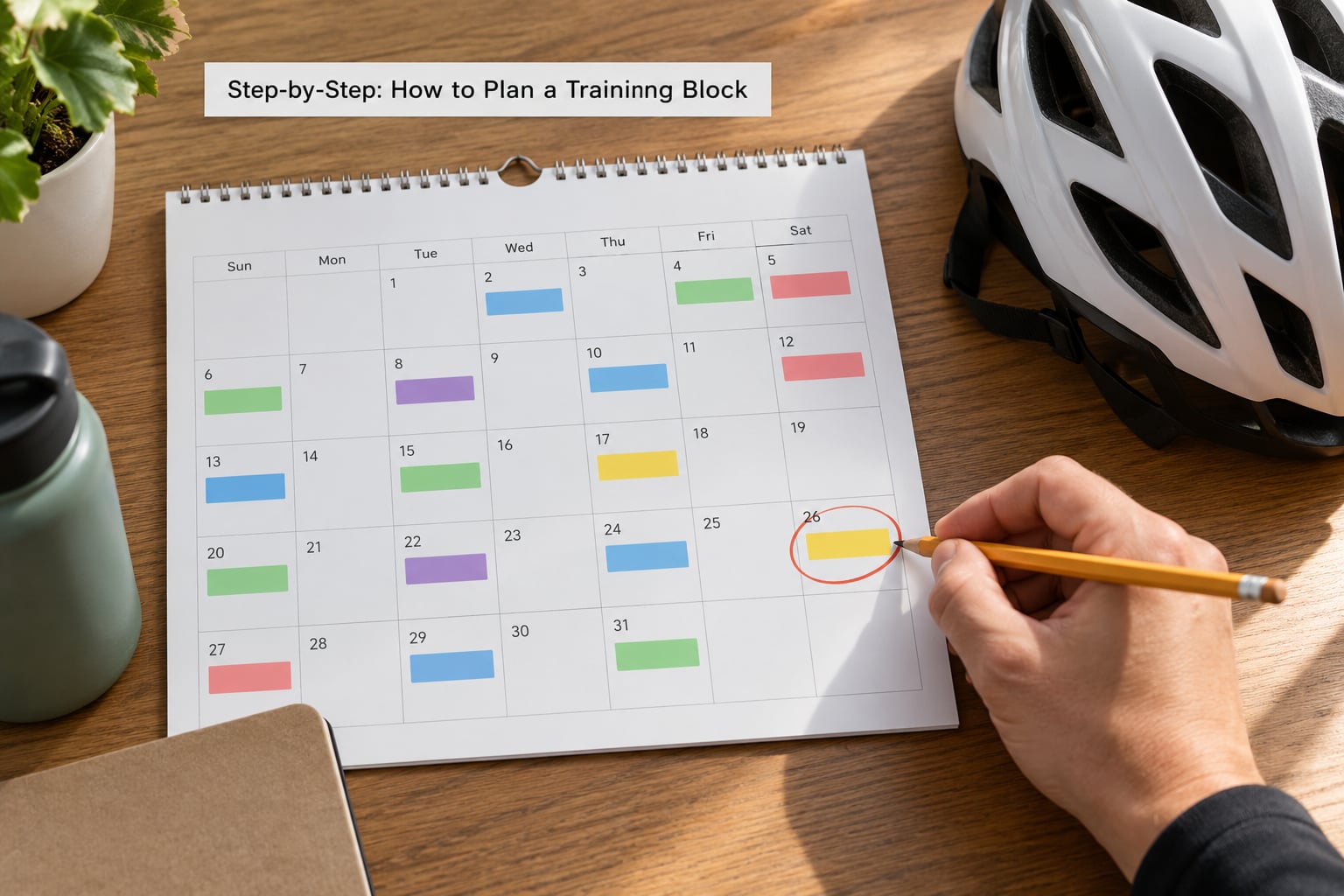
Write the block where you will see it. A printed calendar on the wall beats a plan you have to open on a phone in the cold before a 6 a.m. ride.
Common Mistakes
Adding mileage too fast. Ten percent per week is a ceiling, not a target, and it applies to total weekly hours. Riders coming off a light month often jump 40 percent in week one and spend the rest of the block getting back to normal.
Making every ride hard. A century is an endurance test. If your Tuesday, Thursday, and Saturday sessions all hurt, Sunday is a write-off and the loading weeks stop producing anything.
Planning only by distance. Six hours of climbing is not the same ride as four hours on the flat. Match time, terrain, and the expected pace of the group rather than the odometer.
Ignoring recovery. A recovery week is not lost time. It is the week the previous three get absorbed, and cutting it usually costs more than it saves.
Fueling only on race day. If your stomach has never handled 90 grams of carbohydrate an hour while riding, event day is not the place to find out. Rehearse it on every long ride.
Following a rigid template through a bad patch. Templates assume life cooperates. When it does not, drop the missed session, keep the long ride if you can, and do not try to make up the hours later in the week.
One more worth naming: treating a missed week as a reason to abandon the block. A lost week usually costs a little fitness. Rebuilding from scratch costs weeks.
Frequently Asked Questions
How many weeks should a training block be?
A cycling training block usually runs 4 to 8 weeks, made of three or four loading weeks followed by one lighter recovery week. Beginners building toward a first century should plan 10 to 12 weeks, because the long ride needs time to climb gradually. Riders already riding eight to ten hours a week can shorten the block to 6 to 8 weeks and still arrive prepared.
How much should I increase my weekly mileage each week?
Keep weekly increases under about 10 percent, and treat that as a ceiling rather than a goal. Volume matters less than consistency across the block. If you are returning after a month off, start near your pre-break level and build from there instead of jumping to a bigger number, because the fastest riders to injury are usually the ones who feel good in week one.
What is the 3:1 training week rule?
The 3:1 ratio means three weeks of increased training load followed by one easier week. Riders using it describe three weeks of progressive work and then a week at roughly 60 to 70 percent of normal volume with little intensity. The easy week lets fatigue drop while fitness stays, which is why the same block can repeat three times across a season.
What are the 75 percent and 80/20 rules in cycling?
Both describe intensity distribution: roughly 75 to 80 percent of your weekly riding time should be easy and conversational, with the remaining 20 to 25 percent carrying the harder work. It matters most for century riders, since the event is hours of moderate effort rather than a short burst. Riders who train hard most days tend to fade in the final third.
How do I adjust a training block after a missed week?
Skip the missed week and move forward, then start the progression one week further back rather than cramming the lost sessions into the next week. Protect your long ride first, since it does the most for century fitness, then rebuild the intensity days around it. Cutting the block short is better than chasing missed hours and ending up fatigued.
Do I need a power meter to plan a training block?
No. A power meter makes load easier to quantify, but perceived effort, heart rate, and a written record of duration and distance are enough for a century build. The intensity targets here can be run by feel: Zone 2 is conversational, and a threshold session is hard but sustainable for an hour. Many riders plan whole blocks this way before buying any equipment.
Talk to your doctor before starting if you have a heart condition, recent injury, or any health concerns. A century is a long day on the bike, and how to plan a training block for any rider should start with a body that is ready for it.
Conclusion: Start With This Week’s Next Ride
A century block is one goal, three or four loading weeks, a recovery week, a gradual long-ride climb, and a two-week taper. Write it down, keep most of your riding easy, and protect the recovery days.
Here is your next step, and it takes five minutes: pick the event date, list the training days you genuinely have, and put your first two weeks on a calendar. Fill in the detail once those two weeks are on paper.
Then go ride. The plan only works if this weekend’s long ride happens.