Short answer: yes, but a small amount, and only to support your riding. The question of whether cyclists should lift weights comes up in every club forum, and the useful part of the answer is that most road cyclists get more from one or two short full-body strength sessions a week than from any change to their bike training. The aim is muscles that hold their power and their position for the length of a long ride, not bigger muscles.
So the question is not whether to lift, but how little you can get away with and still benefit. Here is the short version of the rest of this guide.
- Riding builds aerobic fitness almost exclusively; it does very little to build maximum force, tendon strength or bone.
- One or two sessions a week of full-body work, on days away from hard riding, is plenty.
- Most of the measurable benefit shows up in short efforts and long-ride fatigue, not in your FTP alone.
- Muscle gain is driven by training volume, intensity, food intake and genetics, so a twice-weekly maintenance routine is not going to bulk you up.
- Sequencing matters more than the exercises you pick. A hard lifting session the day before an important ride will cost you more than the session gains.
Everything below expands on those five points, starting with what the published work actually shows.
Table of Contents
- What the Research Says About Cycling and Weight Training
- How Weight Training Can Improve Road Cycling
- Stronger force production for climbing and sprinting
- Greater resistance to fatigue on long rides
- Better training tolerance over a season
- Bone and tendon stimulus that cycling cannot give
- Muscle balance and posture
- Where the claims get exaggerated
- Will Lifting Weights Make Cyclists Too Muscular?
- What Kind of Strength Work Is Best for Road Cyclists?
- Can Beginners Add Weights Without Disrupting Endurance Training?
- How Should Cyclists and Strength Training Fit Together?
- What Mistakes Can Make Strength Training Work Against Your Riding?
- Frequently Asked Questions
- Should cyclists lift weights instead of riding?
- Do older cyclists need strength training?
- Is bodyweight exercise enough for cyclists who cannot access a gym?
- Will weight training improve my endurance and climbing ability?
- What should I do with strength training before a century or double century?
- Conclusion
What the Research Says About Cycling and Weight Training
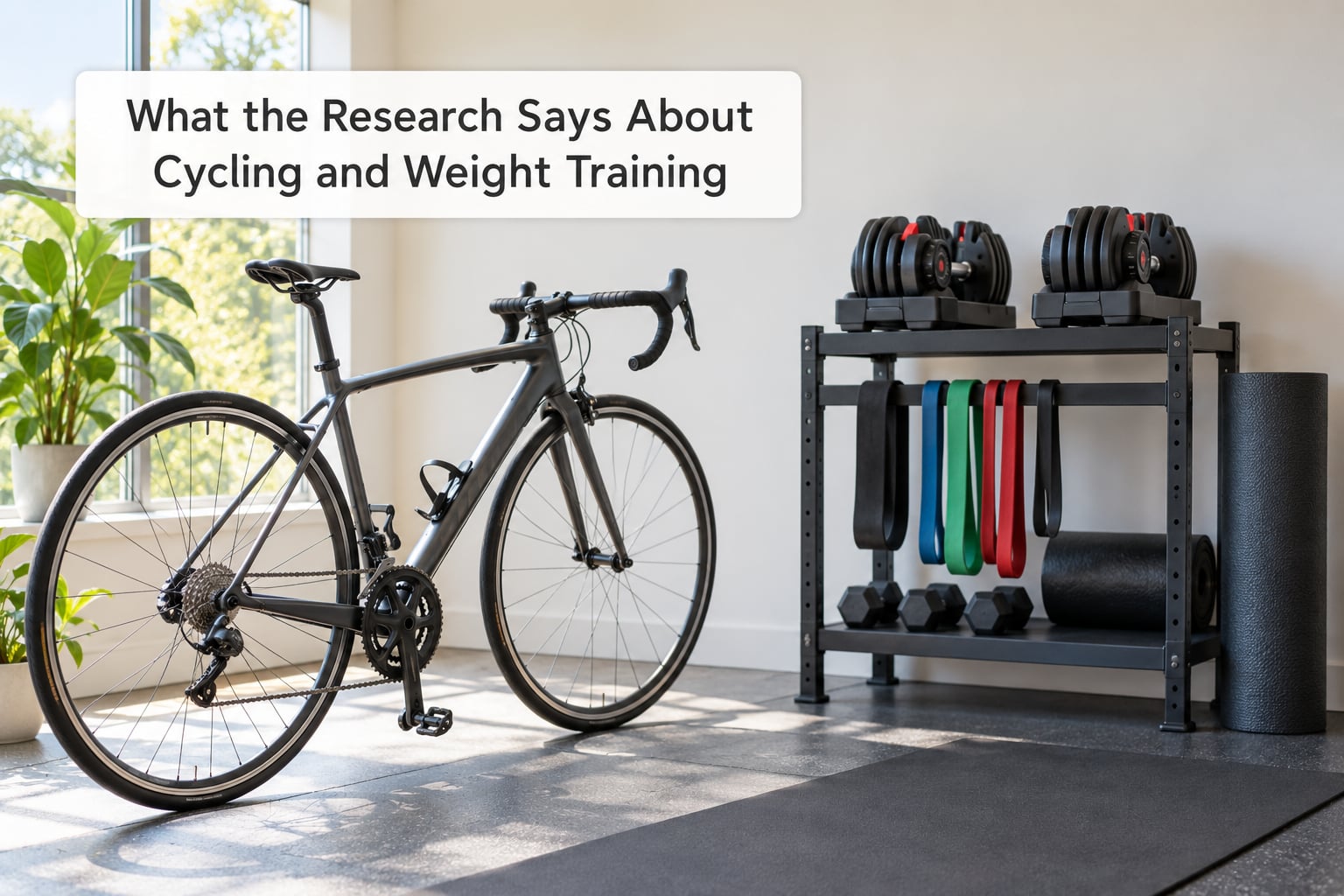
Yes, most road cyclists can benefit from a modest amount of strength work, provided it supports cycling rather than replacing it. The research is consistent on that point, and it is far more consistent than the internet conversation about it.
Pedalling is a repeated, low-load, purely concentric action. Your quadriceps shorten against the pedals thousands of times a ride, but almost never against a load that would make them change. That leaves two gaps: peak force, which limits what you can produce in a sprint or a steep ramp, and tissue capacity in bone, tendon and connective tissue, which limits how much a rider can absorb across a season.
Research on endurance athletes, including work associated with strength and conditioning researcher Bent Rønnestad, has reported mean power improvements in the range of 4 to 7% on short maximal time trials after adding strength work to endurance training. That is a real effect and it is not nothing, but it is modest, and the studies describe a group average rather than a promise about any individual rider.
Individual case reports move further. One rider writing up a 12-week programme in Cycling Weekly reported gains of about 78 watts over 5 seconds, 23 watts over 1 minute, 11 watts over 5 minutes and 30 watts over 20 minutes, alongside less end-of-ride fatigue and smoother pedalling. That is one person, not a study, and the same write-up was honest about a broken arm and a month with no gym access. Treat it as evidence that the effect is achievable, not as a target.
The most common objection on forums is a specificity argument: lifting is “further away” from cycling than riding is. The top thread on that subject in r/cycling opens roughly that way, and the answer given there was blunt: you can train a muscle to get both stronger and faster. Specificity still matters, but it argues for choosing useful exercises, not for skipping the gym.
Two other honest caveats from the experts worth knowing. Sebastian Sitko, a sport scientist at the University of Zaragoza, has argued that the case for core work is weaker than its reputation, pointing out that doing nothing performed as well as core exercises in his own study. And the same experts who recommend strength work for cyclists generally recommend skipping plyometrics and jumping exercises. A cyclist already absorbs a large eccentric and impact load on the road.
How Weight Training Can Improve Road Cycling
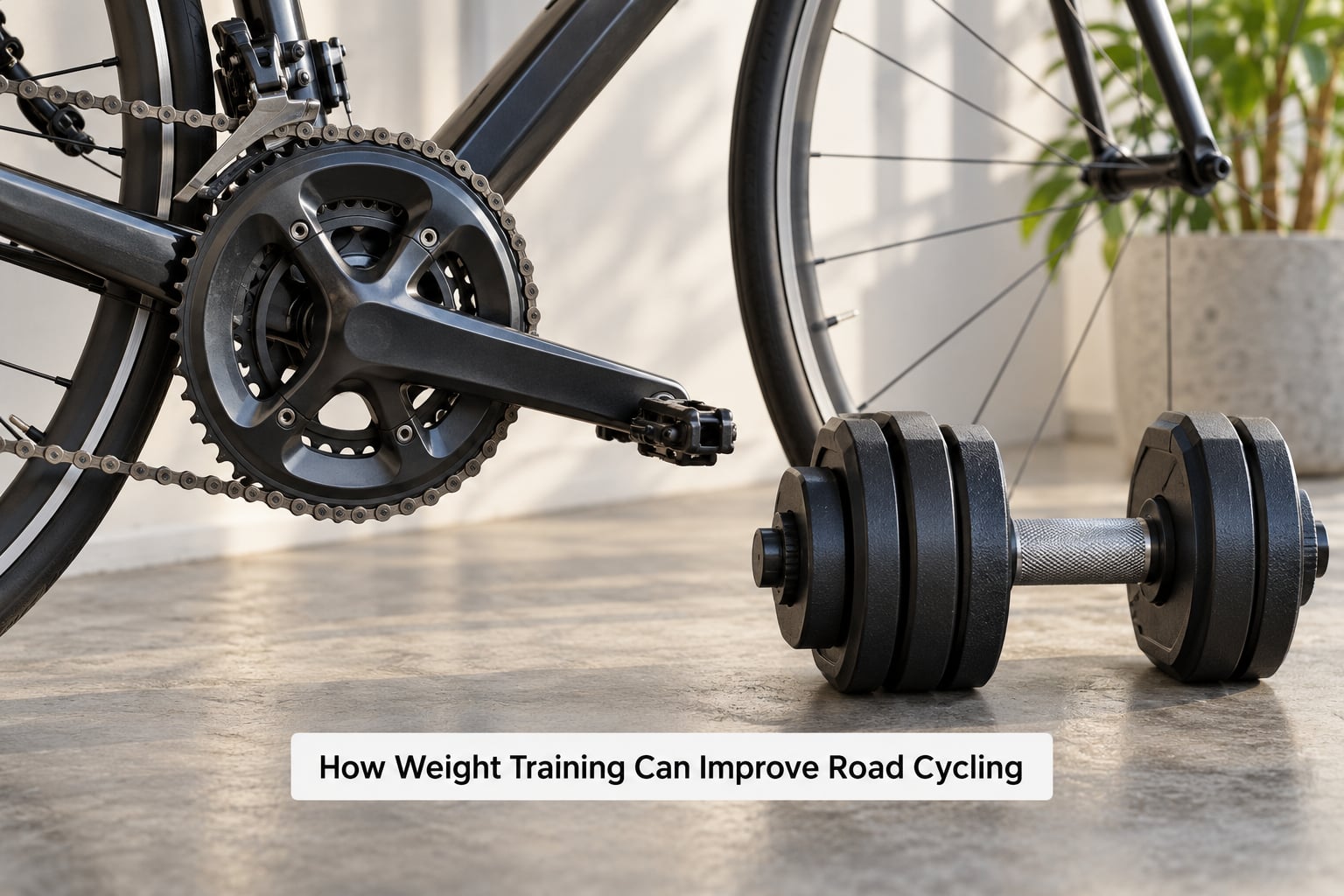
The benefits are real but narrower than most gym marketing suggests. Strength work for cyclists reliably improves force production, muscular endurance and how much training a body tolerates. It is much less reliable at improving VO2 max, and it does nothing at all for your aerobic ceiling on its own.
Stronger force production for climbing and sprinting
Your peak torque in the saddle is limited by how much force your muscles can generate in a short window. Lifting heavier than you ever pedal forces that limit upward, which is why the biggest reported gains in strength work for cyclists show up in the 5-second and 1-minute tests rather than the 20-minute or threshold tests.
Climbing feels different from this. A 5% gradient for 20 minutes is a repeated effort, not a sprint, so better peak force helps you hold an effort you could already nearly hold. Sprinting, criterium racing and out-of-the-saddle climbing are where the force work pays most directly.
Greater resistance to fatigue on long rides
A century is held together by the last 40 kilometres, not the first 60. Muscular endurance, the capacity to produce force repeatedly before fatigue, is what lets a rider hold a slightly lower power with better form. Strength work raises the ceiling, and the ceiling is what determines how much you can lean on it for four hours.
Better training tolerance over a season
Riders who add two short sessions a week often report handling more riding overall, because the same ride costs them less. That is the most underrated benefit in club riding. It shows up as the ability to add volume without the taper, the three weeks of feeling flat, and the injury that ends a block.
Bone and tendon stimulus that cycling cannot give
Bone responds to compression and impact, and road cycling supplies almost neither. That is a genuine long-term argument for resistance work, and it gets stronger as you get older. It is also a slow, honest benefit measured over years, not weeks, so do not expect to feel it this season.
Muscle balance and posture
Road positions involve a lot of hip flexion, a lot of rounding forward over the bars and a great deal of sitting. Rows, pull-ups, carries and core work offset some of that. Riders who pick up pulls and hip work often report that lower-back grumbling settles down, though persistent pain needs a clinician rather than a gym programme.
Where the claims get exaggerated
Two popular claims deserve a flag. First, the idea that lifting will make you “burn more calories” in any meaningful way, which is a rounding error next to four hours on the bike. Second, the idea that strength training prevents injury, which is not established; it improves tissue capacity and balance, which is a related but different thing. The road rider who stays healthy is usually the one who recovers well and rides consistently, not the one in the gym.
Will Lifting Weights Make Cyclists Too Muscular?
No, not at the dose most cyclists use, and not without you also deliberately training for size. Muscle growth is driven by training volume, load, proximity to failure, how much you eat, your genetics and how well you recover. A rider doing two short full-body sessions a week, mostly leaving a rep or two in reserve, does almost none of that.
Hypertrophy, the term for growing muscle size, responds best to more volume, more time under tension and a surplus of food. That is a different programme from the one that helps you ride. If you follow a bodybuilder-style split, train heavy and often, and eat well above what you need, you will get bigger. If you do not, you will not.
It also helps to know that a rider who does add some muscle mass is not automatically slower. More muscle means a slightly heavier bike at the same power, and plenty of riders find a few extra kilograms offset by better power and better looking legs. The dramatic “I’ll turn into a bodybuilder by accident” outcome that circulates on forums is almost impossible to reach by accident.
The real risk is not size, it is that weight training slowly becomes the thing you enjoy more than riding. Guard against that by keeping the number of sessions low and the cycling first.
What Kind of Strength Work Is Best for Road Cyclists?
Full-body work built around squats, hinges, single-leg movements, rows, presses and trunk stability, done two or three times a week. Anything that trains isolated muscles without a functional reason is a poor use of the small amount of time you have.
| Pattern | Example movements | Why it matters on the bike |
|---|---|---|
| Knee dominant | Back squat, front squat, leg press, step-up | Directly loads the quadriceps and hips that drive the pedals |
| Hip dominant | Deadlift, Romanian deadlift, hip thrust, kettlebell swing | Posterior chain strength and back tolerance for out-of-the-saddle riding |
| Single leg | Split squat, walking lunge, single-leg deadlift | Fixes side-to-side imbalance, since riding repeats one pedal stroke thousands of times |
| Horizontal and vertical push | Push-up, dumbbell press, overhead press, dips | Balances the forward-rounded road position, stronger shoulders and trunk |
| Horizontal and vertical pull | Bent-over row, inverted row, pull-up, lat pull-down, face pull | Counters the posture most cyclists adopt, which is rarely pulling anything |
| Core and stability | Plank, side plank, dead bug, Pallof press, carry | Resists excessive rocking and bracing under load; build slowly and stop if your back objects |
| Power | Light-loaded jump squat or med-ball throw | Fast force production, kept low volume and never on a hard-ride day |
Free weights are generally preferred over machines for the simple reason that they ask more smaller muscles to stabilise the load, which is the whole point of the session. Machines are fine when you are learning a movement, when a barbell technique is beyond you for now, or when a gym is busy and the rack is free.
Note the difference between concentric and eccentric work, because it explains the whole programme. Concentric is the shortening phase, the push against the pedal, and cycling trains almost nothing but that. Eccentric is the lengthening phase under load, which is what actually builds tendon and bone. Every lift contains both, which is another reason to keep some free-weight work in the mix.
Can Beginners Add Weights Without Disrupting Endurance Training?
Yes. The realistic starting point for someone who has never trained with weights is two short full-body sessions a week, on non-consecutive days, placed away from your hardest riding. Forty to forty-five minutes is plenty to start.
Use this as general guidance rather than a prescription, and adjust it against how you actually recover.
- First two weeks. Two sets per exercise, roughly 8 to 12 repetitions, with a load you could repeat several more times than you do. The goal is technique, not fatigue. If your last two reps look nothing like your first, the load is too heavy.
- Weeks three and four. Add a third set or add two repetitions per set. Keep the same exercises for at least six weeks so you can see the pattern rather than the novelty.
- Progression. When you hit the top of the rep range with clean form on every set and feel recovered by the next session, add a little load. Small jumps, no heroics.
- Rest between sets. Roughly 60 to 120 seconds. Short rest turns the session into an endurance session, which is not what you want here.
Stop each set with something left. Two reps in reserve is plenty and leaves room for the next session, which is the entire point.
Timing around riding matters more than most people expect. Leave at least a day between a demanding lifting session and an important ride, and never put heavy lower-body lifting immediately before a key effort. If you only have one day free and it is the day before a race or a big climb test, ride instead and lift afterwards.
DOMS, the delayed soreness that shows up a day or two after unfamiliar work, is normal in the first fortnight and then fades. It is not a measure of a good session. If you are sore enough that the next ride is compromised, the load was too high or the session was too long.
How Should Cyclists and Strength Training Fit Together?
Two sessions a week in the off-season and base period, one session or a shortened maintenance session in the racing season, and almost nothing in a race week. The volume of strength work should fall as the importance of riding rises.
| Period | Sessions per week | Focus |
|---|---|---|
| Off-season and base | 2 full-body | Build load, fix imbalances, learn the movements |
| Build phase | 2 full-body | Maintain load, keep the same exercises, shorter sessions |
| Pre-competition | 1, lighter | Keep the habit, drop the effort |
| Race week | 0 or 1 light session | Nothing that creates soreness you cannot ride through |
| Recovery and after an injury | Work with a physio | Rebuild under guidance rather than guessing |
A beginner who rides three or four times a week could put lifting on Monday and Thursday, leaving the weekend for the long ride. A club rider with a hard Tuesday interval session might lift after an easy Monday and again on Saturday, keeping Wednesday’s efforts clean.
Somebody building toward a century or a double century should treat the long ride as the priority fixture and put both lifting sessions at least two days clear of it. Fuelling and hydration for the ride matter far more than an extra set of squats, and the week before a double century is the worst possible time to introduce any new movement.
Nutrition is simpler than it gets made out. Protein supports recovery from both activities, carbohydrate availability matters most for the riding, and hydration is a ride problem rather than a lifting problem. Anyone with specific dietary, injury or medical questions should talk to a registered dietitian or a clinician rather than copying numbers from a forum.
What Mistakes Can Make Strength Training Work Against Your Riding?
Most cyclists who quit strength work do not quit because it was useless. They quit because of one of these, and every one has a straightforward fix.
- Training too hard, too often. Two sessions is not a suggestion. Fix: drop to one, and keep it short.
- Chasing weight on the scale. Strength work can shift body composition slightly without making you meaningfully slower, and a rider who judges the programme by the scale will quit a programme that was working. Fix: judge it by watts, by how the long ride feels, and by how much training you tolerate.
- Skipping the compound movements. Leg presses and curl machines in isolation feel safer and build almost nothing that transfers. Fix: squat, hinge and single-leg work every session, accessories after.
- Changing the routine constantly. Novelty is not progress. Fix: run the same six to eight movements for six to eight weeks, then adjust.
- Skipping the warm-up. Cold, tight riders trying to produce high torque in the first set is how people tweak something. Fix: five to ten minutes of easy movement plus a couple of ramped sets of the first exercise.
- Lifting through pain. Sharp pain, joint pain and pain that lingers into the next ride are all stop signals. Fix: get it assessed by a qualified clinician or physical therapist rather than working around it.
- Chasing supplements. Protein powder is convenient, not magic, and more of it will not make a bad programme work. Fix: eat ordinary food, treat powder as optional, and be sceptical of anything sold with a cycling guarantee attached.
- Putting the hard session next to a key ride. This is the interference problem riders complain about most often in the TrainerRoad forum, and it is a scheduling error rather than a reason to stop lifting. Fix: keep 24 to 48 hours between demanding lifting and your important ride, and move the lifting session rather than the ride when the calendar is tight.
Frequently Asked Questions
Should cyclists lift weights instead of riding?
No. Riding is the training, and strength work is an accessory to it. Keep the hours on the bike roughly where they are and add one or two short full-body sessions in the gaps. If you ever have to choose between the two, the ride wins, particularly in the racing season. A rider who lifts and still rides five times a week will get further than a rider who swaps the weekend ride for the gym.
Do older cyclists need strength training?
They arguably need it more than younger riders, for two reasons that compound with age. Bone density falls when the main activity is a low-impact, non-weight-bearing one, and muscle mass declines unless it is deliberately maintained. Resistance work addresses both, and it also supports balance and confidence on descents and in traffic. Start lighter than you did in your twenties, progress slowly, and get any existing pain or joint condition checked by a clinician first.
Is bodyweight exercise enough for cyclists who cannot access a gym?
Mostly, yes. Squats to a chair or a wall, incline or standard push-ups, inverted rows under a sturdy table, single-leg glute bridges, split squats, planks and band rows cover every pattern in the table above. Bands add cheap progressive load. What you lose without a barbell is heavy low-rep loading, which matters most for peak force, so body-weight work will support your riding well without producing the largest possible gain in sprint power.
Will weight training improve my endurance and climbing ability?
It helps, but not in the way most people expect. Endurance comes from your aerobic training, and strength work will not raise VO2 max on its own. What it does is raise the ceiling on force, improve resistance to muscular fatigue, and let you absorb more training. Reported research puts mean power gains around 4 to 7% on short maximal time trials. On a long climb the benefit usually shows as holding form and power late rather than riding faster from the start.
What should I do with strength training before a century or double century?
Taper it. In the two or three weeks before the ride, drop to one short session a week or stop entirely, and do nothing that leaves you sore. Use the time for long rides, fueling practice, sleep and checking the bike instead. The event itself is the priority, and unfamiliar training in the final fortnight is the most common way riders turn up on the start line tired. If a double century is your first, treat the strength work as off-season preparation for the following year.
Conclusion
Yes, cyclists should lift weights, in small doses, for reasons that are measurable and modest rather than dramatic. Two short full-body sessions a week, placed away from your hard riding, will do more for your climbing, your sprinting and your tolerance of a big training block than any single change to your bike.
Here is what to do first. Keep your riding habit exactly as it is, then add one or two half-hour sessions on days that are already quiet. Use squats, hinges, single-leg work, rows, presses and trunk stability, leave two reps in reserve, and hold the same exercises long enough to see progress. Judge the programme by stronger riding and better training tolerance, not by the mirror or the bathroom scale. And if anything hurts, get it looked at properly rather than training around it.